Showing posts with label Compensation. Show all posts

Friday, February 3, 2017

U.S. judge temporarily blocks Trump's travel ban

A U.S. judge has imposed a nationwide hold on Donald Trump's ban on travellers and immigrants from seven majority-Muslim countries, siding with two states that had challenged the executive order that has launched legal battles across the country.
In Seattle, U.S. District Judge James Robart ruled that Washington state and Minnesota had standing to challenge Trump's order, which government lawyers disputed, and said they showed their case was likely to succeed.
About 60,000 people from the affected countries had their visas cancelled.
"The state has met its burden in demonstrating immediate and irreparable injury," Robart said. "This TRO [temporary restraining order] is granted on a nationwide basis ..."
It wasn't immediately clear what happens next for people who had waited years to receive visas to come to the U.S., however an internal email circulated among Homeland Security officials told employees to comply with the ruling immediately. 
U.S. Customs and Border Protection officials have also informed U.S. airlines that they can once again board travellers who had been barred by the executive order. Canada's WestJet was told the same thing.

White House responds

White House spokesperson Sean Spicer released a statement late Friday saying they "will file an emergency stay of this outrageous order and defend the executive order of the president, which we believe is lawful and appropriate."
Soon after, the White House sent out a new statement that removed the word "outrageous."
"The president's order is intended to protect the homeland and he has the constitutional authority and responsibility to protect the American people," the statement said.
Trump's order last week sparked global protests and confusion at U.S. airports as some travellers were detained. The White House has argued that it will make the country safer.
Washington became the first state to sue over the order that temporarily bans travel for people from Iran, Iraq, Syria, Sudan, Somalia, Libya and Yemen and suspends the U.S. refugee program.
State Attorney General Bob Ferguson said the travel ban significantly harms residents and effectively mandates discrimination. Minnesota joined the lawsuit two days later.

'The law is a powerful thing'

After the ruling, Ferguson said people from the affected countries can now apply for entry to the U.S.
"Judge Robart's decision, effective immediately … puts a halt to President Trump's unconstitutional and unlawful executive order," Ferguson said. "The law is a powerful thing — it has the ability to hold everybody accountable to it, and that includes the president of the United States."
Gillian M. Christensen, a spokesperson for the Department of Homeland Security, said the agency doesn't comment on pending litigation. The judge's ruling could be appealed the 9th U.S. Circuit Court of Appeals.
The judge's written order, released late Friday, said it's not the court's job to "create policy or judge the wisdom of any particular policy promoted by the other two branches" of government.
The court's job "is limited to ensuring that the actions taken by the other two branches comport with our country's laws."
Robart ordered federal defendants "and their respective officers, agents, servants, employees, attorneys and persons acting in concert or participation with them are hereby enjoined and restrained from" enforcing the executive order.
Federal attorneys had argued that Congress gave the president authority to make decisions on national security and immigrant entry.
The two states won a temporary restraining order while the court considers the lawsuit, which aims to permanently block Trump's order. Court challenges have been filed nationwide from states and advocacy groups.
In court, Washington Solicitor General Noah Purcell said the focus of the state's legal challenge was the way Trump's order targeted Islam.
Trump has called for a ban on Muslims entering the country, and the travel ban was an effort to make good on that campaign promise, Purcell told the judge.
"Do you see a distinction between campaign statements and the executive order?" Robart asked. "I think it's a bit of a reach to say the president is anti-Muslim based on what he said in New Hampshire in June."
Purcell said there was an "overwhelming amount of evidence" to show that the order was directed at the Muslim religion, which is unconstitutional.

No attacks from 7 banned countries

When the judge questioned the federal government's lawyer, Michelle Bennett, he repeatedly questioned the rationale behind the order.
Robart, who was appointed the federal bench by President George W. Bush, asked if there had been any terrorist attacks by people from the seven counties listed in Trump's order since 9/11. Bennett said she didn't know.
"The answer is none," Robart said. "You're here arguing we have to protect from these individuals from these countries, and there's no support for that."
Bennett argued that the states can't sue on behalf of citizens and the states have failed to show the order is causing irreparable harm.
Robart disagreed.
Up to 60,000 foreigners from the seven majority-Muslim countries had their visas cancelled because of the executive order, the State Department said Friday.
That figure contradicts a statement from a Justice Department lawyer on the same day during a court hearing in Virginia about the ban. The lawyer in that case said about 100,000 visas had been revoked.
The State Department clarified that the higher figure includes diplomatic and other visas that were actually exempted from the travel ban, as well as expired visas.
Ferguson, a Democrat, said the order is harming Washington residents, businesses and its education system.
Washington-based businesses Amazon, Expedia and Microsoft support the state's efforts to stop the order. They say it's hurting their operations, too.

Thursday, February 2, 2017

Google Tops Apple as the World’s Most Valuable Brand

Google is now the world's most valuable brand, according to a new study, snagging the No.1 spot from Apple which has been the incumbent since 2011.
The annual ranking from Brand Finance says Google's  monetary value increased to $109.5 billion last year, representing a 24% increase overall. By contrast, Apple's  monetary value fell from $145.9 billion in the previous year to $107.1 billion, according to the study. The decrease allowed Google to snag the top spot by about $2.4 billion.
The news of its No.2 spot comes as "Apple has failed to maintain its technological advantage and has repeatedly disillusioned its advocates with tweaks when material changes were expected," the study's authors wrote, who further explained that tech-giant has "over-exploited the goodwill" of its customers, namely because of its failure to generate significant revenues from products like the Apple Watch, and its inability to "demonstrate that genuinely innovative technologies desired by consumers are in the pipeline."
As for Google, the company "remains largely unchallenged in its core search business, which is the mainstay of its advertising income,” Brand Finance wrote in the report. Though Google has largely benefited from increased revenues (parent company Alphabet recently reported better-than-expected fourth-quarter revenue) its brand strength score is also a factor in its success. According to the study, Google's brand strength score was up by two points, indicating "underlying brand equity." In other words, the better the brand equity is for a tech business, the more likely it is to retain customers, or "even command a price premium that its products and services might not be worth," Brand Finance reports.
Out of the 500 brands analyzed, Amazon was deemed third most valuable, at $106.4 billion. Snagging the No. 4 spot was AT&T at $87 billion, which was followed by No.5 Microsoft at $76.3 billion and No.6 Samsung at $66.2 billion. Verizon was No. 7 at $65.9 billion. Walmart, Facebook, and ICBC snagged the last three spots in the top ten, at $62.2 billion, $61.9 billion, and $47.8 billion, respectively.

Wednesday, January 25, 2017

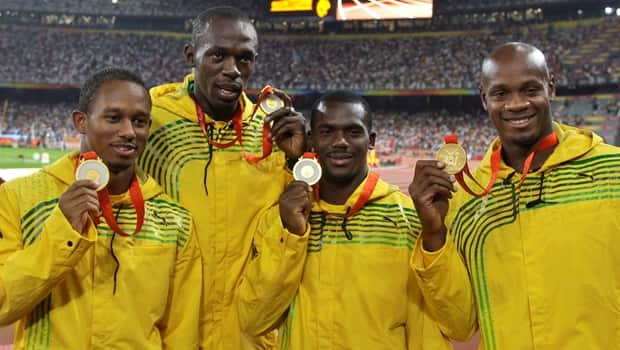
Usain Bolt loses 2008 Olympic relay gold after Nesta Carter's positive test

Usain Bolt has lost one of his nine Olympic gold medals in a doping case involving teammate Nesta Carter.
The IOC said Wednesday that Carter tested positive for methylhexaneamine, a banned stimulant, in re-analysis of samples from the 2008 Beijing Olympics.
Olympic rules state that the entire relay team can be disqualified and stripped of medals if one runner fails a doping test.
Carter and Bolt were teammates on the winning 4x100-metre team, which set a world record of 37.10 seconds. Carter ran the opening leg, and Bolt took the baton third in a team that also included Michael Frater and Asafa Powell.
"The Jamaican team is disqualified," the IOC said in a statement. "The corresponding medals, medallist pins and diplomas are withdrawn and shall be returned."
The relay title in Beijing completed the first of Bolt's gold medal sweeps in the 100, 200 and relay at three straight Olympics.

'This changes everything' 

The Canadian team of Pierre Browne, Anson Henry, Jared Connaughton, Hank Palmer — who finished sixth in the race — will now move into the top five.
"I hear I'm a fifth-place finisher now at the Olympics now," Henry, now a CBC Sports reporter, said on CBC News Network on Wednesday. "A couple of more positive [doping] tests and then I'll have a medal around my neck."
"But seriously, this changes everything", Henry continued. "[Carter] had a really good start in that race. We were right outside of Jamaica. He snuck up on Palmer really quickly. That changes [our] race. It changes our exchange. That changes my leg. Not to mention the rest of the teams."
According to Henry, the disqualification will cause a great deal of pain to the other sprinters. 
"Think about some of the things that are taken away from these [other] athletes," he said. "You see Richard Thompson with Trinidad and Tobago [crossing the finish line] in second place. Yeah, his team got a silver medal. But what better [way] than to cross the line [in first] for your country with your flag across your chest, arms raised, standing on the top of the podium? There were some other people that suffered because of this."
Media placeholder
CBC Sports' Anson Henry discusses downfall of Jamaican relay team6:15
Bolt set world record times for all three sprint titles at the Bird's Nest, establishing himself as the defining superstar of Olympic track.

Possible IAAF ban

Bolt and Carter will retain their gold medals from Jamaica's relay win at the 2012 London Olympics — in a record time of 36.84 seconds that stands today. Bolt ran the final leg on that team. He took the baton from Yohan Blake, who served a ban in 2009 for ingesting the same substance as Carter.
Carter and Bolt also helped lower their relay world record between the Olympic titles, taking gold at the 2011 world championships in Daegu, South Korea, in 37.04.
The 31-year-old Carter has teamed with Bolt on three straight world championship relay-winning teams, from 2011 through 2015. He also took an individual bronze in the 100 in 2013 in Moscow, behind Bolt and Justin Gatlin of the United States.
Carter, who did not compete at the Rio de Janeiro Olympics, faces a ban from the IAAF.
Trinidad and Tobago is in line to get the gold medal from 2008, Japan could be upgraded to silver, and fourth-place finisher Brazil could get the bronze medal.
Carter testified by video conference to an IOC disciplinary hearing held in Lausanne on Oct. 17.
The IOC's ruling states that Carter noted he was taking supplements in 2008 "advised in this respect by his coach, Mr. Stephen Francis."
"The athlete explained that he had given several samples for doping controls whilst he was taking Cell Tech and Nitro Tech before the 2008 Olympic Games and he had never tested positive for a prohibited substance," the detailed verdict stated.
"He therefore did not believe that these supplements could contain prohibited substances. He did not understand how methylhexaneamine could have been found in 2016."
Though methylhexaneamine was not specifically named on the 2008 list of prohibited substances, it "fell within the scope of the general prohibition of stimulants having a similar chemical structure or similar biological effect as the listed stimulants," the judging panel of three IOC members wrote.

Separate ruling 

The panel doubted if the supplements identified had caused the positive test given that Carter "used such supplements regularly and that this did not lead to other problems."
The runner cast doubt on his own ability to avoid doping rule violations. In a written statement to the IOC, "[Carter] asserted that he did not remember having received any formal anti-doping training in his career."
Carter can appeal the sanction to the Court of Arbitration for Sport. However, the IOC panel already anticipated one challenge in its written verdict.
"The Court of Arbitration for Sport ["CAS"] has confirmed that the presence or use of substances falling within the scope of generic definitions of the prohibited list, can be used as a basis of establishing anti-doping rules violations," the verdict said.
In a separate ruling Wednesday, another former Olympic champion was stripped of two silver medals from the Beijing Games.
The IOC said Russian athlete Tatiana Lebedeva tested positive for the anabolic steroid turinabol in re-tests, and would be disqualified from her runner-up placings in the long jump and triple jump.
Lebedeva won long jump gold at the 2004 Athens Olympics and also previously won Olympic silver and bronze in triple jump.

Friday, January 20, 2017

Apple sues Qualcomm over unfair licensing terms

Apple's latest lawsuit target? Qualcomm.
The iPhone maker on Friday filed suit against Qualcomm, alleging the wireless chipmaker didn't give fair licensing terms for its processor technology. Apple also said Qualcomm sought to punish it for cooperating in a South Korean investigation into Qualcomm's licensing practices by withholding a $1 billion rebate.
Apple wants a court to lower the amount it pays Qualcomm in licensing fees, as well as order the return of the $1 billion. The company said in its suit that Qualcomm should be paid royalties based on the value of its particular contribution, not for contributions from other patent holders. Currently, Qualcomm's royalties are based off the selling price of a phone, rather than what portion Qualcomm's technology enabled.
"For many years Qualcomm has unfairly insisted on charging royalties for technologies they have nothing to do with," Apple said in a statement. "The more Apple innovates with unique features such as TouchID, advanced displays, and cameras, to name just a few, the more money Qualcomm collects for no reason and the more expensive it becomes for Apple to fund these innovations."
Qualcomm, meanwhile, fired back at Apple's allegations, calling them "baseless." Don Rosenberg, Qualcomm executive vice president and general counsel, said in a statement:
Apple has intentionally mischaracterized our agreements and negotiations, as well as the enormity and value of the technology we have invented, contributed and shared with all mobile device makers through our licensing program. Apple has been actively encouraging regulatory attacks on Qualcomm's business in various jurisdictions around the world, as reflected in the recent [South Korean Fair Trade Commission] decision and FTC complaint, by misrepresenting facts and withholding information. We welcome the opportunity to have these meritless claims heard in court where we will be entitled to full discovery of Apple's practices and a robust examination of the merits.
Qualcomm is the world's biggest provider of mobile chips, and it created some of the essential standards for connecting phones to cellular networks. The company derives a significant portion of its revenue from licensing that technology to other chipmakers. Apple designs the processors in its iPhones and iPads, but it buys chips from Qualcomm to connect to 4G LTE and other cellular networks. Under Qualcomm's licensing structure, Apple pays it a fee for its chips and another fee for the intellectual property included in those chips. Most components suppliers bundle the IP cost in with the chip sales price.

For the iPhone 7 and 7 Plus introduced this year, Apple also started buying 4G LTE chips from another supplier, Intel. Because Intel's chips use some of Qualcomm's essential technology, Apple pays Qualcomm a licensing fee for those processors, as well, which is based off the total value of the iPhone ($650) versus the value of the Intel chip (closer to $20).
Apple says Qualcomm's practices are unfair, as are the clauses in Qualcomm's licensing terms that prevent Apple from seeking out other suppliers or participating in government inquiries into Qualcomm's practices.
In its heavily redacted complaint (PDF), the FTC said the patents Qualcomm held are standard-essential patents -- technology that is essential to the industry and must be licensed to competitors under fair, reasonable and nondiscriminatory terms (FRAND). But the complaint alleges that Qualcomm consistently refused to license some standard-essential patents to rival chipmakers, in violation of its FRAND commitments.
Qualcomm said in response to the FTC complaint earlier this week that it "has never withheld or threatened to withhold chip supply in order to obtain agreement to unfair or unreasonable licensing terms."
Apple, meanwhile, has been involved in plenty of litigation of its own. The company faced off against Samsung at the Supreme Court in October over a design patent case. Ironically, at issue in that suit was whether Samsung had to pay damages based on the entire value of its infringing phones or only on the portion that infringed. The Supreme Court ultimately decided that damages don't have to be based on an entire device and sent the case back to the lower court.
Apple on Friday said Qualcomm charges it "at least five times more in payments than all the other cellular patent licensors we have agreements with combined." The company added that Qualcomm recently withheld nearly $1 billion in payments from Apple "as retaliation for responding truthfully to law enforcement agencies investigating them."
"Apple believes deeply in innovation and we have always been willing to pay fair and reasonable rates for patents we use," the company said in its statement. "We are extremely disappointed in the way Qualcomm is conducting its business with us and unfortunately after years of disagreement over what constitutes a fair and reasonable royalty we have no choice left but to turn to the courts."
Apple filed the lawsuit in federal district court in the Southern District of California, Qualcomm's backyard instead of Apple's home in Northern California. The company has asked for a jury trial.
Updated at 1:15 p.m. PT with additional details and Apple's comment.

Tuesday, January 17, 2017

Tesla Motors To Share More Gigafactory Details At Trade Show In March

Earlier this month, Tesla Motors Inc (NASDAQ:TSLA) held an investor event at the Gigafactory, which included a factory tour as well as a recently-released handout on the battery cell manufacturing. Yet, most of the analysts have been unsatisfied with the details the automaker has provided up till now.
Electrek reported that Tesla will spill some more beans about what will be the world’s largest factory building at its completion. Both Tesla Senior Director of Cell Supply Chain & Business Development, Kurt Kelty, and the famous battery research partner, Jeff Dahn, will give a presentation at the annual International Battery Seminar & Exhibition, which will be held in Fort Lauderdale, FL between March 20 and March 23.
Mr. Kelty, one of the top battery scientists at Tesla, will give a keynote presentation on “Gigafactory Material Sourcing and Cell Production” at the exhibition on March 22, according to its brochure. Moreover, the cell production for Tesla Energy products, Powerwall and Powerpack built at the Gigafactory, will be discussed.
Soon after, Mr. Dahn will present at the seminar on the same day. The researcher has been studying on battery cell’s voltage, which can be increased to generate better durability and higher energy density of lithium-ion batteries. This would be essential for Tesla to bring down costs of its vehicles and energy storage products.
While his work focuses on nickel manganese cobalt oxide (NMC) lithium-ion cells, which is used by Tesla for its battery cell chemistry. Mr. Dahn’s keynote will be on “Surprising Chemistry in Li-Ion Cells,” discussing ways to counter harmful reactions in battery cells to increase their capacity.

Monday, January 16, 2017

Yukon home to 1st traces of humans in North America 24,000 years ago, research suggests

Humans may have been living in Yukon's Bluefish Caves 10,000 years earlier than previously thought, new research from the University of Montreal suggests.
If confirmed, this would make it the oldest known archeological site in North America, representing the earliest evidence found so far of humans in North America.
New carbon aging tests were done on bones first discovered in the caves south of Old Crow, Yukon, in the 1970s.
The Bluefish Caves in Yukon lie in a region known as Beringia, a dry landmass now mostly underwater. It stretched between Yukon and Alaska, over the Bering Sea to Russia nearly 24,000 years ago during the last ice age. 
The testing suggests that's when the human beings lived near the caves. 
"We have lots of lines of evidence that are converging on what looks like quite a coherent story of what looks like human presence," said Ariane Burke, an anthropologist at the University of Montreal.
Twenty-three fragments studied by Lauriane Bourgeon "definitely" show signs of being cut by human tools, Burke said. The bones likely belong to animals butchered by the people living in the caves.
"You look at the shape the tool makes when it cuts into the bone," she said. "A stone tool will typically leave a 'V' shaped mark and that is straight with streaks on the walls of the cut mark."
Most early presence sites are dated to 14,000 years ago, the time most archeologists think humans first came to North America. It's an accepted theory because those sites have tools or charcoal present. 
When the caves were first studied in the 1970s and 80s, the suggestion that humans had occupied the caves so much earlier was controversial in the scientific community as some questioned the integrity of the site and whether the animal bones found had actually been modified by humans. 
 
Since tools or charcoal have not yet been found at the Bluefish Caves site, some archeologists may still not accept these new findings, said Greg Hare, an archeologist with the Yukon government.  
"There are still going to be a lot of archeologists who look at it with raised eyebrows," he said. 
"Is it the final chapter? I don't think so. But it's good, solid work and I'm excited they've been able to revisit it and come up with those dates."

Study supports standstill theory

Aside from determining the age of the bones, the research examines the standstill theory.
That theory argues a group of humans from Central Asia were isolated in Beringia during the last ice age, 24,000 years ago. Burke says their isolation caused their DNA to become unique, and that type of DNA can be traced in humans today. 
Burke says there was also pollen discovered in the caves, and it was dated to be from 24,000 years ago.

Sunday, January 15, 2017

2 richest Canadians have wealth equal to 11 million poorest

The two richest Canadians have the same amount of wealth as the poorest 30 per cent of the country combined, according to a new report from a group of international aid organizations.
The Oxfam report says the wealth of billionaire businessmen David Thomson and Galen Weston Sr. equals that of about 11 million Canadians.
The group of organizations, under the banner group Oxfam International, published its report "An Economy for the 99%" ahead of the World Economic Forum in Davos, Switzerland, which begins Tuesday.
The report also said that the world's eight richest people have as much wealth as the poorest 50 per cent of the world's population.
"This is not a report about the rich and the poor. It's about the super-rich and the rest of us," said Lauren Ravon, the director of policy and campaigns at Oxfam Canada. 
Oxfam made its calculations about global wealth distribution based on the Credit Suisse Global Wealth Data book, and calculated the wealth of the world's richest people using the annual billionaires list from Forbes Magazine, which was last published in March 2016.

The difference between wealth and income 

Jim Davies, a professor at the University of Western Ontario who works on the Credit Suisse report, said there can be broader implications of wealth inequality. He noted that those implications are often different from those of income inequality.
Wealth is calculated by subtracting a person's debts from their assets, he said, whereas income refers to the money or assets a person makes or receives over a period of time.
Wealth offers security, Davies said, which income doesn't always do.
"If you lose your job, you're in a much worse position if you don't have money in the bank," he noted.
Ravon said the effects of wealth inequality can ricochet into other parts of society.
"In countries that are more unequal, there's higher rates of crime. Those societies are less healthy. People distrust each other more," she said. "People feel like they're disconnected from society when they see that the super-rich are writing the rules in their favour."

Having the government's ear  

And Stephen Harris, a professor of public policy at Carleton University and the University of Ottawa, said wealthy business owners have more power to lobby the government than the majority of everyday Canadians, which contributes to inequality.
"We used to really be a caring-sharing society," he said. "We lost some of that."
A society with so much inequality isn't economically sustainable, Ravon added. "In the long-term, if there's such concentration of wealth in the hands of just a few, there will be no one left to buy the goods, to keep the economy running."
But Harris said the problem isn't so easily fixed.
"I guess if I had a solution I'd be rich," he said. "But I don't have a bullet that would fix it."

Calls for wealth redistribution 

He said there are some things Canada can do to address the problem — such as policies for wealth redistribution used in Nordic countries, which tend to have less inequality — but they won't work unless the population gets behind the changes.
"We can't just migrate a system to this country," he said. "People have to be supportive of it if it's going to have legitimacy."
Oxfam's report made a number of suggestions for the government to implement in its next federal budget, including progressive taxation — a system used in Nordic countries, where those with higher incomes pay a greater portion of that income in taxes.
It also suggested raising the proportion of government spending on public services and social protection.
For the government's part, an official in the office of Social Development Minister Jean-Yves Duclos said in a statement that Trudeau's Liberals have already started making changes to grow the middle class.
Mathieu Filion wrote in an email that one of the first things the government did after coming to power was to cut taxes to the middle class and raise them for families with an income of $250,000 or more.
He also noted the government introduced the Canada Child Benefit, which he said gives an average of $2,300 to 90 per cent of families.
He said the government is watching the issue of wealth inequality "closely."

Sunday, January 1, 2017

Why It’s Time for Apple to Come Clean About the iPhone Battery

It happened again last week. The battery display on my iPhone 6 plunged from around 50% to below 10%, and then the phone shut down entirely. All of a sudden, I found myself cut off from Google Maps (GOOGL, -1.30%) in an unfamiliar part of town, and with no way to text my friends for directions.
This has happened before, and it's a real nuisance. The iPhone pulled the same stunt during a recent road race, cutting off my pace-keeping app and my music, and it's happened right when I've needed to make an important phone call.
But the most annoying aspect of all this is that Apple (AAPL, -0.78%)refuses to come clean about what's going on. While the company is running a limited battery replacement program for some iPhone 6s models, it's still pretending things are just fine with other models.
"A small number of customers outside of the affected range have also reported an unexpected shutdown," an Apple spokesperson wrote as part of an emailed statement to Fortune. (The full response is available below.)
A small number? I don't believe it. In a very informal poll of work colleagues, at least five of them reported iPhone battery issues similar to what I had experienced. Meanwhile, other publications are also calling attention to the problem Apple dare not name.

"Many iPhone 6 and iPhone 6s owners are complaining about a bug that essentially shuts down the phone even when it has a lot of battery life left. This is a problem that is happening right now, and yet, Apple hasn't figured out the true cause or at minimum hasn't disclosed it to the public."
And while the official corporate line at Apple is that things are fine, store employees seem to know better. When I brought my device into the Apple Store at the Oculus-World Trade Center location in Lower Manhattan, a worker there acknowledged she had heard of similar complaints, and offered a solution: Apple could reinstall the firmware on the device, which would fix the battery problem, but would also cause me to lose important data, including all my text messages.
No, thanks. What I would like instead is for Apple to swallow its pride and explain to its customers that there's something amiss with the iPhone and that a real fix is on the way.
Yes, this would be a blow to Apple. The iPhone is its flagship product and is a symbol of Apple's commitment to perfection and engineering excellence — admitting that product is defective would hurt both its reputation and its mystique.
But allowing the problem to fester while blowing off a rising chorus of customer complaints is not befitting of Apple either. Sure, the iPhones aren't literally blowing up in customers' hands (à la Samsung) but the battery problem is surely at a point where Apple needs to take action.
Here is the Apple spokesperson's full response to what is going on with the batteries:
We work hard to offer our customers the best product, experience, and customer support. We believe this is why we have earned the highest customer satisfaction rating of any smartphone maker in China and around the world.
We take every customer concern very seriously, including the limited number of reports of unexpected shutdown with iPhones. We also want to thank the agencies for forwarding concerns to us and their engagement with us. Every time we encounter an issue, we investigate using a thorough process including analyzing these devices. We also look at diagnostic information from the broader set of customers who have opted in to our standard diagnostic data reporting. When we find something, we work to quickly provide our customers with a solution.
As a result of our investigation on this, we found that a small number of iPhone 6s devices made in September and October 2015 contained a battery component that was exposed to controlled ambient air longer than it should have been before being assembled into battery packs. Two weeks ago, we launched a worldwide program to replace affected batteries, free of charge. We again apologize for any customer inconvenience. It's important to note, this is not a safety issue.
A small number of customers outside of the affected range have also reported an unexpected shutdown. Some of these shutdowns can occur under normal conditions in order for the iPhone to protect its electronics. In an effort to gather more information, we are including additional diagnostic capability in an iOS software update which will be available next week. This will allow us to gather information over the coming weeks which may potentially help us improve the algorithms used to manage battery performance and shutdown. If such improvements can be made, they will be delivered in future software updates.
Tim Cook, the ball is in your court: a new year is approaching, and 2017 would be a great time for Apple to restore the iPhone's once-impeccable reputation.

Saturday, December 31, 2016

Texas family blame Apple’s FaceTime in suit over fatal crash

SAN JOSE, Calif. — A Texas couple whose five-year-old daughter died in a crash involving a driver who was allegedly using Apple’s FaceTime video chatting app is suing the tech company.
The lawsuit filed this month in Santa Clara Superior Court accuses Apple of not implementing iPhone features that would automatically disable FaceTime based on technology that calculates highway speeds.
Apple hasn’t responded to the lawsuit and didn’t immediately respond to an email Saturday seeking comment.
Moriah Modisette was killed in a 2014 Christmas Eve accident near Dallas. The lawsuit obtained by California television KTLA claims police found FaceTime running on the iPhone of the driver who struck the Modisette family at 65 mph (105 km/h).
The family claims Apple knew the risks of using FaceTime while driving because the company patented “lock-out” technology in 2008.  

Friday, December 30, 2016

Will Canada’s real estate bubble finally pop in 2017?

A number of things happened in 2016 that were designed to send house prices reeling. In B.C., the government passed a law saying all foreign buyers of Vancouver real estate had to pay a 15% tax. The federal government also changed the rules for all insured mortgages, making it harder for buyers to qualify.
Changes in Vancouver appear to be having the intended impact. Prices in Canada’s third-largest metro have fallen since the foreign buyers’ tax was implemented, especially in more expensive parts of the city.
Other cities have also started to see house prices decline. Regina’s real estate is struggling, and Edmonton is barely treading water. Halifax and Quebec City are also faltering a bit. And Winnipeg’s average price is up a paltry 0.5% over the last year. Surprisingly, Calgary houses are up an average of 5% versus the same period last year.
Will 2017 be the year the year Canadian real estate crashes? Let’s take a closer look.
Yes, it will
The big reason why the market could crash in 2017 is demand drying up from buyers.
The new mortgage rules will have a big impact on already stretched first-time buyers. According to Genworth MI Canada Inc.(TSX:MIC), approximately one-third of first-time homebuyers would no longer qualify for their current homes if they were forced to re-qualify under the new mortgage rules.
Genworth also said in October that approximately half of its total portfolio of insured loans wouldn’t have qualified under the new rules. That is a lot of demand exiting the market.
There’s also the possibility mortgage rates go up. Although the Bank of Canada seems content to keep its bank rate at 0.75%, fixed-rate mortgages are increasing along with bond yields. All of Canada’s largest banks have increased mortgage rates in the last couple of months.
Such a trend could easily continue in 2017, which will eventually hit heavily indebted homeowners right where it hurts most.
Finally, there’s the Toronto factor. If the average price there starts to fall, it could have a real psychological impact on the market. Home Capital Group Inc.(TSX:HCG), the subprime lender with a focus on Toronto, would get hit especially hard if Toronto started crashing.
The counterargument
One of the most interesting things about bubbles is, they can last longer than we expect.
Toronto real estate was in a bubble in mid-2013, back when the average price was $531,000. These days, the average is closer to $780,000.
If prices truly have separated from what a reasonably astute buyer would pay, then what’s the limit? And remember, money is pouring into the Toronto market from wealthy foreigners who have been shut out of Vancouver.
Speaking of Vancouver, plenty of foreigners are using relatives who already live in Canada as proxy buyers. So I’m not sure that market will really correct.
Even Calgary didn’t suffer that much as oil declined. Many economists are predicting the worst is now behind the city.
In fact, when you strip out Toronto and Vancouver from Canadian real estate, the average place is worth $361,000 versus median household income of approximately $79,000. That puts houses at 4.6 times family incomes — a little higher than the average over the last 40 years, which is close to 3.5 times income. But those homeowners didn’t have the benefit of 2-3% mortgage rates, either.
The bottom line
I firmly believe both Toronto and Vancouver real estate prices are insane and would never consider buying a house in both of those metros. But at the same time, it’s hard to predict prices that don’t follow fundamentals. Both markets could easily surge or crash.
As for the rest of the country, I’m not entirely sure houses are that overvalued. Some markets are quite reasonable.
It’s hard to say what’s going to happen. Thus, I think the actionable advice for investors is to just stay away from Genworth or Home Capital shares. If real estate does crash, both those stocks will take it on the chin.
According to a study from RBC Capital Markets, if you had invested $10,000 into one often overlooked class of stock in 1986...
27 years later you would have had $86,346 more than if you had invested in the S&P/TSX index instead -- and you would have experienced even less volatility along the way.
Which is why we asked one of our top analysts -- and experts in this field -- to put together a special report highlighting three of his favorite "earn more, risk less" stocks to buy right now.

Tuesday, December 27, 2016

Students choose Hitler as parade theme

To celebrate the 62nd anniversary of a school in northern Taiwan, students were invited to choose historical figures and “cosplay” them at a parade Friday.
Liu Hsi-cheng, a history teacher at Hsinchu Kuang Fu High School, suggested to his homeroom class that they go with famous people from Arabic culture, he told the Taipei Times.
But Liu's students had another idea: a theme based on Adolf Hitler.
Liu warned his students that such a theme would be “very controversial,” the paper reported — but ultimately “chose to respect the students' decision and did not veto it” after the class voted on it twice.
On Friday, students from the school in Hsinchu, about 55 miles southwest of Taipei, showed up to the festivities wearing Nazi uniforms and brandishing signs, arm bands and long red banners with swastikas on them.
In one photo that the school has since provided to the media, one student can be seen sitting atop a tank made from cardboard boxes, his arm (albeit his left one) raised in a Nazi salute.
As word of the school activity circulated online, the outrage was swift and widespread. On social media, people in Taiwan and abroad condemned the students' decision as “ignorant” and “a disgusting display of disrespect.”
The incident also drew sharp rebukes from both the German Institute Taipei and the Israel Economic and Cultural Office in Taipei, which handle nondiplomatic relations between Taiwan and their respective countries.
Israel's representative office issued a statement Saturday that called the parade “deplorable and shocking” and noted that, less than a year ago, Taiwan had marked International Holocaust Remembrance Day for the first time with the participation of then-president Ma Ying-jeou.
“It is deplorable and shocking that seven decades only after the world had witnessed the horrors of the Holocaust, a high-school in Taiwan is supporting such an outrageous action as we witnessed yesterday at Hsinchu Kuang-Fu Senior High School,” the statement read in part.
“We strongly condemn this tasteless occurrence and call on the Taiwanese authorities, in all levels, to initiate educational programs which would introduce the meaning of the Holocaust and teach its history and universal meaning. Israel would support such endeavors as may be necessary.”
Germany's representative office also released a statement saying it was alarmed by the Hsinchu parade.
“In the course of Nazi rule, millions of people in Europe were persecuted and killed,” the statement read in part. “The Holocaust can be regarded as one of the most heinous crimes in human history. Unfortunately, it is clear that the students are not aware that the Nazi symbol means oppression and contempt for human rights.”
That day, Taiwan's Presidential Office ordered an investigation into the incident and the country's education minister, Pan Wen-chung, formally apologized and urged all schools in Taiwan to learn from the mistake, the Central News Agency reported.
The school's principal, Cheng Hsiao-ming, said Saturday he took responsibility for the incident and would resign from his position.
Holding a sheet of paper with both hands, Cheng read aloud a lengthy statement to local reporters in which he apologized to Holocaust victims and to the general public for what had happened.
“Educational institutions have a responsibility to teach students the correct values,” Cheng said. “We should teach students to learn from their mistakes.”
In that vein, Cheng said the school would organize a series of educational activities about the Holocaust, including watching movies such as “Schindler's List” and “Life is Beautiful.” They had invited staff members from Israel's representative office to speak at the school, he added.
Cheng also asked that the public not blame the teachers and students too much, as they had received overwhelming blowback from the public already, and vowed that they would turn this into an opportunity to teach understanding.
Cheng then bowed deeply to reporters.
Liu, the teacher, told CNS that his students deeply regretted their actions — and that he regretted allowing them to proceed with their theme.
“I should have immediately rejected [their vote] on the spot,” Liu told the news agency.
Teachers' groups in Taiwan lamented the incident as a failure of the nation's education system, the Taipei Times reported.
“We feel that we have not worked hard enough, and have allowed this absurd, ignorant and indifferent attitude toward the universal value of human rights to spread and become an international joke,” said a joint statement issued by Our Story Alliance of History Teachers and Action Coalition of Civics Teacher.

Friday, October 14, 2016

Blue Jays' silenced in ALCS Game 1 loss to Cleveland

Corey Kluber and two other Indians pitchers combined on a shutout and Francisco Lindor's two-run homer lifted Cleveland to a 2-0 victory over the Toronto Blue Jays on Friday night in Game 1 of the American League Championship Series.
Jumping on an 0-2 delivery from Marco Estrada, Lindor broke the pitching deadlock in the bottom of the sixth with a shot 412 feet to right-centre field after Jason Kipnis walked before a sellout crowd of 37,727 at Progressive Field.
It was the Jays' first loss in five games this post-season. Cleveland extended its playoff win streak to four.
Estrada (1-1) had cruised through the early innings, facing minimal resistance, and recovered after the home run in a 101-pitch, six-hit outing. He deserved better in posting the first complete game of his career and the first by a Jay this season.
Cleveland ace Corey Kluber (2-0), meanwhile, had to dig himself out of one early one hole after another before finding his groove. Andrew Miller came in with one out in the seventh and struck out five of the six hitters he faced.
Closer Cody Allen pitched a 1-2-3 ninth, earning his third save.
Toronto, which outhit Cleveland 7-6, lost second baseman Devon Travis in the fifth. The second baseman, who had been nursing a sore knee, limped off after a play in which he covered first and was replaced by Ryan Goins.

Wednesday, October 12, 2016

Airbnb isn't hurting the Hotel Industry

Ever since Airbnb came on the scene, the hotel industry has been worried the home-sharing company could hurt the hospitality and real estate industries. 
It turns out that at least some of those concerns might be unfounded. 
Data research firm STR took a look at Airbnb data alongside hotel data in 13 US and international markets. STR compared Airbnb to the biggest hotel chains in the world, like Marriott and Starwood (which recently merged), Hilton, Intercontinental Hotels Group, and more.
The data found that Airbnb has more than double the number of listings worldwide than Marriott/Starwood and Hilton combined, but it's not actually replacing hotels.  
Comparing Airbnb and hotels in the first place is "apples to oranges," as STR senior research analyst Jessica Haywood notes in her breakdown of the data. Travelers who choose to stay in an Airbnb versus a hotel are often looking for an entirely different type of experience. They want to interact with hosts, want to be immersed in the local culture, or simply can't afford to stay in a hotel, so will only travel if they have free or very cheap accommodations. 
Beyond that, Airbnb offers accommodations that hotels don't, like shared spaces or more whimsical places like tree houses and tents. Haywood notes that those kinds of atypical lodgings may have skewed her findings. 
Still, hotels crushed Airbnb in terms of occupancy in every market measured in the study. 
Hotel occupancy was still significantly higher in major markets like Los Angeles and San Francisco — Airbnb's home town — and the gap was even larger in international cities like Mexico City and London. Haywood estimates that in US cities, Airbnb is picking up the slack when hotels are full. Hotels also saw higher growth than Airbnb in nearly every US city. 
While Airbnb may certainly be stealing a small portion of hotel guests, that portion isn't nearly enough to unseat traditional lodgings. And while the hotel industry has other qualms with Airbnb — many believe Airbnb is contributing to gentrification and impacting housing costs — there's no reason to think Airbnb will put hotels out of business anytime soon.

Don't Drive on an Empty Fuel Tank

Some drivers see their car’s fuel gauge as a nagging parent; it lights up urging you to refuel like your mom or dad would remind you to clean your room. But don’t ignore your car’s insistence on refueling, because you can damage your car by running it on empty.
We’ve all been in the situation where you’re driving along, possibly singing a song, when suddenly *DING* a low fuel warning light pops up and ruins all your fun because you have to take a pit stop or detour and get gas. You’re either the type of driver that gets really nervous or you’re the complete opposite, relaxed because “empty” is just a guideline or friendly suggestion.
Here’s what you should know, regardless of which type of driver you are. The warning light indicates that the fuel has reached the reserve level, which is about 10 to 15 percent of your tank’s total capacity. You can use that reference along with your car’s average fuel economy to calculate your remaining range, but it’s a good idea to not risk running the car until it’s dry.
While standing on the side of the road with your empty car waiting for a tow truck or walking to the nearest gas station and returning with a jerry can is embarrassing enough, there’s another serious concern that could impact your wallet. And it will be way more expensive than a tank of gas.
In your fuel tank, there is a contraption called a fuel pump, which sends the fuel from the tank to the engine. The fuel pump relies on the gasoline in the tank to keep it cool and lubricated. Running the car with a low tank means that the pump isn’t staying as lubricated as it should and is at risk of overheating. The obvious downside to this is premature failure of the pump.
That’s a pretty expensive repair. Failing fuel pumps will lead to poor performance, particularly with a car not accelerating smoothly or starting at all.
Your fuel pump also has a fuel filter, which can quickly get dirty if you drive with a low tank. Since any sediment or dirt sinks to the bottom of the tank, the fuel filter could end up getting blocked or could take in dirty fuel, which also has costly consequences.
Ignoring your car’s low fuel warning is generally a bad idea, and running your car on empty can cause serious and costly problems to your car’s fuel system. Keep that in mind the next time your car nags you to visit the gas station.

Tuesday, October 11, 2016

LA Vs. Nuggets

D’Angelo Russell had one of his best games as a pro Sunday night when the Lakers defeated the Denver Nuggets 124-115. He led all scorers with 33 points on 13-of-19 shooting while also adding three assists and three steals and only turned the ball over twice.
20 of Russell’s 33 points came in the first half. His backcourt mate Lou Williams also had a strong game, scoring 25 points on 8-of-15 shooting, and Jordan Clarkson led all Lakers bench scorers with 12 points and three assists in 19 minutes.

Thursday, August 4, 2016

Pokemon Go Miracle

Three and a half weeks after downloading Pokemon Go, a Toronto man claims to be the city’s first bona fide PokeMaster, catching all 142 Pokemon currently available in Canada.And, on top of earning those bragging rights, Roberto Vazquez says he lost 25 lbs in the process.“Once I went on the scale and saw it, I was in shock,” Vazquez, a professional photographer, told CTV News Channel on Thursday. “Because initially you’re playing the game, you’re running around, you’re walking a lot, you don’t really notice that you’re being very active.”His quest to catch ‘em all began on July 8th and took him across Toronto to areas he’d never seen before. He made new friends, hatched plenty of eggs and reached level 24 in the game. All while clocking more than 266 kilometres on the app.Vazquez said his motivation was rooted in nostalgia.“I just started because as a child I watched the show with my friends, played the games, and it definitely brought back good memories,” he said.Since its July release, Pokemon Go has become a global phenomenon with more than 100 million downloads worldwide. The augmented reality game has made headlines for breathing new life into the 20-year-old Japanese franchise, causing a major boom (and bust) to Nintendo Co.’s stocks, and triggering a series of player-related mishaps. Two men in California tumbled off a cliffplaying the game, and other players have quit their jobs,allegedly been shot at and slapped with parking tickets.Asked about the notorious misadventures, Vazquez said it’s important to heed the game’s warning and stay aware of your surroundings as you play.“At the end of the day, it’s still a game and you’re in real life,” he said. “You want to make sure you’re being safe with others in the area.”And aside from weight loss, the professional photographer says the game has been an eye-opening experience for his job.“For my line of work it’s amazing because I get to see new locations and utilize it for my own work,” he said.His next mission, he says, is to catch the elusive Farfetch’d, a normal- and flying-type Pokemon that resembles a duck and is currently only available in Asia.His gameplay may also be given a second wind if Niantic, the company behind Pokemon Go, decides to release its legendary Pokemon – a development the company’s founder recently alluded to at San Diego Comic Con.Vazquez isn’t the first player to report health benefits from playing Pokemon Go. A British playertold CNN he lost 28 lbs. playing the game, and a University of British Columbia professor has said the game could provide significant mental health benefits for people with depression or social anxiety.