Showing posts with label insurance. Show all posts

Thursday, February 2, 2017

Google Tops Apple as the World’s Most Valuable Brand

Google is now the world's most valuable brand, according to a new study, snagging the No.1 spot from Apple which has been the incumbent since 2011.
The annual ranking from Brand Finance says Google's  monetary value increased to $109.5 billion last year, representing a 24% increase overall. By contrast, Apple's  monetary value fell from $145.9 billion in the previous year to $107.1 billion, according to the study. The decrease allowed Google to snag the top spot by about $2.4 billion.
The news of its No.2 spot comes as "Apple has failed to maintain its technological advantage and has repeatedly disillusioned its advocates with tweaks when material changes were expected," the study's authors wrote, who further explained that tech-giant has "over-exploited the goodwill" of its customers, namely because of its failure to generate significant revenues from products like the Apple Watch, and its inability to "demonstrate that genuinely innovative technologies desired by consumers are in the pipeline."
As for Google, the company "remains largely unchallenged in its core search business, which is the mainstay of its advertising income,” Brand Finance wrote in the report. Though Google has largely benefited from increased revenues (parent company Alphabet recently reported better-than-expected fourth-quarter revenue) its brand strength score is also a factor in its success. According to the study, Google's brand strength score was up by two points, indicating "underlying brand equity." In other words, the better the brand equity is for a tech business, the more likely it is to retain customers, or "even command a price premium that its products and services might not be worth," Brand Finance reports.
Out of the 500 brands analyzed, Amazon was deemed third most valuable, at $106.4 billion. Snagging the No. 4 spot was AT&T at $87 billion, which was followed by No.5 Microsoft at $76.3 billion and No.6 Samsung at $66.2 billion. Verizon was No. 7 at $65.9 billion. Walmart, Facebook, and ICBC snagged the last three spots in the top ten, at $62.2 billion, $61.9 billion, and $47.8 billion, respectively.

Wednesday, January 25, 2017

Google offers a glimpse into its fight against fake news

In the waning months of 2016, two of the world's biggest tech companies decided they would do their part to curb the spread of hoaxes and misinformation on their platforms — by this point, widely referred to under the umbrella of "fake news."
Facebook and Google announced they would explicitly ban fake news publishers from using their advertising networks to make money, while Facebook later announced additional efforts to flag and fact-check suspicious news stories in users' feeds.
How successful have these efforts been? Neither company will say much — but Google, at least, has offered a glimpse.
In a report released today, Google says that its advertising team reviewed 550 sites it suspected of serving misleading content from November to December last year.
Of those 550 sites, Google took action against 340 of them for violating its advertising policies.
"When we say 'take action' that basically means, this is a site that historically was working with Google and our Adsense products to show ads, and now we're no longer allowing our ad systems to support that content," said Scott Spencer, Google's director of product management for sustainable ads in an interview.
Nearly 200 publishers — that is, the site operators themselves — were also removed from Google's AdSense network permanently, the company said.
Not all of the offenders were caught violating the company's new policy specifically addressing misrepresentation; some may have run afoul of other existing policies.
In total, Google says, it took down 1.7 billion ads in violation of its policies in 2016.

Questions remain

No additional information is contained within the report — an annual review of bad advertising practices that Google dealt with last year.
In both an interview and a followup email, Google declined to name any of the publishers that had violated its policies or been permanently removed from its network. Nor could Google say how much money it had withheld from publishers of fake news, or how much money some of its highest-grossing offenders made. 
Some fake news site operators have boasted of making thousands of dollars a month in revenue from advertising displayed on their sites.
"There's no way to know. We take action against sites when they're identified and they violate our policies," Spencer said. "It's not like I can really extrapolate the number."The sites reviewed by Google also represent a very brief snapshot in time — the aftermath of the U.S. presidential election — and Spencer was unable to say how previous months in the year might have compared.

A bigger issue

Companies such as Google are only part of the picture. 
That, however, is easier said than done. Often, advertisers don't know all of the sites on which their ads run — making it difficult to weed out sites designed to serve misinformation. And even if they are able to maintain a partial list of offending sites, "there's no blacklist that's going to be able to keep up with fake news," Bidel said, when publishers can quickly create new sites.
Until advertisers have more insight into where their ads run, Bidel said, it's left to advertising platforms such as Google and Facebook to weed out offending sites.
In an email, Facebook declined to answer specific questions on its efforts — specifically, how many fake news publishers it has suspended or taken action against, the names of publishers or the amount of revenue Facebook has withheld from publishers of fake news.
Instead, the company provided a statement, attributed to an unnamed spokesperson: "It is still early days, but we're looking forward to learning and continuing to roll this out more broadly soon" — "this" referring to its previously announced tools and efforts to address fake news.
"I always say the bad guys with algorithms are going to be one step ahead of the good guys with algorithms," Bidel said. "I don't know that you're ever going to be able to eradicate this form of fraud, or any other form of fraud. But it can be brought to some acceptable level — and that level needs to be determined by the industry."

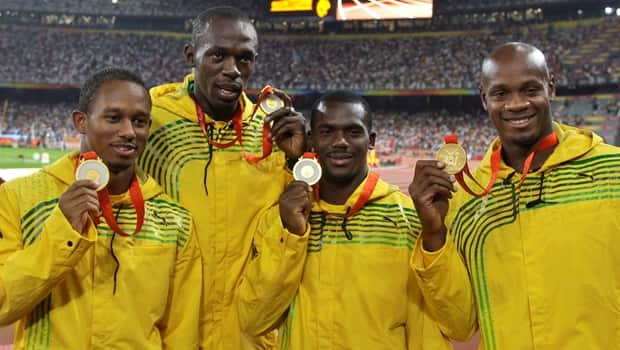
Usain Bolt loses 2008 Olympic relay gold after Nesta Carter's positive test

Usain Bolt has lost one of his nine Olympic gold medals in a doping case involving teammate Nesta Carter.
The IOC said Wednesday that Carter tested positive for methylhexaneamine, a banned stimulant, in re-analysis of samples from the 2008 Beijing Olympics.
Olympic rules state that the entire relay team can be disqualified and stripped of medals if one runner fails a doping test.
Carter and Bolt were teammates on the winning 4x100-metre team, which set a world record of 37.10 seconds. Carter ran the opening leg, and Bolt took the baton third in a team that also included Michael Frater and Asafa Powell.
"The Jamaican team is disqualified," the IOC said in a statement. "The corresponding medals, medallist pins and diplomas are withdrawn and shall be returned."
The relay title in Beijing completed the first of Bolt's gold medal sweeps in the 100, 200 and relay at three straight Olympics.

'This changes everything' 

The Canadian team of Pierre Browne, Anson Henry, Jared Connaughton, Hank Palmer — who finished sixth in the race — will now move into the top five.
"I hear I'm a fifth-place finisher now at the Olympics now," Henry, now a CBC Sports reporter, said on CBC News Network on Wednesday. "A couple of more positive [doping] tests and then I'll have a medal around my neck."
"But seriously, this changes everything", Henry continued. "[Carter] had a really good start in that race. We were right outside of Jamaica. He snuck up on Palmer really quickly. That changes [our] race. It changes our exchange. That changes my leg. Not to mention the rest of the teams."
According to Henry, the disqualification will cause a great deal of pain to the other sprinters. 
"Think about some of the things that are taken away from these [other] athletes," he said. "You see Richard Thompson with Trinidad and Tobago [crossing the finish line] in second place. Yeah, his team got a silver medal. But what better [way] than to cross the line [in first] for your country with your flag across your chest, arms raised, standing on the top of the podium? There were some other people that suffered because of this."
Media placeholder
CBC Sports' Anson Henry discusses downfall of Jamaican relay team6:15
Bolt set world record times for all three sprint titles at the Bird's Nest, establishing himself as the defining superstar of Olympic track.

Possible IAAF ban

Bolt and Carter will retain their gold medals from Jamaica's relay win at the 2012 London Olympics — in a record time of 36.84 seconds that stands today. Bolt ran the final leg on that team. He took the baton from Yohan Blake, who served a ban in 2009 for ingesting the same substance as Carter.
Carter and Bolt also helped lower their relay world record between the Olympic titles, taking gold at the 2011 world championships in Daegu, South Korea, in 37.04.
The 31-year-old Carter has teamed with Bolt on three straight world championship relay-winning teams, from 2011 through 2015. He also took an individual bronze in the 100 in 2013 in Moscow, behind Bolt and Justin Gatlin of the United States.
Carter, who did not compete at the Rio de Janeiro Olympics, faces a ban from the IAAF.
Trinidad and Tobago is in line to get the gold medal from 2008, Japan could be upgraded to silver, and fourth-place finisher Brazil could get the bronze medal.
Carter testified by video conference to an IOC disciplinary hearing held in Lausanne on Oct. 17.
The IOC's ruling states that Carter noted he was taking supplements in 2008 "advised in this respect by his coach, Mr. Stephen Francis."
"The athlete explained that he had given several samples for doping controls whilst he was taking Cell Tech and Nitro Tech before the 2008 Olympic Games and he had never tested positive for a prohibited substance," the detailed verdict stated.
"He therefore did not believe that these supplements could contain prohibited substances. He did not understand how methylhexaneamine could have been found in 2016."
Though methylhexaneamine was not specifically named on the 2008 list of prohibited substances, it "fell within the scope of the general prohibition of stimulants having a similar chemical structure or similar biological effect as the listed stimulants," the judging panel of three IOC members wrote.

Separate ruling 

The panel doubted if the supplements identified had caused the positive test given that Carter "used such supplements regularly and that this did not lead to other problems."
The runner cast doubt on his own ability to avoid doping rule violations. In a written statement to the IOC, "[Carter] asserted that he did not remember having received any formal anti-doping training in his career."
Carter can appeal the sanction to the Court of Arbitration for Sport. However, the IOC panel already anticipated one challenge in its written verdict.
"The Court of Arbitration for Sport ["CAS"] has confirmed that the presence or use of substances falling within the scope of generic definitions of the prohibited list, can be used as a basis of establishing anti-doping rules violations," the verdict said.
In a separate ruling Wednesday, another former Olympic champion was stripped of two silver medals from the Beijing Games.
The IOC said Russian athlete Tatiana Lebedeva tested positive for the anabolic steroid turinabol in re-tests, and would be disqualified from her runner-up placings in the long jump and triple jump.
Lebedeva won long jump gold at the 2004 Athens Olympics and also previously won Olympic silver and bronze in triple jump.

Sunday, January 22, 2017

Most Facebook hacks are done by friends, finds UBC survey

Want to keep your privacy protected? Keep your eyes on your friends.
A study conducted by Wali Ahmed Usmani, a master’s student at University of British Columbia found that those who you trust the most are the most likely to hack their way into your Facebook account.
The study, which was conducted between from February and March of 2016, looked to find out how common attacks on privacy are, who is most likely to be victimized, who is most likely to attack, why these attacks happen, what the damage is, and how one could possibly protect themselves.
1,308 adult Facebook users, 59% male and 41% female from the United States filled out surveys that included questions asking if they had someone use a device of theirs to access their own Facebook account without their permission, and if they had ever used someone else’s device to access that person’s Facebook account without permission.
“It’s clearly a widespread practice. Facebook private messages, pictures or videos are easy targets when the account owner is already logged on and has left their computer or mobile open for viewing,” said Usmani to ubc.ca.
The survey found that 24% of the group had accessed someone’s personal Facebook account without that person’s permission, and 21% had their Facebook’s violated. Reasons for the insider attacks ranged from practical jokes to invading privacy and reading a person’s messages, or in some circumstances malicious attacks on peoples’ friends using that person’s identity, or even deleting everything off their accounts. A lot of those who told their stores reported a lasting feeling of mistrust, ruined relationships, and embarrassment.
“A sizable fraction of Facebook users seem to have been involved in instances of social insider attacks. The high prevalence of attacks demonstrates a need for effective mechanisms to detect and report these attacks to account owners,” reads the report.
There are multiple ways to protect yourself from outside attacks, such as adding an authenticator, changing passwords often, and ensuring you don’t tell anyone your information. But the inside attacks are a much different animal, the only sure defense is to log out of your Facebook after every use on your devices.
Others made sure to make sure their devices were locked after use and making sure no one know the passwords for their devices.
But having to re-enter my Facebook password every time I wanted to simply scroll through my news feed for a bit (which I do very often throughout the day) or just send a few quick messages would get very tiresome. Researchers involved with the study suggested a passive log that would show how long was spent browsing personal messages and other related information. This would help to discourage people with the possibility of getting caught.
“Jealous snoops generally plan their action and focus on personal messages, accessing the account for 15 minutes or longer and the consequences are significant: in many cases, snooping effectively ended the relationship.” said computer science professor Ivan Beschastnikh, who was a co-author of the report.

Sunday, January 15, 2017

Niagara police find Advil mixed in with french vanilla ice cream

Niagara Regional Police are investigating after someone in St. Catharines, Ont., says they found Advil tablets in a sealed container of ice cream.
Police say they were called to home on Jan. 14 after a caller found eight pills mixed into ice cream.
Police say the caller had opened the ice cream to serve it to family but no one had eaten any.
The pills were 400 milligram Advil gel capsules, police say. 
The ice cream was 1.65 litres of Iceberg French Vanilla. The front container numbers are 16279 08:55 and the UPC code is 7 7427611724 2.
The caller thought the ice cream was purchased at either Food Basics on Geneva Street in St. Catharines, or the Freshco on Bunting Road.
Police have notified the manufacturer.

Sunday, January 1, 2017

Calgary man dead after snowplow rollover near Langdon

A Calgary man has died in hospital after a snowplow rollover on Highway 797 near Langdon early Sunday morning.
EMS from Calgary and Strathmore responded to the call around 7:50 a.m. and found the 55-year-old man trapped inside the vehicle, which had rolled into the ditch two kilometres south of Highway 1.
Fire crews arrived and removed the man from the vehicle but due to the weather, an air ambulance was unable to transport the injured driver.
The man was taken to Foothills Hospital where he later died. It's not known what led to the rollover and RCMP are investigating.

Tuesday, December 27, 2016

What to expect from Apple in 2017

Like 2016, Apple is expected to come out with new versions of its signature devices — the iPhone, iPad, iMac and MacBook in 2017.
Apple had altogether a good year if we look from the lens of the iPhone 7 demand and AirPods. Yet, toward the end of 2016, the company started suffering from a slew of software issues with many of its devices. In the coming year, the company is expected to cover more ground with its devices, especially since rivals such as Samsung Galaxy Note series will be out of the running, at least for the first half of the year.
Here’s what you can expect from Apple in 2017:
iPhone 8: iPhone 8 is expected to be a major iPhone generation for Apple; especially since iPhone 8 (also being called the 7S or iPhone X) is its tenth-anniversary iPhone. The device is expected to have all-glass edge-to-edge display, which means that Apple will be making an iPhone without the physical home button for the first time. The company is expected to go for a virtual home button instead.
An OLED iPhone 8 variant is also expected to be in the works. OLED displays are more power efficient and show better images than traditional LCD displays. Other expected features of the device include an A11 processor made with 10nm technology, which is expected to be more performance-optimized and battery efficient than the current device. Additionally, it is also expected to sport wireless charging and iris scanning.
In terms of camera technology, it is expected to come with a multi-sensor camera with light sensing capabilities that will produce more color optimized images.
iPad Series: Apple is expected to come out with an eighth generation iPad and an iPad Pro with a screen size between its existing 9.7-inch and 12.9-inch models.
New iMac and MacBooks: The company is expected to tweak the MacBooks and iMacs in 2017. The expected changes could be USB Type-C connectors and improved graphics chip. The company needs to step up its game for the iMac, ever since its newfound competition from the Surface Studio all-in-one PC.
Augmented Reality (AR) devices — Apple CEO Tim Cook signaled his interest in AR in September and stated that instead of jumping on the VR bandwagon like other major tech companies, Apple would be more interested in AR. Efforts to this end are being made, the newest development being the arrival of the AR game PokĂ©mon Go on Apple Watch.

Monday, December 26, 2016

How to unsend your last Gmail message

We’ve all sent an email that we immediately regretted sending. Maybe you broke up with someone rashly. Maybe you told your boss what’s what, only to remember you didn’t have any job security. Thankfully Gmail has made it easy to recall an email before it gets to its destination, provided you act fast enough. Here’s how to recall an email in Gmail in a few easy steps.

1) Go to your Gmail settings
Go to your Gmail and click on the cog on the top right of the screen. Once the menu is open, select the Settings button.</div></div>
2) In the General tab, find the box that says “Enable Undo Send”
The Settings button will take you to the General page. Scroll down about halfway, until you find the Undo Send section between Send and Archive and Stars. Check the box that says “Enable Undo Send.”</div></div>
3) Set your cancellation period 
Gmail lets you choose how long you want the period of time you can cancel an email to be. Do not choose 5 seconds. Give yourself 30 seconds to make this decision. Every email can wait an extra 30 seconds. Your future might depend on you having 30 seconds to think about taking that email back. Don’t mess this up; give yourself 30 seconds.</div></div>
4) Save your changes 
Don’t just click those buttons and leave the window. Make sure you save and confirm the changes before you go on with your life. There’s nothing worse than thinking a feature is working, only to discover it isn’t. You don’t want to find out as you frantically try to cancel an email that you forgot to confirm the feature. Hit save.</div></div>
5) Take your life into your own hands 
You’re all set. Whenever you send an email from now on, you’ll see a “Undo” button added to the normal “Your message has been sent” notification. You now have 30 seconds after every email to hit “Undo.” When you hit it, the email message window will be reopened complete with your original email—you know, the one that could destroy your life. Aren’t you happy you activated this feature? </div></div></div>

The group trying to take down North Korea with USB sticks

A human rights organization is trying to influence people living in one of the most closed societies in the world, with nothing more than USB sticks.Earlier this year, the Human Rights Foundation launched "Flash Drives for Freedom" with the goal of changing the totalitarian system of North Korea to a more free and open society, by delivering information and education, instead of relying on diplomacy or military action.Roughly 10,000 drives loaded with "subversive" content will be delivered to the country by the end of this year."Truth is an incredibly dangerous weapon," Alex Gladstein, Chief Strategy Officer for the Human Rights Foundation.

Friday, October 14, 2016

Exponential Senior Host Growth with Airbnb

When Ruth Donsky’s grown children moved out of her Toronto home, she looked at their empty bedrooms and spied an opportunity.
“I thought, I’m a little old lady with a house and a garden and two kids’ bedrooms with no one in them,” says Ms. Donsky, 68. “I should be renting them out.”
And that’s what she did, signing up as a host with the home-sharing platform Airbnb to bring in some much needed income to supplement her retirement savings.
“It’s not a lot – this is the first year I’ve made more than $1,000 – but I think it’s a wonderful thing to do in retirement. You get to work from home,” says Ms. Donsky, a former independent school teacher who retired three years ago without a company pension.

The popularity is growing on both ends. Hosts aged 60 and older are Airbnb’s fastest-growing demographic. Senior women make up nearly two-thirds of all senior hosts. They also get the highest ratings from guests.She rents out rooms for $68 to $90 a night, depending on the season, in her semi-detached residence near Lawrence Avenue and Yonge Street. It’s not a downtown location, and in her first couple of years she had very few guests. But this past summer she had more in one month than all the previous years combined.
“Seniors are signing on as hosts at a faster rate than the rest of the population,” says Aaron Zifkin, Airbnb’s Canada country manager. According to surveys done for the company, Airbnb hosts in Canada make an average annual revenue of $6,500.
Citing a 2015 company report, Mr. Zifkin also notes that while hosts from the general population are growing at a rate of 85 per cent, year over year, among seniors, however, hosts are growing at a rate of 100 per cent.
“There are more than 5,600 of them alone in Canada and we have another million-plus [senior hosts] worldwide,” says Mr. Zifkin, adding that the reasons are pretty simple.
“Seniors come to Airbnb to earn a bit of money to pay for extra expenses. But it’s not just the increased earnings. It’s the whole component of social inclusion that comes with being an Airbnb host.
“This is a generation that grew up in an era where travel was about meeting people. It wasn’t about scoring the perfect selfie.”
An older demographic represents a departure from the company’s origins in 2008 as a makeshift bed and breakfast run by a couple of hard-up millennials. Brian Chesky and Joe Gebbia were roommates who supplemented their San Francisco rent by letting out three air mattresses squeezed into their communal living room.
The concept has since taken off. Airbnb today is a $25-billion company and growing – with more than one-million current listings in 34,000 cities and 190 countries around the world, Mr. Zifkin says.
It is free to post a listing, but Airbnb charges guests a booking fee and charges hosts a service fee ranging from 3 to 6 per cent depending on the length of stay.
“A three-day stay comes to around $12, every time it’s different,” says Colin Gillies, a 62-year-old Airbnb host in Toronto at Dovercourt Road and College Avenue.
Mr. Gillies first signed onto Airbnb as a host in 2013. Trained as a graphic designer, he ran his own business. His wife is retired. When forced to shutter his business for health reasons, Mr. Gillies looked for a way to earn extra money.
“It’s been a lifesaver,” remarks Mr. Gillies. “I wasn’t going to perish. I had some savings. But Airbnb gave me the opportunity to have a little fun in my life and meet people. So it was a little selfish.”
Adding a kitchenette to a third storey once occupied by his children, he rents the whole floor for $125 a night, earning more yearly than the average host.
“I think a lot of retirees might not have set aside enough to get by on and so the extra income brought in as an Airbnb host bumps up their savings,” Mr. Gillies says. “But it’s also a way to meet people. I think many older people are starved for company and conversation.”

Meeting others is also why Michele Hall of Vancouver first signed on as an Airbnb host three years ago.
“I love the camaraderie,” says the 66-year-old retiree, an empty nester who rents out her grown daughter’s former bedroom for $59 a night in the East Village. “I really don’t like being on my own.”
Becoming an Airbnb host has meant she no longer lacks for company.
Recently, Ms. Hall travelled with guests who had stayed in her home for two months. “They were more like roommates,” she says. “We ended up becoming friends.”
Ms. Hall won’t disclose how much she earns as an Airbnb host but says it’s below the national average. As she travels so much she can host for only limited periods.
She lives mostly on her government pensions. “I am barely scraping by. But Airbnb has allowed me to live comfortably.”
The seniors paint a rosy picture and that’s because, for the most part, their experience with Airbnb has been positive. They aren’t out to become real-estate moguls; they just want to use their most important asset, their homes, to generate extra income.
“I have had only one bad experience, and it was with a guest, a young man, who celebrated a job promotion by getting drunk,” Ms. Donsky says. “He came back to the house late at night and slammed doors. I was furious. The next day I called Airbnb and asked, ‘How do I get him out?’ They had my back all the way.”
Ms. Donsky tells the story to counter what she calls “all the negative press” generated by critics who say Airbnb’s unprecedented growth is turning neighbourhoods into high-traffic areas, reducing access to affordable housing, and costing the hotel industry not just revenue but also jobs.
But retirees who rent out a few spare rooms in their home aren’t the problem.
“If it helps seniors to supplement their income and they don’t remove units that could be rented out in the existing housing market, I think it’s a great opportunity for them to share their homes if they are present,” says Thorben Wieditz, spokesman for Fairbnb.ca, a national coalition of tenant associations, housing activists, the regulated hotel and bed and breakfast industry, rate payers associations and condo owners.
“In general we would support any type of home sharing as long as it doesn’t remove existing units from the available housing stock. … Research has shown that most problems we are concerned with originate with an absentee landlord renting out an entire property,” Mr. Wieditz says.
Ms. Donsky says that Airbnb invites tourists to live like locals and share in the values of their hosts. Those who might not fit in can easily be kept at bay, Mr. Gillies adds.
“The premise of the sharing economy is building what is called social capital which basically means even though people don’t know you, others have experienced you and they leave comments behind for others to read,” he says.

Tuesday, October 11, 2016

LA Vs. Nuggets

D’Angelo Russell had one of his best games as a pro Sunday night when the Lakers defeated the Denver Nuggets 124-115. He led all scorers with 33 points on 13-of-19 shooting while also adding three assists and three steals and only turned the ball over twice.
20 of Russell’s 33 points came in the first half. His backcourt mate Lou Williams also had a strong game, scoring 25 points on 8-of-15 shooting, and Jordan Clarkson led all Lakers bench scorers with 12 points and three assists in 19 minutes.

Wednesday, September 17, 2014

New Apple devices include default kill switch

WASHINGTON - New Apple Inc phones include a theft deterrent system that enables users to lock their devices and wipe them clean of data if stolen, a victory for regulators who have long pushed the telecommunications industry to do more to stem theft.
The tool, known as a kill switch, will be standard on Apple's new iPhone 6 and iPhone 6 Plus devices and can be installed on previous models of iPhones starting Wednesday, according to an announcement from the office of New York Attorney General Eric Schneiderman.
Schneiderman has long fought alongside New York District Attorney George GascĂ³n to convince device manufacturers to include the kill switch as a default setting on their devices.
"This is a game changer,” said GascĂ³n. "This is a major development that will change behavior on the street and eventually turn around this violent epidemic."
The announcement marks the first time a kill switch is present as a default option on the iPhone.
In April, Apple was among 10 device makers to sign a voluntary agreement to make the feature available on new smartphones.
In 2012, 1.6 million Americans were victimized for their smartphones, according to Schneiderman's office.

Friday, June 27, 2014

One hundred years ago, Europe began its slow sleepwalk towards war

On the last Sunday of June in 1914, a 19-year-old student fired two pistol shots that killed the Austrian Archduke Franz Ferdinand and his wife, Sophie. The echoes of those shots have never really died away.
The heir to the throne of the Austro-Hungarian empire was visiting the then-obscure Bosnian city of Sarajevo when he encountered a group of would-be assassins, including Gavrilo Princip.
One threw a bomb, which failed to injure the archduke. But a wrong turn by his driver put Franz Ferdinand right in front of Princip. The young man fired, fatally wounded the archduke and his wife and precipitated a cataclysm.
The assassins were linked to a secret society in Serbia, which was then a country in its own right. Those ties would lead to disaster.
The archduke was little mourned even in Vienna, but his June 28 death was the catalyst that started the First World War, which has been called the greatest catastrophe of the 20th century.
That war still reverberates. The bitter fighting in the Balkans in the 1990s and the tensions and bloodshed of the Middle East are rooted in the aftermath of the war.
1914 was a time of reverence for institutions and authorities. Governments and churches were seen as mainstays of order and social stability. Aristocracies were taken for granted in most countries; due respect was paid.
Patriotism was seen as a virtue. Nationalism was a given.
Internationally, politics and power were dominated by the so-called Great Powers; Britain, Germany, Austro-Hungary, Russia, France and sometimes Italy. The United States, just beginning to flex its industrial and economic muscle, was not a member of the club. Most of Africa and much of Asia consisted of colonies owned by one or another of the European heavyweights. Canada, Australia and New Zealand were self-governing colonies, but colonies all the same.
The economies and finances of the big powers were closely intertwined. Their relations with each other could be touchy, but Europe had not seen a major conflict since the end of the Napoleonic Wars a century earlier. There had been a clash between France and Germany in 1870, which cost France two of its western provinces, but that was seen as an exception in a generally peaceful era.
But there were tensions and strains beneath the surface. France, leery of a more populous and economically strong Germany, fretted about a repeat of 1870 and allied with Russia as insurance.
Berlin, seeing the Franco-Russian pact, saw itself caught between foes east and west. Germany's only ally, Austro-Hungary, was a fragile, even ramshackle assembly of often-antagonistic minorities.
Vienna worried that neighbouring Serbia might promote revolution within the Austrian empire.
Russia, which lost a war to Japan in 1906, was concerned that its status as a great power might wane as it struggled to rebuild its army and modernize its industries. Even Britain, secure behind its powerful navy, had its traditional worry about one nation dominating Europe, especially the North Sea and Channel coasts.
The problem with all these individual concerns was that in 1914, the world was faced with, in Winston Churchill's words, "the sum of their fears."
In his book "The World Crisis," Churchill wrote of the last days of peace:
"There was a strange temper in the air. Unsatisfied by material prosperity the nations turned restlessly towards strife internal or external. National passions, unduly exalted in the decline of religion, burned beneath the surface of nearly every land with fierce if shrouded fires. Almost one might think the world wished to suffer."
For a couple of weeks after the assassinations, things seemed quiet.
But the smoldering crisis began to blaze late in July. Vienna saw the killing as an excuse to squelch Serbia once and for all and bring its own minority Slavs under tighter rein. The Austrians took the precaution of asking Berlin to back them up in the event Russia tried to step in on the Serbian side. Germany agreed — the so-called blank cheque seen by many historians as a major step towards all-out war.
On July 23, Vienna sent an ultimatum to Serbia which was couched in terms no sovereign country could accept. The Serbs suggested arbitration as a way to resolve dispute, but also begin to mobilize troops.
In those days, mobilization was seen as the last step before war. It meant calling up the reserves to bring units to their wartime manning levels and moving troops to assembly areas along the borders.
In response to the ultimatum, Serbia proposed arbitration, but began to mobilize. Austria-Hungary followed suit two days later.
From today, there's a horrible inevitability about 1914. One historian writes of Europe sleepwalking towards war. Yet each major power had its interests and fears and was dealing with them and what they saw as external threats. They all thought they could win something from a brief, but hard-fought war. Few expected the protracted cataclysm that lay ahead.
On July 26, Britain proposed a political conference to resolve the Austria-Serbia dispute. Germany refused to take part. Two days later, Austria-Hungary declared war on Serbia.
The next day, Britain called for international mediation. Russia urged German restraint, but began partial mobilization itself. Germany began to mobilize.
On July 30, Austrian artillery bombarded Belgrade, the Serbian capital. The next day, Russia began full mobilization. On Aug. 1, Germany declared war on Russia and France began mobilizing.
While Germany had enemies on both flanks, it also had a plan: hold off the slow-moving Russians in the east while launching an all-out attack in the west to crush France.
The German plan included a strong right wing that would swing across behind Paris and pin the French armies against the frontier. But there was not enough room to deploy the million-man right without spilling into Belgium.
That posed a problem because Britain, like Germany, was a guarantor of Belgian neutrality. Berlin, however, didn't think Britain would go to war over the treaty, which a German diplomat dismissed as "a scrap of paper."
On Aug. 3, Germany declared war on France, and invaded Belgium.
In London, the cabinet was faced with a terrible decision. Going to war to help France or Serbia was a tough sell politically. But doing so to defend neutral Belgium and Britain's word of honour was a different matter.
The foreign secretary, Sir Edward Grey, has a poignant passage in his memoirs about the hours before war came. He recalled a friend paying a call on the evening of Aug. 3.
"It was getting dusk, and the lamps were being lit in the space below on which we were looking," Grey wrote.
"My friend recalls that I remarked on this with the words: 'The lamps are going out all over Europe. We shall not see them lit again in our life-time.'"
The following evening, a British ultimatum to Germany expired without a reply and Britain — along with Canada and the rest of the empire — went to war.
The next four years would see millions of deaths, including nearly 60,000 Canadians.

Thursday, June 26, 2014

Bitcoin has a future, but maybe not as a currency

In the course of its five-year run, bitcoin has been heralded as a beacon of hope by those who mistrust banks and an object of suspicion by those who mistrust a grassroots currency.
While the dramatic price fluctuations and high-profile breaches have not helped the cause, bitcoin's champions and critics seem to agree that the technology itself has a future.
Mark Kamstra, a finance professor at York University's Schulich School of Business, says that bitcoin has "fatal flaws" — like its fixed supply — that limit its growth. But he concedes that the underlying technology has the potential to change the online payment system.
Francis Pouliot, director of public affairs for the Bitcoin Foundation Canada, says that the proliferation of other cryptocurrencies inspired by bitcoin is a testament to the power of the technology.
"Cryptocurrencies can't be un-invented," says Pouliot. "The cat is out of the bag, the technology has been proven to be functional, so definitely it's going to be used in one way or the other."
Created in the wake of the worldwide financial crisis of the late-2000s, bitcoin was introduced in 2009 as an alternative payment system to paper currencies, whose value can be manipulated by central banks.
Bitcoin is based on a peer-to-peer computer network akin to those that form the basis of file-sharing system BitTorrent.
Holders store their bitcoins in digital wallets and electronically send bitcoins to each other to pay for goods and services. Every transaction is encrypted and logged in a computer network known as a block chain.
The value of bitcoin has fluctuated dramatically over its short lifespan, from $0.08 US in July 2010 to over $1,200 in November 2013. More recently, it has been trading in the $600 range.
\Bitcoin 'very secure'
The price volatility, as well as a number of high-profile breaches, have contributed to a feeling among many investors that bitcoin is not a stable currency.
Arguably the most serious incident was the revelation earlier this year that Mt. Gox, a Japan-based bitcoin exchange that at one point handled 70 per cent of all worldwide transactions, had lost about $450 million US worth of the cryptocurrency.
While critics have fixated on the high-profile breaches involving bitcoin, the cryptocurrency's block-chain structure makes it "very secure," says Mark Nunnikhoven, vice president of cloud and emerging technologies at online security firm Trend Micro.
He says any security breaches thus far have not been due to the underlying technology.
"With Mt. Gox and some of the other breaches, it hasn't been the currency itself that's been the problem, it's the people handling it," said Nunnikhoven. "And that's going to hold true for quite a long time, and that holds true for real money as well."
Even so, that doesn't settle the trust issue for many people, says Schulich's Kamstra. While bitcoin was created to avoid regulatory interference, he says governments and banks help legitimize currencies.
"You need trust for transactions between people," says Kamstra. "With traditional currencies, they work because countries back up the currencies with their power to tax citizens and, to some extent, stores of gold."
Another problem is the price fluctuation, says Jean-Paul Lam, a professor at the University of Waterloo and a former assistant chief economist at the Bank of Canada. With a traditional currency, a central bank manages price spikes by printing more money.
The bitcoin community has decided to cap the number of available bitcoins at 21 million. (To date, just under 13 million bitcoins have been mined worldwide.) Lam says this "inelastic money supply" is what creates the huge price volatility.
Some commentators have suggested that for bitcoin to grow, it would need to establish some sort of central authority. But that would be contrary to the currency's founding philosophy, says Pouliot.
"The point of Bitcoin is that the whole system is decentralized, and it cannot be centralized," says Pouliot.
Lam says that as long as that attitude prevails, bitcoin can never become a true currency "because it is too volatile."
'A protocol that can do a bunch of things'
While bitcoin's future is a hotly debated subject, the open-source software that underpins it has given rise to hundreds of other digital currencies.
While bitcoin currently occupies about 90 per cent of the cryptocurrency market, there are an estimated 275 digital currencies now in play, many of which cater to specific products or services.
Namecoin, for example, focuses on helping people buy domain names outside the central domain system. Craftcoin is an internal currency for the popular videogame Minecraft, while Potcoin facilitates transactions in legal marijuana markets such as the Netherlands and U.S. states such as Washington and Colorado.
A couple of Montrealers developed PotCoin because "the legalized marijuana industry called out for its own distinct payment system," co-founder Joel Yaffe said in an email. But he acknowledges that Potcoin is a niche currency.
"The coin has been designed to attract the cannabis community exclusively, so we aren’t expecting too much further penetration outside the industry," says Yaffe.
The sheer variety of cryptocurrencies is a testament to the potential of the block-chain concept, but bitcoin's architecture has many more uses, says Jean-Philippe Vergne, an economics professor at Western University's Ivey Business School.
Due to the elaborate verification system of the block-chain concept, some bitcoin startups have been using the open-source software for all sorts of applications, from a lending network (BTC Jam) to a text-messaging service (Gliph) to a Bitcoin-only travel agency (BTC Trip).
In a report released in February, the digital currency news site Coindesk projected that venture capital invested in bitcoin startups would hit $300 million by the end of 2014.
Vergne says the block-chain structure could someday even underpin the entire internet.
"What we call cryptocurrency is really a piece of software," says Vergne. "It's a protocol that can do a bunch of things. Only one of them is mimicking money."

Thursday, June 12, 2014

Will players of Indian descent start cracking rosters in North American pro sports?

When Jaskaran Dhillon was drafted in the third round by the Toronto Argonauts last month, he was deluged by ethnic media outlets in Vancouver celebrating the occasion since players of Indian descent are rare in the CFL.
On Wednesday, Sim Bhullar, a 7-foot-5 centre, worked out for his hometown Raptors, also attracting a media horde. He’s a 21-year-old who can dunk while standing on his tip-toes.
And last month, the movie Million Dollar Arm came out, based on the story of an agent who went to India in 2008 to recruit two talented cricket players with the hope of developing them into major league pitchers.
Even if their pro dreams die, these athletes are the leading edge of what some hope will one day be a wave of athletes with Indian backgrounds filling roster spots on North American pro sports teams.
The Toronto-born Bhullar, whose family is from the state of Punjab, hopes to be the first Indo-Canadian ever drafted into the NBA on June 26. He left New Mexico State following his sophomore year where he was voted Western Athletic Conference tournament MVP in leading the Aggies to the championship.
The interest in the Indian and the Punjab communities in Canada was so big for his Raptors workout, local ethnic media showed up excitedly at the Air Canada Centre to interview Bhullar. His college games were covered in Toronto’s Punjabi newspaper, Parvasi.
Bhullar said he hopes he can do for India what Yao Ming did for basketball in China, where the game became even more popular with kids and consumers in the world’s largest economy.
“Hopefully if I can make it and get to the next level, I can really go back there and impact the community,” Bhullar said. “I want to give back to the community out there. Especially growing up being a little kid, I always wanted to one of the NBA players to come to my community.
“I really want to be a role model for the kids and just open their eyes and know they can do anything they want. Anything they put their mind to.”
Bhullar said he doesn’t feel any pressure carrying the flag for India and wants to be a role model for others.
He’s used to such talk. In 2011, the New York Times wrote that Bhullar was poised to become the world’s first prominent men’s basketball player of Indian descent.
“There’s not really any pressure for me,” he said. “I had it for this long this far.”
He said there are more players in India with basketball talent, but they are lacking a place to showcase their skills.
Bhullar wants to make a difference in that area.
Bhullar said basketball courts are being built across the country and many more are picking up the game.
“It’s more pride,” he said. “I just want to be the best I can be and inspire some young guys. It really helps our community take a step forward. It brings a positive light to our community.
Dhillon, at 6-foot-3 and 290 pounds, can also trace his family roots to the Punjab area.
Dhillon felt family pressure to play soccer growing up in B.C., but he didn’t really like it. He fell in love with the gridiron game watching the NFL and the Denver Broncos became his favourite team.
Rupan Bal, of Punjab-based PTC (PTCnetwork.ca) that broadcasts out of Toronto, grew up playing basketball in India and cautions that developing more talent will take time.
He played high school basketball in Amritsar, and the only reason he played was that it was a Canadian-oriented school. He started playing basketball in Grade 5, but “it was not really that great.”
He said the national basketball program is on a par with high school basketball in Canada.
Social media is also responsible for raising the profile of emerging stars like Bhullar in the Punjab community.
“In Canada, in every Punjabi community, he (Bhullar) is really popular because of his height and the fact that he is the first one to make it to the NBA draft,” Bal said. “People want to take pictures wherever he walks.”
Bal added that he thinks there is pressure on Bhullar to do well in basketball because of his heritage.
“As Punjabi Canadians, we are looking for someone from our community to break the barrier and bring two generations together. What happens is the generation from my parent’s era didn’t really support sports. They don’t believe in sports. Studies is the only option. So someone breaking through this, they will visualize a new picture.”

Thursday, June 5, 2014

Why we can't buy some popular European cars in Canada

Mercedes-Benz, Volkswagen and Audi all say it’s time regulatory standards were harmonized, allowing more choice, faster access and lower prices on European models.
The global auto standards issue recently resurfaced in the wake of the tentative free trade agreement between Canada and the European Union’s 28 countries. If ratified in about two years’ time, the Comprehensive Economic Trade Agreement (CETA) will allow for the free flow of goods for everything from Italian wine to French bread to pork bellies and Porsches.
CETA would also gradually eliminate the 6.1-per-cent tariff on European cars imported to Canada, over seven years.
In December, Tim Reuss, president of Mercedes-Benz Canada, questioned the notion that Canada’s standards are better: “Are you really going to say that a car that has been deemed safe enough and environmentally okay for Europe is not environmentally okay and safe to be driven in Canada or vice versa?”
Veteran auto analyst Dennis DesRosiers says Reuss’s comment is dead on. “He’s got it summarized in the most cogent way I’ve ever read.”
The gap is not just with Europe; standards even differ between Canada and the United States – on the height of a seatbelt or bumper and daytime running lights, says DesRosiers.
“We don’t need Canadian-specific regulations,” says Global Automakers of Canada president David Adams.
But Transport Canada insists we do. The government department that is responsible for and oversees policies and regulations for the vehicles we drive, also points to “Canadian-specific factors” such as geography, road and weather conditions and driver training as reasons we do need our own standards.
Meanwhile, DesRosiers warns eliminating these standards is no easy task. “Canada has to get the U.S. on side before it meets the EU standard. It becomes politically complex; there are egos and science and economics in the way.”
But Transport Canada defends its differences by saying it has “several significant vehicle safety requirements which are more stringent in Canada than in Europe.” The strength of the anchoring system for child seats and rear crash test speed are two examples (See sidebar).
It’s tough to pinpoint exactly how much Canada’s own auto testing adds to the MSRP, but everyone agrees it is a significant cost. “It’s much higher than the tariff imposed,” says DesRosiers. “You can easily get into a $1,000-to-$5,000 increase because of the standard differential of a cost or higher … but we don’t know for sure.”
Don Mertens, spokesperson for Volkswagen and Audi, agrees Canada-only standards are unnecessary, and hopes CETA will bring new flexibility.
“We don’t have all the fine details about the free-trade agreement, but we hope there will be more acceptance of UNEC (United Economic Commission for Europe) standards.”
There has been a worldwide move in the industry to try to forge a global standard, DesRosiers says. But the long evolution of North American standards makes them difficult to negotiate or eliminate. Standards were ramped up after consumer advocate Ralph Nader’s 1965 book, Unsafe At Any Speed, accused the auto industry of disregarding safety standards.
“The need for regulatory standards became more intense with that book,” says DesRosiers. In those days, there wasn’t a global auto industry as we know it today.
The United States created its Federal Motor Vehicle Safety Standards while the United Nations Economic Commission crafted another set for Europe and those are also followed by Japan and China. Canada follows many of the rules set by the United States, but layers on its unique standards.
DesRosiers fears free-trade agreements, like CETA, will slow the shift to one set of standards because they are used as “negotiating chips.” But Adams insists auto makers would prefer one set of global regulations. And, through CETA, Canada has the chance to take the lead by eliminating overlaps in regulatory testing.
“Canada’s tradition has been to follow the U.S. in its regulatory environment,” says Adams. “Now we have an opportunity. Do we want to sit back and wait for the U.S.?”
Transport Canada says it is open to developing or reviewing existing standards “as long as they fulfill national objectives.” The agency continues to “actively participate in the development of global technical regulations under the auspices of the World Forum for the harmonization of Vehicle Regulations”
Reuss points to two models that could come to Canada right away if European standards were accepted: the Mercedes A-Class subcompact with new technology, featuring brake lights that flash if a car is approaching too quickly from behind, and the all-wheel-drive version of the Sprinter commercial van.
Mertens would like to see “harmonization-plus.” He says we should be able to expand, at minimum, some European advanced technology and add some European standards to Canada’s regime, citing advanced lighting and the latest in clean diesel.
“For us, it’s technology that helps the consumer, whether it’s safety technologies, but certainly engine choices,” he says. “We need to accept European standards that benefit the consumer."
Thomas Tetzlaf, also of Volkswagen and Audi, is convinced the enhanced choice would be a win with car enthusiasts.
“Many of them call us immediately upon return from summer vacation in Europe … and ask us why we can’t the get the ‘blank’ … or this engine in North America.”
Adams and DesRosiers both argue that Canadian consumers are more open to Euro-style diesels, subcompacts and hatchbacks – people like Kenney, who pines for the sporty Scirocco.
“I’ve always been a big VW fan,” he says. “When I get in, I always know what it’s going to feel like. The fit, the finish and interior design; they take it much more seriously.”
A comparison of Canadian and U.S. Prices:
VehicleCanadian PriceU.S. Price
2014 Ford F-150$17,999$24,445
2014 Chevrolet Corvette$52,475 $51,000
2014 Toyota Prius$26,105$24,200
2014 Toyota Camry$23,750$22,425
2014 Honda Civic$15,690$18,390
2014 Porsche Boxster S$70,900$62,100
Porsche 911 Turbo S Cabriolet$221,200$193,900
Audi R8 $134,000$114,900
2014 BMW M6 Cabriolet$128,900$117,500

Thursday, May 29, 2014

Harper government rejects offer to save $500M on new icebreaker

Public Works Minister Diane Finley has firmly rejected an offer by Quebec's Davie shipyard to save the government half a billion dollars on a new icebreaker.
Finley told reporters Thursday that "it's very hard to believe" that Davie could actually build the icebreaker for the budget originally set six years ago.
"I don't see how any reasonable person could suddenly believe they can do the same job for half the price," she said.
The new icebreaker — dubbed the Diefenbaker — was originally priced in 2008 at $720 million. However, since construction has been delayed for at least 10 years, that figure's been drastically revised to $1.3 billion.
Although no construction contract has been signed yet, the work has been assigned to the Seaspan shipyard in North Vancouver. However, Seaspan requires a $200-million upgrade before it can handle the job, and has also been assigned two new supply ships for the navy.
Since the work on the Diefenbaker won't even begin until those two ships are finished, it's not likely to enter service for a decade at least.
Finley was responding to an offer Davie made six months ago, but made public only this week, to start work on the icebreaker immediately, for delivery in two years. Davie is Canada's largest shipyard and requires no upgrade to do the work, according to Alex Vicefield, the CEO of Davie's parent company.
Vicefield told CBC News Thursday that his offer is both firm and realistic.
"We'll guarantee the costs. We're not asking for a cost-plus arrangement. We can guarantee the price," said Vicefield.
He added that the reason the government's budget for the job has soared to over a billion dollars is that costs in the shipbuilding industry commonly rise between five per cent and 10 per cent a year.
"Each year you wait to build the ship, the more expensive it gets."
Finley, however, insists that Davie lost out in the original bidding for the job and that its offer comes too late.
"Davie did not qualify. That procurement is done. It's over. And there's absolutely no reason to believe that those numbers would be credible. We already have a contract in place and we're going to move ahead with that."
When a reporter noted that there is, in fact, no construction contract with Seaspan, the minister added, "Well, we don't have a contract, but we have made an award under that procurement based on the credibility, the viability, the reliability of the companies at the time."
"They had a chance to compete. At the time, they weren't successful."
When the government made that decision in 2011, however, the Davie shipyard was in bankruptcy. Today, Vicefield says that's history, because Davie is now part of a competitive international shipping conglomerate.
"We're a competitive international shipbuilder today," he said.
"We're building these ships today. We're building similar vessels. What we would do here is, we would add this vessel[(the Canadian icebreaker] into our existing schedule, which maybe helps us to reduce some of the costs as well, compared to other shipyards where you really have to build the shipyard to build the ship. We have it going today."
The Davie yard recently finished a 130-metre offshore construction vessel for a Norwegian customer. Named the Cecon Pride, it was delivered on time for $200 million. The yard is now building two similar ships.

Saturday, May 17, 2014

Global sponsorship deal between FC Barcelona and Stanley Black & Decker

FC Barcelona has reached an agreement with Stanley Black & Decker by which the global tools provider will become an official Club sponsor. The deal relates to the power, hand and security tools pertaining to the brands in the group, namely STANLEY, BLACK+DECKER, DEWALT and FACOM. This partnership will run until July 2017, with the possibility of it being extended for a further season, and is a strategic alliance designed to create synergies between the two brands on a worldwide level.
Stanley Black & Decker, through its status as an official Club sponsor, thus acquires image association and digital marketing rights; sponsorship rights for tours and friendly matches; and hospitality rights in the Camp Nou.
The agreement will enable both entities to work together on promotional campaigns such as “Striker Challenge” by which consumers, when they purchase the group’s products, will have the chance to access different activities related with FC Barcelona (http://www.stanleytools.eu/striker-challenge).
This alliance is a further example of FC Barcelona’s desire to partner with leading and ambitious companies, with a global outlook and shared values, such as the passion for innovation. Stanley Black & Decker, meanwhile, will enjoy a high-profile presence in the Club’s different distribution channels.
Stanley Black & Decker, headquartered in Connecticut (United States), is a global provider of hand tools, power tools and related accessories, engineered fastening systems, storage, as well as solutions for electronic security, mechanical access, healthcare, infrastructure and more. Since 1843, with its dedication to excellence in products, people and practices, the company is committed to sustainable business policies and initiatives that reduce its impact on the environment, and improve the lives of its customers and their communities.
“For FC Barcelona it is a pleasure to unite our name with that of a leading global brand in the tools and electronic security sector like Stanley Black & Decker. This is a strategic alliance that goes much further than a traditional sponsorship deal, because it unites two internationally prestigious entities, both of which feature prominently in the everyday lives of so many homes around the world, who will seek to achieve common objectives and to create highly beneficial synergies. Barça fans and Stanley Black & Decker customers will be the main beneficiaries of this association”.
“This partnership with FC Barcelona demonstrates our continued investment and ongoing commitment to the world of football. It provides the perfect stage to highlight Stanley Black & Decker’s brand portfolio and engage with our customers by delivering exciting content and promotions across all global markets”.
"To maximise the new partnership amongst Barca’s wide-reaching fan base, as well as our own customers around the world, we’ll be creating a series of highly engaging marketing promotions through both traditional and online media. Coupled with exclusive in-store promotions and unique live events, this partnership will heighten global brand exposure to our key target audiences”.

Swiss vote Sunday on world’s highest minimum wage

GENEVA—In a nation of mostly haves and have-mores, Swiss voters head to the polls Sunday to decide on a union proposal that would create a new nationwide minimum wage at 22 Swiss francs ($24.70 U.S.) an hour — the world’s highest.
But the proposal “to protect equitable pay” is only the most prominent of several referendums on the ballot: Others include a controversial plan to buy new Swedish-made Gripen fighter jets for the Swiss Air Force and to impose a lifelong ban against convicted pedophiles working with children.
Most attention is focusing on the push to set a minimum wage at 4,000 francs ($4,500 U.S.) a month for those working a 42-hour week. The Swiss Trade Union Federation has based its proposal on 2010 figures when the median wage was almost 6,000 francs monthly.
The union submitted the referendum in 2012 in keeping with Switzerland’s tradition of direct democracy. Voters in the country who collect 100,000 signatures can force a binding referendum on any issue.
Groups representing Swiss employers are opposed to the plan to create a minimum wage that is more than three times the rate in the United States and more than double Germany’s current proposal for 8.50 euros ($11.64 U.S.) per hour as of 2017. Opponents say it would tinker too much with the economy and hurt businesses by causing production costs to rise.
Switzerland’s seven-member Federal Council of ministers — which has relatively limited power over the 26 cantons (states) — doesn’t support the creation of a minimum wage.
“A legal minimum wage is a bad way to help people with low incomes,” the Council said in a statement. “There would be a high risk that jobs disappear ... It would be a greater help to those affected by providing them with jobs and supporting them with tax breaks and social policy measures.”
Wages have to be high in the Alpine nation to keep up with what some surveys have found to be the world’s highest prices. However, there is now a growing scrutiny over who earns what following criticism of “fat cat” bosses.
There was particular outrage last year at the news that the outgoing chairman of Swiss drugmaker Novartis AG, Daniel Vasella, was to receive a leaving package worth 72 million francs. Vasella later said he would forego his deal.
Unia, a Swiss trade union with over 200,000 members, gathered activists and organizers beneath a statue of an immigrant in Geneva to argue that “the fight against poverty” must include fast-food workers and coffee chains.