Showing posts with label auto insurance. Show all posts

Saturday, January 28, 2017

Bye bye downtown Vancouver stations. It was nice gassing up at you

Gas stations in downtown Vancouver are quickly going the way of the dodo bird, driven out by the city's astronomical real estate values.
Chevron announced last year it was considering selling off one of the last two remaining downtown stations on West Georgia Street near Bidwell.
That would leave the Esso at Davie Street and Burrard Street as the last downtown gas station standing, although word is a "for sale" sign may soon go up at that location as well.  
"My understanding is that station is also being marketed so we're likely to have zero in the near future," said Mehdi Shokri of Avison Young Real Estate.
"We've has such a bull market here on the residential land side ... the numbers are getting so incredibly high that gas stations can't make sense of their business model any more," he said.
The land value of the West Georgia Chevron was pegged at $32.8-million by B.C. Assessment earlier this month, more than triple the value of its 2016 assessment of $10.2-million.

New tax, same story

Mehdi says the drag that was expected on real estate prices when the 15 per cent foreign buyers tax was introduced this past summer hasn't materialized in the Coal Harbour neighbourhood where the Chevron station is located. 
"A block away [developer] Bosa went to market with their Cardero project just after the 15 per cent tax so everyone was looking at that project as a sign of where land and condos could be going," said Mehdi. "They basically sold out that project averaging $1,800 a square foot.
"You're still seeing presales at historic levels."
Mehdi says downtown grocery stores and banks are also changing the way they evaluate their businesses as the value of the land they occupy soars.
"Some of the traditional stores like Safeway are sitting on sizable properties ... and they realize there's a lot of value there. So you're finding a lot of pension funds and development partners giving them an understanding of how they can realize more value by not only selling it, but by becoming part of the development."

Gone for good?

While online banking is making brick and mortar banks less relevant, and grocery stores are moving into ground floors of new high rises, Mohdi believes the downtown Vancouver gas station may truly be on the verge of extinction. 
"There's been a trend here with a lot of the downtown condos that parking isn't being used any more. Most of the people who chose to live here do so because of the amenities and, frankly, they don't want to be in a car — they want to walk or ride their bike," he said.
"I really don't think there will be much of an impact from not having a gas station downtown, particularly for local residents."

Wednesday, January 25, 2017

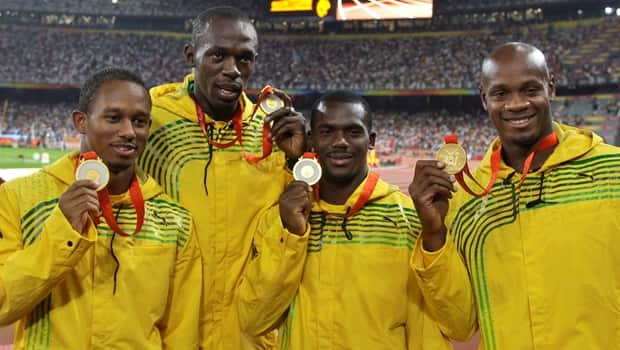
Usain Bolt loses 2008 Olympic relay gold after Nesta Carter's positive test

Usain Bolt has lost one of his nine Olympic gold medals in a doping case involving teammate Nesta Carter.
The IOC said Wednesday that Carter tested positive for methylhexaneamine, a banned stimulant, in re-analysis of samples from the 2008 Beijing Olympics.
Olympic rules state that the entire relay team can be disqualified and stripped of medals if one runner fails a doping test.
Carter and Bolt were teammates on the winning 4x100-metre team, which set a world record of 37.10 seconds. Carter ran the opening leg, and Bolt took the baton third in a team that also included Michael Frater and Asafa Powell.
"The Jamaican team is disqualified," the IOC said in a statement. "The corresponding medals, medallist pins and diplomas are withdrawn and shall be returned."
The relay title in Beijing completed the first of Bolt's gold medal sweeps in the 100, 200 and relay at three straight Olympics.

'This changes everything' 

The Canadian team of Pierre Browne, Anson Henry, Jared Connaughton, Hank Palmer — who finished sixth in the race — will now move into the top five.
"I hear I'm a fifth-place finisher now at the Olympics now," Henry, now a CBC Sports reporter, said on CBC News Network on Wednesday. "A couple of more positive [doping] tests and then I'll have a medal around my neck."
"But seriously, this changes everything", Henry continued. "[Carter] had a really good start in that race. We were right outside of Jamaica. He snuck up on Palmer really quickly. That changes [our] race. It changes our exchange. That changes my leg. Not to mention the rest of the teams."
According to Henry, the disqualification will cause a great deal of pain to the other sprinters. 
"Think about some of the things that are taken away from these [other] athletes," he said. "You see Richard Thompson with Trinidad and Tobago [crossing the finish line] in second place. Yeah, his team got a silver medal. But what better [way] than to cross the line [in first] for your country with your flag across your chest, arms raised, standing on the top of the podium? There were some other people that suffered because of this."
Media placeholder
CBC Sports' Anson Henry discusses downfall of Jamaican relay team6:15
Bolt set world record times for all three sprint titles at the Bird's Nest, establishing himself as the defining superstar of Olympic track.

Possible IAAF ban

Bolt and Carter will retain their gold medals from Jamaica's relay win at the 2012 London Olympics — in a record time of 36.84 seconds that stands today. Bolt ran the final leg on that team. He took the baton from Yohan Blake, who served a ban in 2009 for ingesting the same substance as Carter.
Carter and Bolt also helped lower their relay world record between the Olympic titles, taking gold at the 2011 world championships in Daegu, South Korea, in 37.04.
The 31-year-old Carter has teamed with Bolt on three straight world championship relay-winning teams, from 2011 through 2015. He also took an individual bronze in the 100 in 2013 in Moscow, behind Bolt and Justin Gatlin of the United States.
Carter, who did not compete at the Rio de Janeiro Olympics, faces a ban from the IAAF.
Trinidad and Tobago is in line to get the gold medal from 2008, Japan could be upgraded to silver, and fourth-place finisher Brazil could get the bronze medal.
Carter testified by video conference to an IOC disciplinary hearing held in Lausanne on Oct. 17.
The IOC's ruling states that Carter noted he was taking supplements in 2008 "advised in this respect by his coach, Mr. Stephen Francis."
"The athlete explained that he had given several samples for doping controls whilst he was taking Cell Tech and Nitro Tech before the 2008 Olympic Games and he had never tested positive for a prohibited substance," the detailed verdict stated.
"He therefore did not believe that these supplements could contain prohibited substances. He did not understand how methylhexaneamine could have been found in 2016."
Though methylhexaneamine was not specifically named on the 2008 list of prohibited substances, it "fell within the scope of the general prohibition of stimulants having a similar chemical structure or similar biological effect as the listed stimulants," the judging panel of three IOC members wrote.

Separate ruling 

The panel doubted if the supplements identified had caused the positive test given that Carter "used such supplements regularly and that this did not lead to other problems."
The runner cast doubt on his own ability to avoid doping rule violations. In a written statement to the IOC, "[Carter] asserted that he did not remember having received any formal anti-doping training in his career."
Carter can appeal the sanction to the Court of Arbitration for Sport. However, the IOC panel already anticipated one challenge in its written verdict.
"The Court of Arbitration for Sport ["CAS"] has confirmed that the presence or use of substances falling within the scope of generic definitions of the prohibited list, can be used as a basis of establishing anti-doping rules violations," the verdict said.
In a separate ruling Wednesday, another former Olympic champion was stripped of two silver medals from the Beijing Games.
The IOC said Russian athlete Tatiana Lebedeva tested positive for the anabolic steroid turinabol in re-tests, and would be disqualified from her runner-up placings in the long jump and triple jump.
Lebedeva won long jump gold at the 2004 Athens Olympics and also previously won Olympic silver and bronze in triple jump.

Sunday, January 22, 2017

Most Facebook hacks are done by friends, finds UBC survey

Want to keep your privacy protected? Keep your eyes on your friends.
A study conducted by Wali Ahmed Usmani, a master’s student at University of British Columbia found that those who you trust the most are the most likely to hack their way into your Facebook account.
The study, which was conducted between from February and March of 2016, looked to find out how common attacks on privacy are, who is most likely to be victimized, who is most likely to attack, why these attacks happen, what the damage is, and how one could possibly protect themselves.
1,308 adult Facebook users, 59% male and 41% female from the United States filled out surveys that included questions asking if they had someone use a device of theirs to access their own Facebook account without their permission, and if they had ever used someone else’s device to access that person’s Facebook account without permission.
“It’s clearly a widespread practice. Facebook private messages, pictures or videos are easy targets when the account owner is already logged on and has left their computer or mobile open for viewing,” said Usmani to ubc.ca.
The survey found that 24% of the group had accessed someone’s personal Facebook account without that person’s permission, and 21% had their Facebook’s violated. Reasons for the insider attacks ranged from practical jokes to invading privacy and reading a person’s messages, or in some circumstances malicious attacks on peoples’ friends using that person’s identity, or even deleting everything off their accounts. A lot of those who told their stores reported a lasting feeling of mistrust, ruined relationships, and embarrassment.
“A sizable fraction of Facebook users seem to have been involved in instances of social insider attacks. The high prevalence of attacks demonstrates a need for effective mechanisms to detect and report these attacks to account owners,” reads the report.
There are multiple ways to protect yourself from outside attacks, such as adding an authenticator, changing passwords often, and ensuring you don’t tell anyone your information. But the inside attacks are a much different animal, the only sure defense is to log out of your Facebook after every use on your devices.
Others made sure to make sure their devices were locked after use and making sure no one know the passwords for their devices.
But having to re-enter my Facebook password every time I wanted to simply scroll through my news feed for a bit (which I do very often throughout the day) or just send a few quick messages would get very tiresome. Researchers involved with the study suggested a passive log that would show how long was spent browsing personal messages and other related information. This would help to discourage people with the possibility of getting caught.
“Jealous snoops generally plan their action and focus on personal messages, accessing the account for 15 minutes or longer and the consequences are significant: in many cases, snooping effectively ended the relationship.” said computer science professor Ivan Beschastnikh, who was a co-author of the report.

Wednesday, January 18, 2017

Super Mario Run will be available on Android in March

Super Mario Run, Nintendo’s first real foray into mobile gaming, won’t be available on Android until March, the company announced in a tweet. In our review of the iOS version we thought the game was fun, but compromised, with surprisingly deep gameplay considering there’s only one control (tap to jump), but a bit repetitious. 
The question now is was it worth it for Nintendo? The company has been fretting about a move to mobile gaming for years, and is set to release two further titles in 2017 (Fire Emblem and Animal Crossing) with more to come in the following years. But while initial interest in Super Mario Run was highestimates from third-parties suggest that only around three percent of users paid for the full game.
Mario hasn’t run out of steam yet, but he seems to be finding mobile gaming a bit of a slog. We’ll see how it goes on Android. You can sign up to be notified with Super Mario Run is released through the Google Play Store.

Sleeping man wakened by heat and flames from Samsung S5 phone

A Toronto man says he woke up to "massive flames shooting out the sides" of his Samsung S5 phone on Tuesday morning.
Mario Jakab went to bed around midnight on Tuesday, and woke up from the heat and firework-like sounds coming from his bedside table. 
"I jumped out of bed, alerted my girlfriend because I wasn't sure if anything was going to catch fire," said Jakab. "I waited for the fire to go out, because I'm not touching a flame."
In a statement to CBC Toronto, a spokesperson for Samsung said customer safety was their highest priority. 
"Upon being made aware of the reported incident we began working with Mr. Jakab to investigate the matter. Until we have had an opportunity to analyze the phone we are unable to comment on the matter further."
'There were two-foot high flames pretty close to my face, shooting upwards.' - Mario Jakab
Samsung has recalled batteries on the Galaxy Note 7 models, after the devices started catching fire. The S5 model is not included in the recall. This appears to be one of the first reports of an S5 catching fire, though a lawsuit filed in the U.S. alleges the problem extends to several other smartphones.

Jakab said a Samsung engineer picked up his device on Wednesday morning. When asked if he had modified the phone, he told them the battery and charging cable were all originals that came with the phone he bought in 2014. 
"I couldn't pick up my phone or take a video of what it was doing, or even call 911," he says.
Jakab doesn't want to think what might have happened if he didn't wake up, or if the phone was in his pocket.
He wants people to learn from what happened to him and protect themselves, but said he would likely not change his own habits when it comes to charging his phone at night. 
He also worries about children playing with Samsung phones.
"Just a battery heating up can burn a young child's hands, just from holding it," he said. "Apparently they're not toys, like we thought they were."

Sunday, January 15, 2017

2 richest Canadians have wealth equal to 11 million poorest

The two richest Canadians have the same amount of wealth as the poorest 30 per cent of the country combined, according to a new report from a group of international aid organizations.
The Oxfam report says the wealth of billionaire businessmen David Thomson and Galen Weston Sr. equals that of about 11 million Canadians.
The group of organizations, under the banner group Oxfam International, published its report "An Economy for the 99%" ahead of the World Economic Forum in Davos, Switzerland, which begins Tuesday.
The report also said that the world's eight richest people have as much wealth as the poorest 50 per cent of the world's population.
"This is not a report about the rich and the poor. It's about the super-rich and the rest of us," said Lauren Ravon, the director of policy and campaigns at Oxfam Canada. 
Oxfam made its calculations about global wealth distribution based on the Credit Suisse Global Wealth Data book, and calculated the wealth of the world's richest people using the annual billionaires list from Forbes Magazine, which was last published in March 2016.

The difference between wealth and income 

Jim Davies, a professor at the University of Western Ontario who works on the Credit Suisse report, said there can be broader implications of wealth inequality. He noted that those implications are often different from those of income inequality.
Wealth is calculated by subtracting a person's debts from their assets, he said, whereas income refers to the money or assets a person makes or receives over a period of time.
Wealth offers security, Davies said, which income doesn't always do.
"If you lose your job, you're in a much worse position if you don't have money in the bank," he noted.
Ravon said the effects of wealth inequality can ricochet into other parts of society.
"In countries that are more unequal, there's higher rates of crime. Those societies are less healthy. People distrust each other more," she said. "People feel like they're disconnected from society when they see that the super-rich are writing the rules in their favour."

Having the government's ear  

And Stephen Harris, a professor of public policy at Carleton University and the University of Ottawa, said wealthy business owners have more power to lobby the government than the majority of everyday Canadians, which contributes to inequality.
"We used to really be a caring-sharing society," he said. "We lost some of that."
A society with so much inequality isn't economically sustainable, Ravon added. "In the long-term, if there's such concentration of wealth in the hands of just a few, there will be no one left to buy the goods, to keep the economy running."
But Harris said the problem isn't so easily fixed.
"I guess if I had a solution I'd be rich," he said. "But I don't have a bullet that would fix it."

Calls for wealth redistribution 

He said there are some things Canada can do to address the problem — such as policies for wealth redistribution used in Nordic countries, which tend to have less inequality — but they won't work unless the population gets behind the changes.
"We can't just migrate a system to this country," he said. "People have to be supportive of it if it's going to have legitimacy."
Oxfam's report made a number of suggestions for the government to implement in its next federal budget, including progressive taxation — a system used in Nordic countries, where those with higher incomes pay a greater portion of that income in taxes.
It also suggested raising the proportion of government spending on public services and social protection.
For the government's part, an official in the office of Social Development Minister Jean-Yves Duclos said in a statement that Trudeau's Liberals have already started making changes to grow the middle class.
Mathieu Filion wrote in an email that one of the first things the government did after coming to power was to cut taxes to the middle class and raise them for families with an income of $250,000 or more.
He also noted the government introduced the Canada Child Benefit, which he said gives an average of $2,300 to 90 per cent of families.
He said the government is watching the issue of wealth inequality "closely."

TAKE A CLOSE LOOK AT FARADAY FUTURE’S (SUPPOSED) TESLA-KILLER

Faraday Future is nothing if not ambitious. The Los Angeles startup promises to do more than make electric vehicles even cooler than Elon Musk did, steal his customers, and deliver a fully autonomous ride. It promises to change how the auto industry works, and how people get around.
Changing the world is hard, especially for a company that has in just the past year lost a slew of key executives, fallen behind on payments for its new factory, and been accused of running a Ponzi scheme by a Nevada official. Company brass remain unfazed. They rolled into CES earlier this month with what they promise will be Faraday’s first production vehicle, the FF91.
Your skepticism is warranted. History has seen no end of upstart automakers with big plans to shake up the industry. Remember Preston Tucker? John DeLorean? Henrik Fisker? Put aside your doubts, and this super-luxe electric limo—which would cost as much as a Bentley—shows some serious style. No wonder it attracted sizable crowds at CES. It’s outfitted for autonomous tech, it sports touchscreens built into the interior, and those doors open themselves at the touch of a button.

Niagara police find Advil mixed in with french vanilla ice cream

Niagara Regional Police are investigating after someone in St. Catharines, Ont., says they found Advil tablets in a sealed container of ice cream.
Police say they were called to home on Jan. 14 after a caller found eight pills mixed into ice cream.
Police say the caller had opened the ice cream to serve it to family but no one had eaten any.
The pills were 400 milligram Advil gel capsules, police say. 
The ice cream was 1.65 litres of Iceberg French Vanilla. The front container numbers are 16279 08:55 and the UPC code is 7 7427611724 2.
The caller thought the ice cream was purchased at either Food Basics on Geneva Street in St. Catharines, or the Freshco on Bunting Road.
Police have notified the manufacturer.

Friday, January 13, 2017

Newly discovered ruby sea dragon seen alive in wild for 1st time

Australian researchers have observed two specimens of a rare sea dragon that's never before been seen alive.
Sea dragons aren't very common, found in the waters off the coast of southern Australia. For some time, only two types were known: the leafy sea dragon and the common sea dragon (sometimes also called the weedy sea dragon). 
Then, in 2015, PhD student Josefin Stiller discovered that four samples collected over the years — the first in 1919 — had been misclassified as a common sea dragon. Instead, it was its own species, named the ruby sea dragon.
While this was an exciting discovery, a live ruby sea dragon had never been recorded — neither by divers nor those in the fishing industry. 
Fast-forward to 2016, when Stiller, together with Greg Rouse of the Scripps Institution of Oceanography and Nerida Wilson of the Western Australian Museum embarked on a study to sequence the DNA of both the common and leafy sea dragons, part of Stiller's ongoing study. They also decided to try for the ruby sea dragon, though they didn't hold out much hope.
"We had a brainstorm: 'why don't we go to the place it was first trawled in 2007?'" Rouse told CBC News. "They kept very good records of where the net went in." 
Using that data, they believed that the ruby sea dragon lived at a depth of around 55 metres, about 30 metres deeper than its cousins. Diving would be dangerous, so they deployed a remote underwater camera. 
The ocean didn't co-operate: rough seas plagued their expedition for the first two days.
As water moves up from the Antarctic, it heavily influences the environment, Rouse said. Even shallow waves make a big difference at that depth. On one particular day, the only thing the remote underwater camera could see was sand churned up by the moving water.
"I can tell you we did not really expect to find them," Rouse said. "And unbelievably, really, we found it."
Incredibly, the team found not just one, but two — on the final day of the expedition.
The results of the study were published in Marine Biodiversity Records.

Unique features

Seeing the ruby sea dragons in their natural habitat helped the researchers learn a lot more about them.
Because the only known samples had washed up on shores, not much was known about the lobes, protrusions from their body.
The common sea dragon has long, fleshy ones; those of the leafy sea dragons are even more elaborate. Part of the reason the ruby sea dragon had been misclassified was because it was believed that the longer lobes had been broken off, leaving it with just stumps. 
Instead, the video showed that the ruby sea dragons' lobes were just that: stumps.
As well, it wasn't clear why the fins behind the head were quite bulgy, with a lot more muscle than those of the other sea dragons. But now the team believes that it is used to help it swim at deeper depths. 
As for the tail, all the dead specimens were found with straight ones, common to the other sea dragons. However, the video showed that, in the wild, their tails are actually curled. The researchers surmise that, because of the active waters at that depth, they may use it to cling to flora, though they hadn't directly observed that behaviour.

U-Haul evicted man living in Vancouver storage locker

A video posted on YouTube by a Vancouver man who says he lived in a U-Haul storage locker for two months shows how far people will go to avoid paying the city's sky-high rents, but the company has a warning for anyone thinking of copying the move.
"U-Haul has procedures in place to detect anyone attempting to break the law and live in a storage locker/unit," company spokesman Jeff Lockridge told CBC News.
In the video, the man identified only as 007craft gives a guided tour of his tiny home inside the 10x10-foot storage locker at a U-Haul facility in South Vancouver. 
His amenities included a double bed, big screen TV, love seat, hot plate, and toaster oven. He also shows how he ran power to the unit from a nearby plug and picked up phone service with an extra antenna. He also rigged up running water.
In a matching post on the social media site Reddit, the man details how he made the small space livable — at a cost of about $100 for hardware. The cost of renting the locker was $205 a month, including insurance.
"Staff knew about my power and charged me $5 a month for it.... so I didn't need to keep unplugging the power," he said.
He used the washroom in the building and showered at a local gym and claims staff at the facility let him live there as long as he kept a low profile.
"I had 24-hour access, I was allowed to be there at any time for as long as I wanted. The only rule I broke was sleeping there," he said.

Evicted in November, U-Haul says

U-haul has a slightly different version of events, saying the man's locker lifestyle was illegal and once detected he was evicted long before he posted the YouTube video this week.
"Though the video insinuates he got away with doing this, this individual was caught and immediately evicted from the facility in November, two months before the video was posted," said U-Haul spokesman Lockridge.
"Local management didn't seek police involvement and was simply more interested in having the individual out and the illegal behavior ceased," he said.
At the end of the video, the man tells viewers he since moved into a small apartment, which he said he plans to convert into a climbing gym.
In another video, he reveals how he previously put a double bed and foldout kitchen with running water inside a Honda Civic for living on the road.

Wednesday, January 11, 2017

Is this the end of the Scottie dog and the top hat? Monopoly holds vote on future of its tokens

Everyone who has ever played Monopoly has their favourite token, from the top hat to the motor car or the Scottie dog.
But some long-standing pieces could soon be made redundant and replaced with more up to date symbols.
The hat, the shoe or even, heaven forbid, the much-loved Scottie, could be replaced by a mobile phone, a winking face emoji or even a hashtag.

Sponsored stories
Recommended byThe makers of Monopoly, have put the board game tokens to a public vote in order to determine which symbols should be employed by players in its new editions.
The eight standard pieces used for decades are lined up against a choice of more than 50 new designs.
Among the new tokens are a cowboy hat, cowboy boot, two different race car models, and a rotary phone.
The planned changes follow a public vote in 2013, in which people voted for Hazel the cat to replace the iron token which had been in the game since its inception.
Other choices on offer but rejected that year included a guitar, a helicopter, a diamond ring, and a robot.
The original six tokens in the popular board game were the thimble, top hat, iron, shoe, battleship and the cannon - which has now been retired.
Announcing the vote Jonathan Berkowitz, senior vice president of marketing for Hasbro Gaming, said: "The Monopoly Token Madness Vote lets our passionate fans choose all eight tokens in the Monopoly game and no token - not even the Scottie dog -- is safe.
“Only time will tell if fans will decide to stay with the classics, keep a few favorites or pick an entirely new lineup of tokens."
When the game was first devised in its current form in 1935 by domestic heater salesman and games designer Charles Darrow, he envisioned players using small items from around their homes as playing pieces.
The family’s little girl could have been a button, her older brother a bottle cap and the parents a car and a household pet.
Darrow’s niece suggested the tokens could be made to resemble the charms from a girl’s charm bracelet.
Many of the original tokens which Darrow settled on have an intriguing history of their own.
The top hat, one of the game’s most recognisable symbols, was based on the hat the game’s lead character, Mr. Monopoly, would wear. When the game was introduced, he was known as Rich Uncle Pennybags, and historians have long speculated the character was based on the wealthy US tycoon J.P. Morgan.
The shoe has also been around since the game’s original launch as a symbol of both hard work and the riches that, with a bit of luck, can accompany it.
Watch | Monopoly fans vote to add a cat and eliminate iron token from game The battleship was originally used by Parker Brothers in a game called “Conflict.” When that game failed the pieces were taken and used in the Monopoly set.
Until the 1950s there was also a purse among the tokens, along with a rocking horse.
The Scottie dog, though now regarded as an intrinsic part of the game, was only introduced during the 1950s.
During the 2013 poll it was by far the most popular piece, receiving almost a third of the vote.
Also introduced during the 1950s was the wheelbarrow, which replaced the lantern, purse and the rocking horse.
It was included as another symbol of hard work and one of the tools needed to build the properties around the board.
A sack of money became the first new token in over 40 years when it was added in 1999, only to be retired a decade later.
 The vote opens  on January 31 and the results will be announced by Hasbro on March 19, World Monopoly Day.

THE INCREASINGLY LONELY HOPE OF BARACK OBAMA

You can tell I’m a lame duck,” Barack Obama joked before his farewell address, on Tuesday night, in Chicago, “because nobody’s following instructions.” This was a teasing reference to the unbridled whoop of cheers that had gone up as he’d appeared at the podium; despite his best efforts, the President couldn’t convince the twenty-thousand-person congregation of true believers and long-standing aides to quiet down and take a seat. The quip also worked as a mordant description of the wider atmosphere of chaos and unpredictability that has taken hold during the two months since Donald Trump’s still-shocking election as Obama’s successor. To the extent that there exist “instructions” for a dignified transfer of power in America, they would seem to include the principle of “one President at a time,” a willingness on the part of the President-elect to communicate at reasonable intervals via press conference rather than Twitter outburst, and a general disinclination to comment on the fortunes of once-storied reality shows or the Golden Globes. Trump, in shredding these unwritten rules to ribbons, has made them seem instantly outdated. In the hours before Obama’s speech, a series of news reports and document dumps concerning the role of Russian interference on Trump’s behalf only served to deepen the impression of disorder.
The farewell address gave Obama one last opportunity to exert control, if only of the rhetorical kind, over national events. Eventually, the crowd quieted, and Obama insisted, as has been his habit recently, on recalling the accomplishments of his Administration. “If I had told you eight years ago that America would reverse a great recession, reboot our auto industry, and unleash the longest stretch of job creation in our history,” he began, “if I had told you that we would win marriage equality, and secure the right to health insurance for another twenty million of our fellow-citizens, you might have said our sights were set a little too high.” That last phrase was an echo of Obama’s victory speech after the 2008 caucus in Iowa. “They said our sights were set too high,” he said that night, inaugurating a tradition of smilingly chiding his doubters—“cynics,” he called them—that has continued, essentially unchanged, for the past nine years.
The coming Trump Administration will be a monumental test of Obama’s enduring optimism, and, perhaps, of his impatience with those who don’t share it. On Tuesday night, Obama carried on his long-running argument in favor of positive thinking, not as a perfect analytical tool—“there will be times when the process disappoints you,” he said—but, instead, as a moral obligation, and an instrument in the work of continual American renewal. Trust me, he seemed to be saying: you’ll need it.
Obama said the name Trump precisely once, and then only to extol the glories of the peaceful Presidential transfer. Still, it was impossible to interpret the speech without reference to the man who will be remembered by history as Obama’s foil. The President cannily framed his successor’s stated policy preferences not only as ill-advised but as directly opposed to the health of American cohesion. The most conspicuous spoke of this argument was a passage about race. For all his restraint, and despite his sometimes maddening insistence upon rhetorical balance, Obama, has, since his “race speech” of 2008, been uncommonly willing to wade into the intricacies of the subject. This time, with Trump as the implied target, he trained his focus on the country’s capacity to welcome the children of immigrants. “If we decline to invest” in them, he said, “we diminish the prospects of our own children—because those brown kids will represent a larger share of America’s workforce.” He reminded those who cheer Trump’s anti-immigrant rhetoric that “the stereotypes about immigrants today were said, almost word for word, about the Irish, Italians, and Poles.” America, he said, “wasn’t weakened by the presence of these newcomers; they embraced this nation’s creed, and it was strengthened.”
Obama also levelled particularly pointed challenges to both sides of the black-white dialectic that has guided and determined so much of the country’s history. From blacks “and other minorities”—one imagined that he had youthful, campus-grown activists, affiliated with Black Lives Matter and other related movements, in mind—he requested an interesting bit of imaginative enlargement. We should link “our own struggles for justice to the challenges that a lot of people in this country face—the refugee, the immigrant, the rural poor, the transgender American, and also the middle-aged white man who from the outside may seem like he’s got all the advantages, but who’s seen his world upended by economic, cultural, and technological change.” On the other hand, he continued, white Americans should acknowledge that “the effects of slavery and Jim Crow didn’t suddenly vanish in the sixties; that when minority groups voice discontent, they’re not just engaging in reverse racism or practicing political correctness; that when they wage peaceful protest, they’re not demanding special treatment but the equal treatment our Founders promised.”

This opposition laid bare an aspect of Obama’s analysis that puts him increasingly out of step with much of the current thinking. For Obama, racism is real, and still pervasive—his background means that he could never have been shielded from this fact—but it is not a necessarily permanent feature of American life. While he is not shy about invoking the horrors of slavery, he never drops the word “racism”—with its civil-rights-era-descended promise of eventual eradicability—in favor of the phrase “white supremacy,” which has lately come to signal an almost mystical belief in racial oppression as our founding national fact. Obama does subscribe to a civic metaphysics, but it is centered instead on the bonds between people and the perennial American ability to change. He spoke last night of “the sacred ties that make us one,” and this was the closest he came to religious language, apart from the perfunctory “God bless” toward the end.
It is not, Obama said, “that our nation has been flawless from the start but that we have shown the capacity to change and make life better for those who follow.” This version of American exceptionalism, he suggested, might prove more lasting than our oldest and bloodiest divisions. The President is an increasingly lonely torchbearer for the “We Shall Overcome” generation. It is striking, in this regard, that the lone literary reference in the speech was not to someone like James Baldwin—who often spoke of an American religion, centered on white skin—but to Atticus Finch, the hero of Harper Lee’s “To Kill a Mockingbird.” “You never really understand a person,” Obama said, quoting Finch, “until you consider things from his point of view . . . until you climb into his skin and walk around in it.”
Obama’s faith in the eventual solubility of things is closely related to his reverence for the Enlightenment, which he name-checked while speaking of another good that Trump threatens to destroy: the truth. Obama posited reason as the link between challenges as diverse as climate change and international terrorism, placing it as a counterpoint to fear, which might tempt our citizenry to shake off, or take “for granted,” the freedoms guaranteed by the Constitution.

But the most moving portion of the speech was more personal: a tribute to Michelle Obama, “girl of the South Side.” While the President spoke to his wife, he briefly lost his cool—that prized possession—and dabbed away a tear or two with a handkerchief. He went on to thank his daughters; Malia was seated next to her mother, also wiping away tears, while Sasha was reportedly back in Washington, because she had a midyear exam on Wednesday morning. The President thanked his Vice-President, Joe Biden, and the rest of the people who had made possible his time in office. And here, too, was a contrast with Trump, who has yet to demonstrate an ability ardently and earnestly to praise a person other than himself. We were reminded, once again, that part of the “soft power” that accompanies the Presidency, for good or ill, is the appearance of wholesomeness, of moral capacity, of love. For eight years, putting policy aside, Obama has displayed those qualities. It remains to be seen—but gets clearer as the transition daily shortens—which attributes of Trump’s will fill the void.

Sunday, January 1, 2017

Why It’s Time for Apple to Come Clean About the iPhone Battery

It happened again last week. The battery display on my iPhone 6 plunged from around 50% to below 10%, and then the phone shut down entirely. All of a sudden, I found myself cut off from Google Maps (GOOGL, -1.30%) in an unfamiliar part of town, and with no way to text my friends for directions.
This has happened before, and it's a real nuisance. The iPhone pulled the same stunt during a recent road race, cutting off my pace-keeping app and my music, and it's happened right when I've needed to make an important phone call.
But the most annoying aspect of all this is that Apple (AAPL, -0.78%)refuses to come clean about what's going on. While the company is running a limited battery replacement program for some iPhone 6s models, it's still pretending things are just fine with other models.
"A small number of customers outside of the affected range have also reported an unexpected shutdown," an Apple spokesperson wrote as part of an emailed statement to Fortune. (The full response is available below.)
A small number? I don't believe it. In a very informal poll of work colleagues, at least five of them reported iPhone battery issues similar to what I had experienced. Meanwhile, other publications are also calling attention to the problem Apple dare not name.

"Many iPhone 6 and iPhone 6s owners are complaining about a bug that essentially shuts down the phone even when it has a lot of battery life left. This is a problem that is happening right now, and yet, Apple hasn't figured out the true cause or at minimum hasn't disclosed it to the public."
And while the official corporate line at Apple is that things are fine, store employees seem to know better. When I brought my device into the Apple Store at the Oculus-World Trade Center location in Lower Manhattan, a worker there acknowledged she had heard of similar complaints, and offered a solution: Apple could reinstall the firmware on the device, which would fix the battery problem, but would also cause me to lose important data, including all my text messages.
No, thanks. What I would like instead is for Apple to swallow its pride and explain to its customers that there's something amiss with the iPhone and that a real fix is on the way.
Yes, this would be a blow to Apple. The iPhone is its flagship product and is a symbol of Apple's commitment to perfection and engineering excellence — admitting that product is defective would hurt both its reputation and its mystique.
But allowing the problem to fester while blowing off a rising chorus of customer complaints is not befitting of Apple either. Sure, the iPhones aren't literally blowing up in customers' hands (à la Samsung) but the battery problem is surely at a point where Apple needs to take action.
Here is the Apple spokesperson's full response to what is going on with the batteries:
We work hard to offer our customers the best product, experience, and customer support. We believe this is why we have earned the highest customer satisfaction rating of any smartphone maker in China and around the world.
We take every customer concern very seriously, including the limited number of reports of unexpected shutdown with iPhones. We also want to thank the agencies for forwarding concerns to us and their engagement with us. Every time we encounter an issue, we investigate using a thorough process including analyzing these devices. We also look at diagnostic information from the broader set of customers who have opted in to our standard diagnostic data reporting. When we find something, we work to quickly provide our customers with a solution.
As a result of our investigation on this, we found that a small number of iPhone 6s devices made in September and October 2015 contained a battery component that was exposed to controlled ambient air longer than it should have been before being assembled into battery packs. Two weeks ago, we launched a worldwide program to replace affected batteries, free of charge. We again apologize for any customer inconvenience. It's important to note, this is not a safety issue.
A small number of customers outside of the affected range have also reported an unexpected shutdown. Some of these shutdowns can occur under normal conditions in order for the iPhone to protect its electronics. In an effort to gather more information, we are including additional diagnostic capability in an iOS software update which will be available next week. This will allow us to gather information over the coming weeks which may potentially help us improve the algorithms used to manage battery performance and shutdown. If such improvements can be made, they will be delivered in future software updates.
Tim Cook, the ball is in your court: a new year is approaching, and 2017 would be a great time for Apple to restore the iPhone's once-impeccable reputation.