Showing posts with label consolidation. Show all posts

Sunday, February 5, 2017

Google’s Super Bowl ad accidentally set off a lot of Google Homes

Early during tonight’s game, Google’s ad for the Google Home aired on millions of TVs. We’ve actually seen the ad before: loving families at home meeting, hugging, and being welcomed by the Google Assistant. Someone says “Okay, Google,” and those familiar, colorful lights pop up.
But then my Google Home perked up, confused. “Sorry,” it said. “Something went wrong.” I laughed, because that wasn’t supposed to happen. I wasn’t the only one.
This isn’t the first time television has set off people’s home assistants. A month ago, a TV broadcast accidentally triggered a whole bunch of Amazon Echos.
Poor Dave... At some point, some enterprising TV writer or ad jerk is gonna plant an “Okay, Google” into some on TV with intent and force everyone to listen to Nickelback. Mark my words. This is a massive troll waiting to happen.

Saturday, January 28, 2017

Mark Zuckerberg Says He’s Not Running For President

Mark Zuckerberg has no plans to run for president, the Facebook founder and CEO told BuzzFeed News Tuesday.
"No," Zuckerberg wrote in response to a question about his intent to run. "I'm focused on building our community at Facebook and working on the Chan Zuckerberg Initiative," referring to the limited-liability corporation he and his wife, Priscilla Chan, founded in 2015 to advance human potential and promoting equality through major bets in education and science research. Zuckerberg did not immediately respond to follow-up questions about whether he'd explicitly ruled out a run.
Zuckerberg's response comes after weeks of speculation from the tech press and beyond, set off by a series of events that indicated a run might be in the cards, including a pledge to visit the approximately 30 US states he hadn't yet been to. "Will Mark Zuckerberg Be Our Next President?" Vanity Fair asked in January.

"There's absolutely no truth to the idea that Mark is running for office and I've heard it directly from him," the source told BuzzFeed News. "Here's the thing: For Mark, Facebook is global community that already plays this huge part in the lives of billions of people around the world and plays an incredibly important role in shaping the base on the issues that matter."
Zuckerberg is preparing for a political battle, the source was careful to emphasize, but as a private citizen focused on the goals he has already outlined through the Chan Zuckerberg Initiative. "There is absolutely a possibility that Mark may choose to play a stronger role in the political system and political debates," the source said. Zuckerberg has been "very transparent" in his advocacy for "greater equality and optimizing research that find cures for disease and solves the fundamental problems of our time, but I really don't see him stepping away from Facebook."
Last week, Zuckerberg announced that he had poached Uber executive David Plouffe, a former campaign manager for Barack Obama, as CZI's president of policy and advocacy. He also tapped Ken Mehlman, George W. Bush's former campaign manager, in an advisory role. "You can make change, but in order for it to be sustainable, you need to build a movement to support it," Zuckerberg told The New York Times.
Calling for a movement, backed by bipartisan political operatives, sounds awfully presidential, but Zuckerberg used the same language when he first launched CZI in December, 2015.
The stock restructuring deal ties back to CZI as well. The changes were made after Zuckerberg and Chan donated 99 percent of their Facebook shares, then worth roughly $45 billion, to CZI. In order retain control while he gave away equity, Zuckerberg introduced a new class of stock and revised rules, including a concession that "serving in a government position or office," for two years would not constitute a voluntary resignation.
Success in business doesn't necessarily guarantee success at the polls. . "First thing is these people should not be running for office," Bradley Tusk, an Uber advisor and investor, who also managed Michael Bloomberg's 2009 mayoral campaign, told BuzzFeed Newsduring a conversation about the increasingly political role played by Silicon Valley leaders. "It worked for Mike [Bloomberg] because of 9/11. If you look at the history of rich people from business or tech running for office, they almost always lose. That personality type is very different from running a company. The reality is if you're Mark, with your wealth and platform," you're better off as CEO of Facebook than President, he said.
Tusk also pointed out that direct political engagement has not been as successful for Zuckerberg in the past. "Look at Fwd.us. How much money did those guys get taken for? And they accomplished nothing," he said, referring to Zuckerberg's ill-conceived immigration advocacy group. "They are better off using their strengths and their skills," than jumping directly into the political arena, Tusk said.

Scientists have a plan to make tomatoes great again

What happened to the tomato?

It was really one of the first casualties of large-scale agricultural selective breeding. Agricultural companies and mass producers started breeding the tomato in the 1960s for desirable characteristics.  
Firmness helped them ship tomatoes longer distances. Size yielded higher prices. But flavour was left behind, leading to a slow, almost imperceptible decline in taste. The result is the tomatoes we see on the shelves today.  

What are scientists planning to do about it?

An international group of scientists looked at 160 tomato samples from 101 varieties, ranging from modern store-shelf ones to wild, heirloom tomatoes, and asked a bunch of tomato aficionados to rate them based on overall liking and flavour intensity.
From that data, they could narrow down which chemicals in the more-desired tomatoes were actually responsible for the preferred flavour. 
Dozens of flavour compounds were identified, and scientists eventually whittled the group down to 13 different chemicals that were found to be higher in tastier tomatoes.

How does identifying flavour compounds improve the tomato?

That's where genomics — sequencing and analysis of an organism's genome — comes in. Researchers say they were able to identify the specific genes involved in making those 13 different flavour compounds.
One of the reasons tomatoes have lost their flavour is because these compounds are present in very small amounts. The concentration is so small that they are almost undetectable by chemical profiles but definitely detectable by our taste buds. That means that small tweaks in concentration can drastically improve the flavour. 
The plan is to use this new genetic knowledge to help breeders produce higher concentrations of desirable flavour compounds. The hope is that the tomato can still have the durability and size that the commercial producers want but also the flavour consumers desire.
There are some hurdles though — boosting sugar content and maintaining size may be a problem. Here's how Harry Klee, one of the lead researchers from the University of Florida, explains it: 
"Sugars are a challenge because we know that the only way you're going to get more sugar is to reduce the yield or reduce the size of the fruit… There's going to be a trade-off." 
But, let's face it, most of us would be more than willing to buy smaller tomatoes if they have double the flavour.

When can we expect to see these improved tomatoes?

The experiments are already underway. Klee expects that within two years the more flavourful tomato will be ready for commercial viability testing.
It should be noted that there's a huge caveat to all this work: no matter what tomato you buy, even a fancy homegrown organic, wild, heirloom tomato will lose all flavour if you put it in the refrigerator. So if you love your tomatoes but store them in the fridge — the blame rests on you!

Wednesday, January 25, 2017

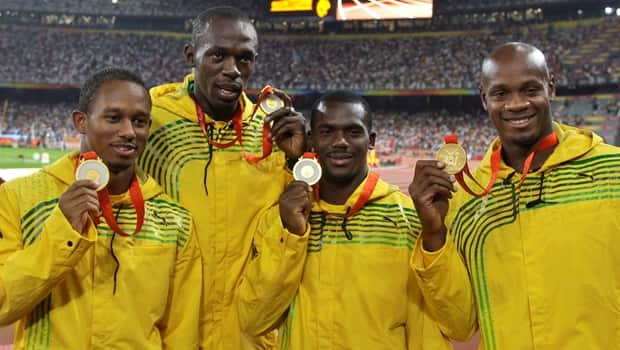
Usain Bolt loses 2008 Olympic relay gold after Nesta Carter's positive test

Usain Bolt has lost one of his nine Olympic gold medals in a doping case involving teammate Nesta Carter.
The IOC said Wednesday that Carter tested positive for methylhexaneamine, a banned stimulant, in re-analysis of samples from the 2008 Beijing Olympics.
Olympic rules state that the entire relay team can be disqualified and stripped of medals if one runner fails a doping test.
Carter and Bolt were teammates on the winning 4x100-metre team, which set a world record of 37.10 seconds. Carter ran the opening leg, and Bolt took the baton third in a team that also included Michael Frater and Asafa Powell.
"The Jamaican team is disqualified," the IOC said in a statement. "The corresponding medals, medallist pins and diplomas are withdrawn and shall be returned."
The relay title in Beijing completed the first of Bolt's gold medal sweeps in the 100, 200 and relay at three straight Olympics.

'This changes everything' 

The Canadian team of Pierre Browne, Anson Henry, Jared Connaughton, Hank Palmer — who finished sixth in the race — will now move into the top five.
"I hear I'm a fifth-place finisher now at the Olympics now," Henry, now a CBC Sports reporter, said on CBC News Network on Wednesday. "A couple of more positive [doping] tests and then I'll have a medal around my neck."
"But seriously, this changes everything", Henry continued. "[Carter] had a really good start in that race. We were right outside of Jamaica. He snuck up on Palmer really quickly. That changes [our] race. It changes our exchange. That changes my leg. Not to mention the rest of the teams."
According to Henry, the disqualification will cause a great deal of pain to the other sprinters. 
"Think about some of the things that are taken away from these [other] athletes," he said. "You see Richard Thompson with Trinidad and Tobago [crossing the finish line] in second place. Yeah, his team got a silver medal. But what better [way] than to cross the line [in first] for your country with your flag across your chest, arms raised, standing on the top of the podium? There were some other people that suffered because of this."
Media placeholder
CBC Sports' Anson Henry discusses downfall of Jamaican relay team6:15
Bolt set world record times for all three sprint titles at the Bird's Nest, establishing himself as the defining superstar of Olympic track.

Possible IAAF ban

Bolt and Carter will retain their gold medals from Jamaica's relay win at the 2012 London Olympics — in a record time of 36.84 seconds that stands today. Bolt ran the final leg on that team. He took the baton from Yohan Blake, who served a ban in 2009 for ingesting the same substance as Carter.
Carter and Bolt also helped lower their relay world record between the Olympic titles, taking gold at the 2011 world championships in Daegu, South Korea, in 37.04.
The 31-year-old Carter has teamed with Bolt on three straight world championship relay-winning teams, from 2011 through 2015. He also took an individual bronze in the 100 in 2013 in Moscow, behind Bolt and Justin Gatlin of the United States.
Carter, who did not compete at the Rio de Janeiro Olympics, faces a ban from the IAAF.
Trinidad and Tobago is in line to get the gold medal from 2008, Japan could be upgraded to silver, and fourth-place finisher Brazil could get the bronze medal.
Carter testified by video conference to an IOC disciplinary hearing held in Lausanne on Oct. 17.
The IOC's ruling states that Carter noted he was taking supplements in 2008 "advised in this respect by his coach, Mr. Stephen Francis."
"The athlete explained that he had given several samples for doping controls whilst he was taking Cell Tech and Nitro Tech before the 2008 Olympic Games and he had never tested positive for a prohibited substance," the detailed verdict stated.
"He therefore did not believe that these supplements could contain prohibited substances. He did not understand how methylhexaneamine could have been found in 2016."
Though methylhexaneamine was not specifically named on the 2008 list of prohibited substances, it "fell within the scope of the general prohibition of stimulants having a similar chemical structure or similar biological effect as the listed stimulants," the judging panel of three IOC members wrote.

Separate ruling 

The panel doubted if the supplements identified had caused the positive test given that Carter "used such supplements regularly and that this did not lead to other problems."
The runner cast doubt on his own ability to avoid doping rule violations. In a written statement to the IOC, "[Carter] asserted that he did not remember having received any formal anti-doping training in his career."
Carter can appeal the sanction to the Court of Arbitration for Sport. However, the IOC panel already anticipated one challenge in its written verdict.
"The Court of Arbitration for Sport ["CAS"] has confirmed that the presence or use of substances falling within the scope of generic definitions of the prohibited list, can be used as a basis of establishing anti-doping rules violations," the verdict said.
In a separate ruling Wednesday, another former Olympic champion was stripped of two silver medals from the Beijing Games.
The IOC said Russian athlete Tatiana Lebedeva tested positive for the anabolic steroid turinabol in re-tests, and would be disqualified from her runner-up placings in the long jump and triple jump.
Lebedeva won long jump gold at the 2004 Athens Olympics and also previously won Olympic silver and bronze in triple jump.

Friday, January 20, 2017

Mexican drug lord 'El Chapo' faces life sentence in U.S. prison

Mexican drug kingpin Joaquin "El Chapo" Guzman will spend the rest of his life in a U.S. prison if convicted on charges he ran the world's largest drug-trafficking organization during a decades-long criminal career, U.S. prosecutors said on Friday.
El Chapo (Shorty), once one of the world's most wanted drug lords, was set to appear at 2 p.m. ET in federal court in Brooklyn, N.Y., to be arraigned on 17 criminal counts, a day after his surprise extradition from Mexico.
The charges carry a mandatory minimum sentence of life in prison, Robert Capers, U.S. attorney for the Eastern District of New York, said at a news conference.
"Who is Chapo Guzman? In short, he's a man known for no other life but a life of crime, violence, death and destruction, and now he'll have to answer to that," Capers said.
Guzman, 59, arrived in a small jet at Long Island's MacArthur Airport after nightfall on Thursday from a prison in the city of Juarez in the northern state of Chihuahua, where his Sinaloa cartel rules.
A few hours earlier, he was bundled out of the Mexican cell block with his hands cuffed above his bowed head, Mexican television footage showed.
Guzman is charged in six separate U.S. indictments. He is accused of money laundering and drug trafficking, kidnapping and murder in Chicago, Ill., Miami, Fla., New York and other cities.

More than 40 witnesses

Federal prosecutors in Brooklyn, N.Y., have more than 40 witnesses ready to testify against Guzman, Capers told reporters, adding that the trial will likely last "many" weeks.
U.S. prosecutors gave assurances to Mexican officials that they would not seek the death penalty in order to secure his extradition, Capers said. Mexico opposes capital punishment.
One of Guzman's lawyers was surprised at the extradition, saying that four appeals in Mexico were outstanding to stop it.
U.S. authorities did not have much notice, either, although they had long planned for Guzman's arrival, Justice Department official Kenneth Blanco said at the news conference. "We were notified yesterday that he would be on his way," he said.
Leading the Sinaloa cartel, Guzman oversaw perhaps the world's largest transnational cocaine, heroin and methamphetamine smuggling operation, playing a key role in Mexico's decade-long drug war that has killed over 100,000 people.
"Guzman and the Sinaloa cartel had a veritable army, ready to war with competitors and anyone Guzman deemed to be a traitor," U.S. prosecutors said. He was known to carry a gold-plated AK-47 rifle.

$14 billion in drug proceeds and profits

The indictment of Guzman seeks to recover more than $14 billion in drug proceeds and illicit profits.
"We can't say how much we have eyes on or how much we'll recover but what we do know is that the government will be vigilant in trying to recover as much of those assets as we can," Capers said.
The extradition came on the eve of Donald Trump's inauguration, a coincidence that some officials said was an olive branch to the incoming president who declared he would kick Guzman's "ass" on taking office.
The Mexican attorney general's office rejected claims the move was related to Trump's swearing-in, noting that Guzman faces 10 pending cases in Mexico following his U.S. sentence.
He was captured a year ago after he had fled a high-security penitentiary in central Mexico through a mile-long tunnel, his second dramatic prison escape.
U.S. authorities, citing security concerns, declined to say where he would be held while awaiting trial, but they vowed to prevent any further escapes.
"I assure you, no tunnel will be built leading to his bathroom," Special Agent In Charge Angel Melendez of U.S. Homeland Security Investigations said at the news conference.
Melendez said he was present when Guzman deplaned in Long Island.
"As you looked into his eyes you could see the surprise, you could see the shock, and to a certain extent you could actually see the fear as the realization started to kick in that he's about to face American justice," he said. 

Wednesday, January 18, 2017

YouTube is testing in-app messaging to take on Facebook

Google-owned video platform is currently testing a new in-app messaging feature on iOS and Android that will allow users to exchange clips, texts and links without ever having to leave the app. 
But there’s one catch: The functionality is solely available in Canada for the time being. Google product manager Shimrit Ben Yair told Canada’s Financial Post the decision to run trials on Canadian soil has to do with the fact that it’s the country that shares videos more than anyone else in the world.
The messaging platform is pretty straightforward and has no specific video-centric features. Still, the move towards in-app messaging could have much larger implications for the future of YouTube.
A few months back, Google toyed around with the idea of giving certain channels the option to send direct messages to their audience. It also briefly tested with in-app messaging last year in May.
The move was likely aimed at encouraging creators and fans to interact more on YouTube itself, rather than resorting to other platforms like Facebook, Twitter and Reddit.
While it’s unclear whether Google has any plans to roll out the feature to all users in the future, the experiment is a strong indication that the company hasn’t quite given up on turning YouTube into more of a social network.
In case you want to sneak a peek at YouTube’s new messaging feature, get one of your Canadian friends to add you to a conversation – that should give you an early preview.

Tuesday, January 17, 2017

Tesla Motors To Share More Gigafactory Details At Trade Show In March

Earlier this month, Tesla Motors Inc (NASDAQ:TSLA) held an investor event at the Gigafactory, which included a factory tour as well as a recently-released handout on the battery cell manufacturing. Yet, most of the analysts have been unsatisfied with the details the automaker has provided up till now.
Electrek reported that Tesla will spill some more beans about what will be the world’s largest factory building at its completion. Both Tesla Senior Director of Cell Supply Chain & Business Development, Kurt Kelty, and the famous battery research partner, Jeff Dahn, will give a presentation at the annual International Battery Seminar & Exhibition, which will be held in Fort Lauderdale, FL between March 20 and March 23.
Mr. Kelty, one of the top battery scientists at Tesla, will give a keynote presentation on “Gigafactory Material Sourcing and Cell Production” at the exhibition on March 22, according to its brochure. Moreover, the cell production for Tesla Energy products, Powerwall and Powerpack built at the Gigafactory, will be discussed.
Soon after, Mr. Dahn will present at the seminar on the same day. The researcher has been studying on battery cell’s voltage, which can be increased to generate better durability and higher energy density of lithium-ion batteries. This would be essential for Tesla to bring down costs of its vehicles and energy storage products.
While his work focuses on nickel manganese cobalt oxide (NMC) lithium-ion cells, which is used by Tesla for its battery cell chemistry. Mr. Dahn’s keynote will be on “Surprising Chemistry in Li-Ion Cells,” discussing ways to counter harmful reactions in battery cells to increase their capacity.

Sunday, January 15, 2017

2 richest Canadians have wealth equal to 11 million poorest

The two richest Canadians have the same amount of wealth as the poorest 30 per cent of the country combined, according to a new report from a group of international aid organizations.
The Oxfam report says the wealth of billionaire businessmen David Thomson and Galen Weston Sr. equals that of about 11 million Canadians.
The group of organizations, under the banner group Oxfam International, published its report "An Economy for the 99%" ahead of the World Economic Forum in Davos, Switzerland, which begins Tuesday.
The report also said that the world's eight richest people have as much wealth as the poorest 50 per cent of the world's population.
"This is not a report about the rich and the poor. It's about the super-rich and the rest of us," said Lauren Ravon, the director of policy and campaigns at Oxfam Canada. 
Oxfam made its calculations about global wealth distribution based on the Credit Suisse Global Wealth Data book, and calculated the wealth of the world's richest people using the annual billionaires list from Forbes Magazine, which was last published in March 2016.

The difference between wealth and income 

Jim Davies, a professor at the University of Western Ontario who works on the Credit Suisse report, said there can be broader implications of wealth inequality. He noted that those implications are often different from those of income inequality.
Wealth is calculated by subtracting a person's debts from their assets, he said, whereas income refers to the money or assets a person makes or receives over a period of time.
Wealth offers security, Davies said, which income doesn't always do.
"If you lose your job, you're in a much worse position if you don't have money in the bank," he noted.
Ravon said the effects of wealth inequality can ricochet into other parts of society.
"In countries that are more unequal, there's higher rates of crime. Those societies are less healthy. People distrust each other more," she said. "People feel like they're disconnected from society when they see that the super-rich are writing the rules in their favour."

Having the government's ear  

And Stephen Harris, a professor of public policy at Carleton University and the University of Ottawa, said wealthy business owners have more power to lobby the government than the majority of everyday Canadians, which contributes to inequality.
"We used to really be a caring-sharing society," he said. "We lost some of that."
A society with so much inequality isn't economically sustainable, Ravon added. "In the long-term, if there's such concentration of wealth in the hands of just a few, there will be no one left to buy the goods, to keep the economy running."
But Harris said the problem isn't so easily fixed.
"I guess if I had a solution I'd be rich," he said. "But I don't have a bullet that would fix it."

Calls for wealth redistribution 

He said there are some things Canada can do to address the problem — such as policies for wealth redistribution used in Nordic countries, which tend to have less inequality — but they won't work unless the population gets behind the changes.
"We can't just migrate a system to this country," he said. "People have to be supportive of it if it's going to have legitimacy."
Oxfam's report made a number of suggestions for the government to implement in its next federal budget, including progressive taxation — a system used in Nordic countries, where those with higher incomes pay a greater portion of that income in taxes.
It also suggested raising the proportion of government spending on public services and social protection.
For the government's part, an official in the office of Social Development Minister Jean-Yves Duclos said in a statement that Trudeau's Liberals have already started making changes to grow the middle class.
Mathieu Filion wrote in an email that one of the first things the government did after coming to power was to cut taxes to the middle class and raise them for families with an income of $250,000 or more.
He also noted the government introduced the Canada Child Benefit, which he said gives an average of $2,300 to 90 per cent of families.
He said the government is watching the issue of wealth inequality "closely."

Wednesday, January 11, 2017

Is this the end of the Scottie dog and the top hat? Monopoly holds vote on future of its tokens

Everyone who has ever played Monopoly has their favourite token, from the top hat to the motor car or the Scottie dog.
But some long-standing pieces could soon be made redundant and replaced with more up to date symbols.
The hat, the shoe or even, heaven forbid, the much-loved Scottie, could be replaced by a mobile phone, a winking face emoji or even a hashtag.

Sponsored stories
Recommended byThe makers of Monopoly, have put the board game tokens to a public vote in order to determine which symbols should be employed by players in its new editions.
The eight standard pieces used for decades are lined up against a choice of more than 50 new designs.
Among the new tokens are a cowboy hat, cowboy boot, two different race car models, and a rotary phone.
The planned changes follow a public vote in 2013, in which people voted for Hazel the cat to replace the iron token which had been in the game since its inception.
Other choices on offer but rejected that year included a guitar, a helicopter, a diamond ring, and a robot.
The original six tokens in the popular board game were the thimble, top hat, iron, shoe, battleship and the cannon - which has now been retired.
Announcing the vote Jonathan Berkowitz, senior vice president of marketing for Hasbro Gaming, said: "The Monopoly Token Madness Vote lets our passionate fans choose all eight tokens in the Monopoly game and no token - not even the Scottie dog -- is safe.
“Only time will tell if fans will decide to stay with the classics, keep a few favorites or pick an entirely new lineup of tokens."
When the game was first devised in its current form in 1935 by domestic heater salesman and games designer Charles Darrow, he envisioned players using small items from around their homes as playing pieces.
The family’s little girl could have been a button, her older brother a bottle cap and the parents a car and a household pet.
Darrow’s niece suggested the tokens could be made to resemble the charms from a girl’s charm bracelet.
Many of the original tokens which Darrow settled on have an intriguing history of their own.
The top hat, one of the game’s most recognisable symbols, was based on the hat the game’s lead character, Mr. Monopoly, would wear. When the game was introduced, he was known as Rich Uncle Pennybags, and historians have long speculated the character was based on the wealthy US tycoon J.P. Morgan.
The shoe has also been around since the game’s original launch as a symbol of both hard work and the riches that, with a bit of luck, can accompany it.
Watch | Monopoly fans vote to add a cat and eliminate iron token from game The battleship was originally used by Parker Brothers in a game called “Conflict.” When that game failed the pieces were taken and used in the Monopoly set.
Until the 1950s there was also a purse among the tokens, along with a rocking horse.
The Scottie dog, though now regarded as an intrinsic part of the game, was only introduced during the 1950s.
During the 2013 poll it was by far the most popular piece, receiving almost a third of the vote.
Also introduced during the 1950s was the wheelbarrow, which replaced the lantern, purse and the rocking horse.
It was included as another symbol of hard work and one of the tools needed to build the properties around the board.
A sack of money became the first new token in over 40 years when it was added in 1999, only to be retired a decade later.
 The vote opens  on January 31 and the results will be announced by Hasbro on March 19, World Monopoly Day.