Showing posts with label student loan. Show all posts

Thursday, February 2, 2017

Google Tops Apple as the World’s Most Valuable Brand

Google is now the world's most valuable brand, according to a new study, snagging the No.1 spot from Apple which has been the incumbent since 2011.
The annual ranking from Brand Finance says Google's  monetary value increased to $109.5 billion last year, representing a 24% increase overall. By contrast, Apple's  monetary value fell from $145.9 billion in the previous year to $107.1 billion, according to the study. The decrease allowed Google to snag the top spot by about $2.4 billion.
The news of its No.2 spot comes as "Apple has failed to maintain its technological advantage and has repeatedly disillusioned its advocates with tweaks when material changes were expected," the study's authors wrote, who further explained that tech-giant has "over-exploited the goodwill" of its customers, namely because of its failure to generate significant revenues from products like the Apple Watch, and its inability to "demonstrate that genuinely innovative technologies desired by consumers are in the pipeline."
As for Google, the company "remains largely unchallenged in its core search business, which is the mainstay of its advertising income,” Brand Finance wrote in the report. Though Google has largely benefited from increased revenues (parent company Alphabet recently reported better-than-expected fourth-quarter revenue) its brand strength score is also a factor in its success. According to the study, Google's brand strength score was up by two points, indicating "underlying brand equity." In other words, the better the brand equity is for a tech business, the more likely it is to retain customers, or "even command a price premium that its products and services might not be worth," Brand Finance reports.
Out of the 500 brands analyzed, Amazon was deemed third most valuable, at $106.4 billion. Snagging the No. 4 spot was AT&T at $87 billion, which was followed by No.5 Microsoft at $76.3 billion and No.6 Samsung at $66.2 billion. Verizon was No. 7 at $65.9 billion. Walmart, Facebook, and ICBC snagged the last three spots in the top ten, at $62.2 billion, $61.9 billion, and $47.8 billion, respectively.

Saturday, January 28, 2017

Mark Zuckerberg Says He’s Not Running For President

Mark Zuckerberg has no plans to run for president, the Facebook founder and CEO told BuzzFeed News Tuesday.
"No," Zuckerberg wrote in response to a question about his intent to run. "I'm focused on building our community at Facebook and working on the Chan Zuckerberg Initiative," referring to the limited-liability corporation he and his wife, Priscilla Chan, founded in 2015 to advance human potential and promoting equality through major bets in education and science research. Zuckerberg did not immediately respond to follow-up questions about whether he'd explicitly ruled out a run.
Zuckerberg's response comes after weeks of speculation from the tech press and beyond, set off by a series of events that indicated a run might be in the cards, including a pledge to visit the approximately 30 US states he hadn't yet been to. "Will Mark Zuckerberg Be Our Next President?" Vanity Fair asked in January.

"There's absolutely no truth to the idea that Mark is running for office and I've heard it directly from him," the source told BuzzFeed News. "Here's the thing: For Mark, Facebook is global community that already plays this huge part in the lives of billions of people around the world and plays an incredibly important role in shaping the base on the issues that matter."
Zuckerberg is preparing for a political battle, the source was careful to emphasize, but as a private citizen focused on the goals he has already outlined through the Chan Zuckerberg Initiative. "There is absolutely a possibility that Mark may choose to play a stronger role in the political system and political debates," the source said. Zuckerberg has been "very transparent" in his advocacy for "greater equality and optimizing research that find cures for disease and solves the fundamental problems of our time, but I really don't see him stepping away from Facebook."
Last week, Zuckerberg announced that he had poached Uber executive David Plouffe, a former campaign manager for Barack Obama, as CZI's president of policy and advocacy. He also tapped Ken Mehlman, George W. Bush's former campaign manager, in an advisory role. "You can make change, but in order for it to be sustainable, you need to build a movement to support it," Zuckerberg told The New York Times.
Calling for a movement, backed by bipartisan political operatives, sounds awfully presidential, but Zuckerberg used the same language when he first launched CZI in December, 2015.
The stock restructuring deal ties back to CZI as well. The changes were made after Zuckerberg and Chan donated 99 percent of their Facebook shares, then worth roughly $45 billion, to CZI. In order retain control while he gave away equity, Zuckerberg introduced a new class of stock and revised rules, including a concession that "serving in a government position or office," for two years would not constitute a voluntary resignation.
Success in business doesn't necessarily guarantee success at the polls. . "First thing is these people should not be running for office," Bradley Tusk, an Uber advisor and investor, who also managed Michael Bloomberg's 2009 mayoral campaign, told BuzzFeed Newsduring a conversation about the increasingly political role played by Silicon Valley leaders. "It worked for Mike [Bloomberg] because of 9/11. If you look at the history of rich people from business or tech running for office, they almost always lose. That personality type is very different from running a company. The reality is if you're Mark, with your wealth and platform," you're better off as CEO of Facebook than President, he said.
Tusk also pointed out that direct political engagement has not been as successful for Zuckerberg in the past. "Look at Fwd.us. How much money did those guys get taken for? And they accomplished nothing," he said, referring to Zuckerberg's ill-conceived immigration advocacy group. "They are better off using their strengths and their skills," than jumping directly into the political arena, Tusk said.

Scientists have a plan to make tomatoes great again

What happened to the tomato?

It was really one of the first casualties of large-scale agricultural selective breeding. Agricultural companies and mass producers started breeding the tomato in the 1960s for desirable characteristics.  
Firmness helped them ship tomatoes longer distances. Size yielded higher prices. But flavour was left behind, leading to a slow, almost imperceptible decline in taste. The result is the tomatoes we see on the shelves today.  

What are scientists planning to do about it?

An international group of scientists looked at 160 tomato samples from 101 varieties, ranging from modern store-shelf ones to wild, heirloom tomatoes, and asked a bunch of tomato aficionados to rate them based on overall liking and flavour intensity.
From that data, they could narrow down which chemicals in the more-desired tomatoes were actually responsible for the preferred flavour. 
Dozens of flavour compounds were identified, and scientists eventually whittled the group down to 13 different chemicals that were found to be higher in tastier tomatoes.

How does identifying flavour compounds improve the tomato?

That's where genomics — sequencing and analysis of an organism's genome — comes in. Researchers say they were able to identify the specific genes involved in making those 13 different flavour compounds.
One of the reasons tomatoes have lost their flavour is because these compounds are present in very small amounts. The concentration is so small that they are almost undetectable by chemical profiles but definitely detectable by our taste buds. That means that small tweaks in concentration can drastically improve the flavour. 
The plan is to use this new genetic knowledge to help breeders produce higher concentrations of desirable flavour compounds. The hope is that the tomato can still have the durability and size that the commercial producers want but also the flavour consumers desire.
There are some hurdles though — boosting sugar content and maintaining size may be a problem. Here's how Harry Klee, one of the lead researchers from the University of Florida, explains it: 
"Sugars are a challenge because we know that the only way you're going to get more sugar is to reduce the yield or reduce the size of the fruit… There's going to be a trade-off." 
But, let's face it, most of us would be more than willing to buy smaller tomatoes if they have double the flavour.

When can we expect to see these improved tomatoes?

The experiments are already underway. Klee expects that within two years the more flavourful tomato will be ready for commercial viability testing.
It should be noted that there's a huge caveat to all this work: no matter what tomato you buy, even a fancy homegrown organic, wild, heirloom tomato will lose all flavour if you put it in the refrigerator. So if you love your tomatoes but store them in the fridge — the blame rests on you!

Thursday, January 26, 2017

SpaceX and Lockheed CEOs meet with Donald Trump

Lockheed Martin CEO Marillyn Hewson and SpaceX CEO Elon Musk were among a dozen business leaders who met with the president to discuss manufacturing and related issues.
Trump said he would seek to keep manufacturing jobs in the United States and cut down on regulations.

Wednesday, January 25, 2017

Google offers a glimpse into its fight against fake news

In the waning months of 2016, two of the world's biggest tech companies decided they would do their part to curb the spread of hoaxes and misinformation on their platforms — by this point, widely referred to under the umbrella of "fake news."
Facebook and Google announced they would explicitly ban fake news publishers from using their advertising networks to make money, while Facebook later announced additional efforts to flag and fact-check suspicious news stories in users' feeds.
How successful have these efforts been? Neither company will say much — but Google, at least, has offered a glimpse.
In a report released today, Google says that its advertising team reviewed 550 sites it suspected of serving misleading content from November to December last year.
Of those 550 sites, Google took action against 340 of them for violating its advertising policies.
"When we say 'take action' that basically means, this is a site that historically was working with Google and our Adsense products to show ads, and now we're no longer allowing our ad systems to support that content," said Scott Spencer, Google's director of product management for sustainable ads in an interview.
Nearly 200 publishers — that is, the site operators themselves — were also removed from Google's AdSense network permanently, the company said.
Not all of the offenders were caught violating the company's new policy specifically addressing misrepresentation; some may have run afoul of other existing policies.
In total, Google says, it took down 1.7 billion ads in violation of its policies in 2016.

Questions remain

No additional information is contained within the report — an annual review of bad advertising practices that Google dealt with last year.
In both an interview and a followup email, Google declined to name any of the publishers that had violated its policies or been permanently removed from its network. Nor could Google say how much money it had withheld from publishers of fake news, or how much money some of its highest-grossing offenders made. 
Some fake news site operators have boasted of making thousands of dollars a month in revenue from advertising displayed on their sites.
"There's no way to know. We take action against sites when they're identified and they violate our policies," Spencer said. "It's not like I can really extrapolate the number."The sites reviewed by Google also represent a very brief snapshot in time — the aftermath of the U.S. presidential election — and Spencer was unable to say how previous months in the year might have compared.

A bigger issue

Companies such as Google are only part of the picture. 
That, however, is easier said than done. Often, advertisers don't know all of the sites on which their ads run — making it difficult to weed out sites designed to serve misinformation. And even if they are able to maintain a partial list of offending sites, "there's no blacklist that's going to be able to keep up with fake news," Bidel said, when publishers can quickly create new sites.
Until advertisers have more insight into where their ads run, Bidel said, it's left to advertising platforms such as Google and Facebook to weed out offending sites.
In an email, Facebook declined to answer specific questions on its efforts — specifically, how many fake news publishers it has suspended or taken action against, the names of publishers or the amount of revenue Facebook has withheld from publishers of fake news.
Instead, the company provided a statement, attributed to an unnamed spokesperson: "It is still early days, but we're looking forward to learning and continuing to roll this out more broadly soon" — "this" referring to its previously announced tools and efforts to address fake news.
"I always say the bad guys with algorithms are going to be one step ahead of the good guys with algorithms," Bidel said. "I don't know that you're ever going to be able to eradicate this form of fraud, or any other form of fraud. But it can be brought to some acceptable level — and that level needs to be determined by the industry."

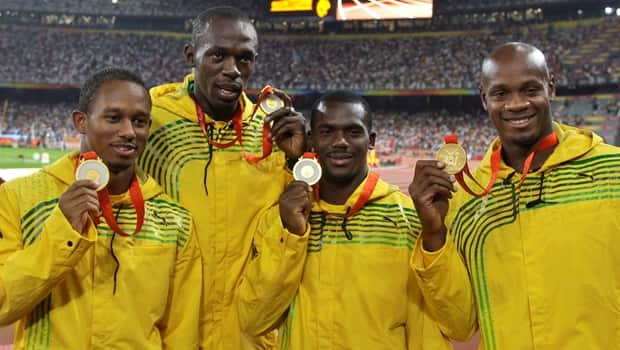
Usain Bolt loses 2008 Olympic relay gold after Nesta Carter's positive test

Usain Bolt has lost one of his nine Olympic gold medals in a doping case involving teammate Nesta Carter.
The IOC said Wednesday that Carter tested positive for methylhexaneamine, a banned stimulant, in re-analysis of samples from the 2008 Beijing Olympics.
Olympic rules state that the entire relay team can be disqualified and stripped of medals if one runner fails a doping test.
Carter and Bolt were teammates on the winning 4x100-metre team, which set a world record of 37.10 seconds. Carter ran the opening leg, and Bolt took the baton third in a team that also included Michael Frater and Asafa Powell.
"The Jamaican team is disqualified," the IOC said in a statement. "The corresponding medals, medallist pins and diplomas are withdrawn and shall be returned."
The relay title in Beijing completed the first of Bolt's gold medal sweeps in the 100, 200 and relay at three straight Olympics.

'This changes everything' 

The Canadian team of Pierre Browne, Anson Henry, Jared Connaughton, Hank Palmer — who finished sixth in the race — will now move into the top five.
"I hear I'm a fifth-place finisher now at the Olympics now," Henry, now a CBC Sports reporter, said on CBC News Network on Wednesday. "A couple of more positive [doping] tests and then I'll have a medal around my neck."
"But seriously, this changes everything", Henry continued. "[Carter] had a really good start in that race. We were right outside of Jamaica. He snuck up on Palmer really quickly. That changes [our] race. It changes our exchange. That changes my leg. Not to mention the rest of the teams."
According to Henry, the disqualification will cause a great deal of pain to the other sprinters. 
"Think about some of the things that are taken away from these [other] athletes," he said. "You see Richard Thompson with Trinidad and Tobago [crossing the finish line] in second place. Yeah, his team got a silver medal. But what better [way] than to cross the line [in first] for your country with your flag across your chest, arms raised, standing on the top of the podium? There were some other people that suffered because of this."
Media placeholder
CBC Sports' Anson Henry discusses downfall of Jamaican relay team6:15
Bolt set world record times for all three sprint titles at the Bird's Nest, establishing himself as the defining superstar of Olympic track.

Possible IAAF ban

Bolt and Carter will retain their gold medals from Jamaica's relay win at the 2012 London Olympics — in a record time of 36.84 seconds that stands today. Bolt ran the final leg on that team. He took the baton from Yohan Blake, who served a ban in 2009 for ingesting the same substance as Carter.
Carter and Bolt also helped lower their relay world record between the Olympic titles, taking gold at the 2011 world championships in Daegu, South Korea, in 37.04.
The 31-year-old Carter has teamed with Bolt on three straight world championship relay-winning teams, from 2011 through 2015. He also took an individual bronze in the 100 in 2013 in Moscow, behind Bolt and Justin Gatlin of the United States.
Carter, who did not compete at the Rio de Janeiro Olympics, faces a ban from the IAAF.
Trinidad and Tobago is in line to get the gold medal from 2008, Japan could be upgraded to silver, and fourth-place finisher Brazil could get the bronze medal.
Carter testified by video conference to an IOC disciplinary hearing held in Lausanne on Oct. 17.
The IOC's ruling states that Carter noted he was taking supplements in 2008 "advised in this respect by his coach, Mr. Stephen Francis."
"The athlete explained that he had given several samples for doping controls whilst he was taking Cell Tech and Nitro Tech before the 2008 Olympic Games and he had never tested positive for a prohibited substance," the detailed verdict stated.
"He therefore did not believe that these supplements could contain prohibited substances. He did not understand how methylhexaneamine could have been found in 2016."
Though methylhexaneamine was not specifically named on the 2008 list of prohibited substances, it "fell within the scope of the general prohibition of stimulants having a similar chemical structure or similar biological effect as the listed stimulants," the judging panel of three IOC members wrote.

Separate ruling 

The panel doubted if the supplements identified had caused the positive test given that Carter "used such supplements regularly and that this did not lead to other problems."
The runner cast doubt on his own ability to avoid doping rule violations. In a written statement to the IOC, "[Carter] asserted that he did not remember having received any formal anti-doping training in his career."
Carter can appeal the sanction to the Court of Arbitration for Sport. However, the IOC panel already anticipated one challenge in its written verdict.
"The Court of Arbitration for Sport ["CAS"] has confirmed that the presence or use of substances falling within the scope of generic definitions of the prohibited list, can be used as a basis of establishing anti-doping rules violations," the verdict said.
In a separate ruling Wednesday, another former Olympic champion was stripped of two silver medals from the Beijing Games.
The IOC said Russian athlete Tatiana Lebedeva tested positive for the anabolic steroid turinabol in re-tests, and would be disqualified from her runner-up placings in the long jump and triple jump.
Lebedeva won long jump gold at the 2004 Athens Olympics and also previously won Olympic silver and bronze in triple jump.

Sunday, January 22, 2017

Defeated Gambian leader Yahya Jammeh made off with government money, luxury cars

Exiled Gambian ruler Yahya Jammeh stole millions of dollars in his final weeks in power, plundering the state coffers and shipping out luxury vehicles by cargo plane, a special adviser for the new president said Sunday.
Meanwhile, a regional military force rolled in, greeted by cheers, to secure this tiny West African nation so that democratically elected President Adama Barrow could return home. He remained in neighbouring Senegal, where he took the oath of office Thursday because of concerns for his safety.
At a press conference in the Senegalese capital, Barrow's special adviser Mai Ahmad Fatty told journalists that the president "will return home as soon as possible.
Underscoring the challenges facing the new administration, Fatty confirmed that Jammeh made off with more than $11.4 million US during a two-week period alone. That is only what they have discovered so far since Jammeh and his family took an offer of exile after more than 22 years in power and departed late Saturday.
GAMBIA-POLITICS/
People celebrate the arrival of the regional ECOWAS force in Banjul, Gambia, on Sunday. The soldiers are clearing the way for newly elected President Adama Barrow to arrive. (Afolabi Sotunde/Reuters)

'Gambia is in financial distress'

"The Gambia is in financial distress. The coffers are virtually empty. That is a state of fact," Fatty said. "It has been confirmed by technicians in the ministry of finance and the Central Bank of the Gambia."
Fatty also confirmed that a Chadian cargo plane had transported luxury goods out of the country on Jammeh's behalf in his final hours in power, including an unknown number of vehicles.
'The coffers are virtually empty. That is a state of fact.'- Mai Ahmad Fatty, presidential adviser 
Fatty said officials at the Gambia airport have been ordered not to allow any of Jammeh's belongings to leave. Separately, it appeared that some of his goods remained in Guinea, where Jammeh and his closest allies stopped on their flight into exile.
Fatty said officials "regret the situation," but it appeared that the major damage had been done, leaving the new government with little recourse to recoup the funds.

Exiled in Equatorial Guinea

The unpredictable Jammeh, known for startling declarations like his claim that bananas and herbal rubs could cure AIDS, went into exile under mounting international pressure, with a wave to supporters as soldiers wept. He is now in Equatorial Guinea, home to Africa's longest-serving ruler and not a state party to the International Criminal Court.
Jammeh's dramatic about-face on his December election loss to Barrow, at first conceding and then challenging the vote, appeared to be the final straw for the international community, which had been alarmed by his moves in recent years to declare an Islamic republic and leave the Commonwealth and the ICC.
GAMBIA-POLITICS/EXILE
A security officer of former Gambian president Yahya Jammeh cries as he arrives at the airport before flying into exile from Gambia on Saturday. The new administration says he left government coffers empty when he took off. (Thierry Gouegnon/Reuters)
Barrow's adviser disavowed a joint declaration issued after Jammeh's departure by the United Nations, African Union and the Economic Community Of West African States (ECOWAS) that bestowed a number of protections upon Jammeh, his family and his associates — including the assurance that their lawful assets would not be seized.
"As far as we're concerned, it doesn't exist," Fatty said.
The declaration also said Jammeh's exile was "temporary" and that he reserved the right to return to Gambia at the time of his choosing.
Although the declaration was written to provide Jammeh with maximum protection, it doesn't give him amnesty, according to international human rights lawyer Reed Brody.
"Under international law in fact you can't amnesty certain crimes like torture and massive or systematic political killings," he said in an email. "Depending where Jammeh ends up, though, the real obstacles to holding him accountable will be political."

Clearing the way for Barrow

Barrow will now begin forming a cabinet and working with Gambia's national assembly to reverse the state of emergency Jammeh declared in his final days in power, said Halifa Sallah, spokesman for the coalition backing the new leader.
The president's official residence, State House, needs to be cleared of any possible hazards before Barrow arrives, Sallah added.
GAMBIA-POLITICS/
Members of the regional ECOWAS force are seen at the Denton Bridge check point in Banjul. Gambia's defence chief said he welcomes the West African soldiers 'wholeheartedly.' (Thierry Gouegnon/Reuters)
The regional military force that had been poised to force out Jammeh if diplomatic efforts failed rolled into Gambia's capital, Banjul, on Sunday night to secure it for Barrow's arrival.
Hundreds greeted the force's approach to State House, cheering and dancing, while some people grabbed soldiers to take selfies.

Truth and reconciliation 

With Jammeh gone, a country that had waited in silence during the crisis sprang back to life. Shops and restaurants opened, music played and people danced in the streets.
GAMBIA-DAILYLIFE/
A woman selling tomatoes laughs in a market at Serekunda, Gambia, on Sunday. Since the exile of defeated leader Yahya Jammeh, people are returning to the country.
Defence chief Ousmane Badjie said the military welcomed the arrival of the regional force "wholeheartedly." With proper orders, he said, he would open the doors to the notorious prisons where rights groups say many who have disappeared over the years may be kept.
"We are going to show Barrow we are really armed forces with a difference, I swear to God," Badjie said. "I have the Qu'ran with me."
Some of the 45,000 people who had fled the tiny country during the crisis began to return. The nation of 1.9 million, which promotes itself to overseas tourists as "the Smiling Coast of Africa," has been a major source of migrants heading toward Europe because of the situation at home.
GAMBIA-POLITICS/Barrow, who has promised to reverse many of Jammeh's actions, told The Associated Press on Saturday he will launch a truth and reconciliation commission to investigate alleged human rights abuses of Jammeh's regime. Rights groups say those include arbitrary detentions, torture and even killing of opponents.
"After 22 years of fear, Gambians now have a unique opportunity to become a model for human rights in West Africa," Amnesty International's deputy director for West and Central Africa, Steve Cockburn, said in a statement Sunday.

Most Facebook hacks are done by friends, finds UBC survey

Want to keep your privacy protected? Keep your eyes on your friends.
A study conducted by Wali Ahmed Usmani, a master’s student at University of British Columbia found that those who you trust the most are the most likely to hack their way into your Facebook account.
The study, which was conducted between from February and March of 2016, looked to find out how common attacks on privacy are, who is most likely to be victimized, who is most likely to attack, why these attacks happen, what the damage is, and how one could possibly protect themselves.
1,308 adult Facebook users, 59% male and 41% female from the United States filled out surveys that included questions asking if they had someone use a device of theirs to access their own Facebook account without their permission, and if they had ever used someone else’s device to access that person’s Facebook account without permission.
“It’s clearly a widespread practice. Facebook private messages, pictures or videos are easy targets when the account owner is already logged on and has left their computer or mobile open for viewing,” said Usmani to ubc.ca.
The survey found that 24% of the group had accessed someone’s personal Facebook account without that person’s permission, and 21% had their Facebook’s violated. Reasons for the insider attacks ranged from practical jokes to invading privacy and reading a person’s messages, or in some circumstances malicious attacks on peoples’ friends using that person’s identity, or even deleting everything off their accounts. A lot of those who told their stores reported a lasting feeling of mistrust, ruined relationships, and embarrassment.
“A sizable fraction of Facebook users seem to have been involved in instances of social insider attacks. The high prevalence of attacks demonstrates a need for effective mechanisms to detect and report these attacks to account owners,” reads the report.
There are multiple ways to protect yourself from outside attacks, such as adding an authenticator, changing passwords often, and ensuring you don’t tell anyone your information. But the inside attacks are a much different animal, the only sure defense is to log out of your Facebook after every use on your devices.
Others made sure to make sure their devices were locked after use and making sure no one know the passwords for their devices.
But having to re-enter my Facebook password every time I wanted to simply scroll through my news feed for a bit (which I do very often throughout the day) or just send a few quick messages would get very tiresome. Researchers involved with the study suggested a passive log that would show how long was spent browsing personal messages and other related information. This would help to discourage people with the possibility of getting caught.
“Jealous snoops generally plan their action and focus on personal messages, accessing the account for 15 minutes or longer and the consequences are significant: in many cases, snooping effectively ended the relationship.” said computer science professor Ivan Beschastnikh, who was a co-author of the report.

Friday, January 20, 2017

Apple sues Qualcomm over unfair licensing terms

Apple's latest lawsuit target? Qualcomm.
The iPhone maker on Friday filed suit against Qualcomm, alleging the wireless chipmaker didn't give fair licensing terms for its processor technology. Apple also said Qualcomm sought to punish it for cooperating in a South Korean investigation into Qualcomm's licensing practices by withholding a $1 billion rebate.
Apple wants a court to lower the amount it pays Qualcomm in licensing fees, as well as order the return of the $1 billion. The company said in its suit that Qualcomm should be paid royalties based on the value of its particular contribution, not for contributions from other patent holders. Currently, Qualcomm's royalties are based off the selling price of a phone, rather than what portion Qualcomm's technology enabled.
"For many years Qualcomm has unfairly insisted on charging royalties for technologies they have nothing to do with," Apple said in a statement. "The more Apple innovates with unique features such as TouchID, advanced displays, and cameras, to name just a few, the more money Qualcomm collects for no reason and the more expensive it becomes for Apple to fund these innovations."
Qualcomm, meanwhile, fired back at Apple's allegations, calling them "baseless." Don Rosenberg, Qualcomm executive vice president and general counsel, said in a statement:
Apple has intentionally mischaracterized our agreements and negotiations, as well as the enormity and value of the technology we have invented, contributed and shared with all mobile device makers through our licensing program. Apple has been actively encouraging regulatory attacks on Qualcomm's business in various jurisdictions around the world, as reflected in the recent [South Korean Fair Trade Commission] decision and FTC complaint, by misrepresenting facts and withholding information. We welcome the opportunity to have these meritless claims heard in court where we will be entitled to full discovery of Apple's practices and a robust examination of the merits.
Qualcomm is the world's biggest provider of mobile chips, and it created some of the essential standards for connecting phones to cellular networks. The company derives a significant portion of its revenue from licensing that technology to other chipmakers. Apple designs the processors in its iPhones and iPads, but it buys chips from Qualcomm to connect to 4G LTE and other cellular networks. Under Qualcomm's licensing structure, Apple pays it a fee for its chips and another fee for the intellectual property included in those chips. Most components suppliers bundle the IP cost in with the chip sales price.

For the iPhone 7 and 7 Plus introduced this year, Apple also started buying 4G LTE chips from another supplier, Intel. Because Intel's chips use some of Qualcomm's essential technology, Apple pays Qualcomm a licensing fee for those processors, as well, which is based off the total value of the iPhone ($650) versus the value of the Intel chip (closer to $20).
Apple says Qualcomm's practices are unfair, as are the clauses in Qualcomm's licensing terms that prevent Apple from seeking out other suppliers or participating in government inquiries into Qualcomm's practices.
In its heavily redacted complaint (PDF), the FTC said the patents Qualcomm held are standard-essential patents -- technology that is essential to the industry and must be licensed to competitors under fair, reasonable and nondiscriminatory terms (FRAND). But the complaint alleges that Qualcomm consistently refused to license some standard-essential patents to rival chipmakers, in violation of its FRAND commitments.
Qualcomm said in response to the FTC complaint earlier this week that it "has never withheld or threatened to withhold chip supply in order to obtain agreement to unfair or unreasonable licensing terms."
Apple, meanwhile, has been involved in plenty of litigation of its own. The company faced off against Samsung at the Supreme Court in October over a design patent case. Ironically, at issue in that suit was whether Samsung had to pay damages based on the entire value of its infringing phones or only on the portion that infringed. The Supreme Court ultimately decided that damages don't have to be based on an entire device and sent the case back to the lower court.
Apple on Friday said Qualcomm charges it "at least five times more in payments than all the other cellular patent licensors we have agreements with combined." The company added that Qualcomm recently withheld nearly $1 billion in payments from Apple "as retaliation for responding truthfully to law enforcement agencies investigating them."
"Apple believes deeply in innovation and we have always been willing to pay fair and reasonable rates for patents we use," the company said in its statement. "We are extremely disappointed in the way Qualcomm is conducting its business with us and unfortunately after years of disagreement over what constitutes a fair and reasonable royalty we have no choice left but to turn to the courts."
Apple filed the lawsuit in federal district court in the Southern District of California, Qualcomm's backyard instead of Apple's home in Northern California. The company has asked for a jury trial.
Updated at 1:15 p.m. PT with additional details and Apple's comment.

Anti-Trump protesters clash with riot police in Washington

Protesters and an Associated Press photographer say police fired rubber projectiles at them during demonstrations against U.S. President Donald Trump in downtown Washington.
An AP photographer says he was hit three times by projectiles — once on his left shin and twice on his right — while covering demonstrations Friday.
A photo of a spent canister appears to show the bottom part of a "rubber sponge." The foam-nosed projectile is launched at high-speed by police as a form of less lethal force. 
District of Columbia police spokesman Dustin Sternbeck said police did not use rubber bullets but would not comment on whether they used rubber sponges. He said he will "gladly provide" a comprehensive after-action report once the demonstrations wrap up.
Demonstrations broke out across the U.S. as Trump was sworn in as America's 45th president on Friday.
Black-clad anarchists smashed windows and clashed with police in Washington, D.C., less than a kilometre from where Trump took the oath of office, smashing store and car windows and fighting with officers in riot gear who responded with pepper spray and stun grenades. Police said at least 200 people have been arrested. 
About 500 people, some wearing masks and kerchiefs over their faces, marched through the city's downtown, breaking the windows of a Bank of America branch, a McDonald's outlet and a Starbucks shop, all symbols of the American capitalist system. 
The crowd, which carried banners and at least one sign that read "Make Racists Afraid Again," largely dispersed after police responded in force. 
D.C. police said two uniformed officers sustained "minor injuries" in the altercations and that numerous arrests had been made and suspects charged with rioting. 
Shortly after, workers were on the scene cleaning up the broken windows and debris.  
In San Francisco, around 3,000 people staged a protest on the Golden Gate Bridge. Demonstrators say it was a symbol of love rather than an anti-Trump event and held hands as a show of unity. Eight people were arrested.
Hundreds gathered in Houston where immigrant communities and labour groups came together and marched through downtown after gathering in Sesquicentennial Park. Organizers described the event, attended by a range of groups including interfaith Justice Coalition and Planned Parenthood, as "the start of the resistance movement" to keep communities safe, free and thriving.
Similarly, hundreds gathered in Denver and Phoenix carrying anti-Trump signs. Both were peaceful and didn't result in any arrests.

Protests around the world

On his inauguration day, Trump faced protests not just at home but in cities from Toronto to Sydney, Addis Ababa and Dublin over his politics, which critics say are divisive and dangerous.
​Protesters in Montreal burned an American flag and an effigy of Trump in the first of several planned demonstrations against the new U.S. president.
About 200 people marched through downtown, waving signs and chanting slogans, most commonly "No Trump, No Hate, America was Never Great!"
They stopped outside the offices of the U.S. Consulate, where they set fire to a cardboard replica of Trump as a dozen police officers guarded the door.
Organizer Nicole LeBlanc said despite the focus on Trump, the protest was less about him than the values he stands for.
"We want to start a conversation about the fact that the sexist, anti-immigrant, Islamophobic, xenophobic policies that Trump represents are not just limited to Trump," she said. "There are far-right groups with very similar policies operating here in Quebec."
A lone Trump supporter who showed up wearing a shirt reading "Hillary for Prison" was chased and knocked to the ground before police intervened.

'Build bridges not walls'

A banner reading "Build Bridges Not Walls" was draped across London's Tower Bridge Friday. Protesters on the iconic bridge held up pink letters reading  "Act Now!" soon after sunrise, while others unfurled the banner over the railings and a speedboat with a black flag reading "Build Bridges Not Walls" raced down the River Thames. 
The protest in London was organized by the campaign group also called Bridges not Walls, in reference to Trump's pledge to build a wall on the Mexican border. 
Hundreds marched in Madrid, making their way the city's Opera House to the emblematic Sol Square, waving placards calling Trump a racist and homophobic, and hundreds more gathered in protest in central Brussels, lighting candles in defence of women's rights in the bitter cold on Friday evening.
​"It's as important as anything is important, to have respect for everyone. Because women are oppressed and have been oppressed and will continue to be oppressed unless we do something about it," said U.S. citizen David Berstein, who lives in the Belgian capital.
Along with demonstrations in other parts of Europe, protests erupted in Latin American countries including Bolivia, Peru and Mexico.
Massive protest actions against Trump — including a Women's March on Washington — are planned for Saturday and are expected to draw more than a hundred thousand participants.
U.S. embassies and consulates in at least 10 countries in Asia, Europe and Latin America were warning of potentially violent protests through the weekend, as well. 
Security notices posted by U.S. diplomatic missions in Chile, Denmark, France, Greece, Haiti, Italy the Netherlands, Paraguay, Portugal and the Philippines advised American in those countries to steer clear of embassies and consulates on Friday and, in some cases, on Saturday and Sunday, due to the possibility of unrest and clashes with police.
The notices said the planned demonstrations are either focused on "U.S. politics" or are "inauguration-related."

'Great moment in history'

Ahead of the inauguration, Trump supporters flooded into the American capital, many sporting shirts and hats bearing his "Make America Great Again" campaign slogan. 
Carl Beams, 36, from Howell, New Jersey, stood in line with thousands of Trump supporters waiting to enter the National Mall to view the midday inauguration. 
"This is a great moment in history. I wanted to be able to say I was here first-hand," said Beams, who runs a martial-arts school. 

Mexican drug lord 'El Chapo' faces life sentence in U.S. prison

Mexican drug kingpin Joaquin "El Chapo" Guzman will spend the rest of his life in a U.S. prison if convicted on charges he ran the world's largest drug-trafficking organization during a decades-long criminal career, U.S. prosecutors said on Friday.
El Chapo (Shorty), once one of the world's most wanted drug lords, was set to appear at 2 p.m. ET in federal court in Brooklyn, N.Y., to be arraigned on 17 criminal counts, a day after his surprise extradition from Mexico.
The charges carry a mandatory minimum sentence of life in prison, Robert Capers, U.S. attorney for the Eastern District of New York, said at a news conference.
"Who is Chapo Guzman? In short, he's a man known for no other life but a life of crime, violence, death and destruction, and now he'll have to answer to that," Capers said.
Guzman, 59, arrived in a small jet at Long Island's MacArthur Airport after nightfall on Thursday from a prison in the city of Juarez in the northern state of Chihuahua, where his Sinaloa cartel rules.
A few hours earlier, he was bundled out of the Mexican cell block with his hands cuffed above his bowed head, Mexican television footage showed.
Guzman is charged in six separate U.S. indictments. He is accused of money laundering and drug trafficking, kidnapping and murder in Chicago, Ill., Miami, Fla., New York and other cities.

More than 40 witnesses

Federal prosecutors in Brooklyn, N.Y., have more than 40 witnesses ready to testify against Guzman, Capers told reporters, adding that the trial will likely last "many" weeks.
U.S. prosecutors gave assurances to Mexican officials that they would not seek the death penalty in order to secure his extradition, Capers said. Mexico opposes capital punishment.
One of Guzman's lawyers was surprised at the extradition, saying that four appeals in Mexico were outstanding to stop it.
U.S. authorities did not have much notice, either, although they had long planned for Guzman's arrival, Justice Department official Kenneth Blanco said at the news conference. "We were notified yesterday that he would be on his way," he said.
Leading the Sinaloa cartel, Guzman oversaw perhaps the world's largest transnational cocaine, heroin and methamphetamine smuggling operation, playing a key role in Mexico's decade-long drug war that has killed over 100,000 people.
"Guzman and the Sinaloa cartel had a veritable army, ready to war with competitors and anyone Guzman deemed to be a traitor," U.S. prosecutors said. He was known to carry a gold-plated AK-47 rifle.

$14 billion in drug proceeds and profits

The indictment of Guzman seeks to recover more than $14 billion in drug proceeds and illicit profits.
"We can't say how much we have eyes on or how much we'll recover but what we do know is that the government will be vigilant in trying to recover as much of those assets as we can," Capers said.
The extradition came on the eve of Donald Trump's inauguration, a coincidence that some officials said was an olive branch to the incoming president who declared he would kick Guzman's "ass" on taking office.
The Mexican attorney general's office rejected claims the move was related to Trump's swearing-in, noting that Guzman faces 10 pending cases in Mexico following his U.S. sentence.
He was captured a year ago after he had fled a high-security penitentiary in central Mexico through a mile-long tunnel, his second dramatic prison escape.
U.S. authorities, citing security concerns, declined to say where he would be held while awaiting trial, but they vowed to prevent any further escapes.
"I assure you, no tunnel will be built leading to his bathroom," Special Agent In Charge Angel Melendez of U.S. Homeland Security Investigations said at the news conference.
Melendez said he was present when Guzman deplaned in Long Island.
"As you looked into his eyes you could see the surprise, you could see the shock, and to a certain extent you could actually see the fear as the realization started to kick in that he's about to face American justice," he said. 

Wednesday, January 18, 2017

YouTube is testing in-app messaging to take on Facebook

Google-owned video platform is currently testing a new in-app messaging feature on iOS and Android that will allow users to exchange clips, texts and links without ever having to leave the app. 
But there’s one catch: The functionality is solely available in Canada for the time being. Google product manager Shimrit Ben Yair told Canada’s Financial Post the decision to run trials on Canadian soil has to do with the fact that it’s the country that shares videos more than anyone else in the world.
The messaging platform is pretty straightforward and has no specific video-centric features. Still, the move towards in-app messaging could have much larger implications for the future of YouTube.
A few months back, Google toyed around with the idea of giving certain channels the option to send direct messages to their audience. It also briefly tested with in-app messaging last year in May.
The move was likely aimed at encouraging creators and fans to interact more on YouTube itself, rather than resorting to other platforms like Facebook, Twitter and Reddit.
While it’s unclear whether Google has any plans to roll out the feature to all users in the future, the experiment is a strong indication that the company hasn’t quite given up on turning YouTube into more of a social network.
In case you want to sneak a peek at YouTube’s new messaging feature, get one of your Canadian friends to add you to a conversation – that should give you an early preview.

Sleeping man wakened by heat and flames from Samsung S5 phone

A Toronto man says he woke up to "massive flames shooting out the sides" of his Samsung S5 phone on Tuesday morning.
Mario Jakab went to bed around midnight on Tuesday, and woke up from the heat and firework-like sounds coming from his bedside table. 
"I jumped out of bed, alerted my girlfriend because I wasn't sure if anything was going to catch fire," said Jakab. "I waited for the fire to go out, because I'm not touching a flame."
In a statement to CBC Toronto, a spokesperson for Samsung said customer safety was their highest priority. 
"Upon being made aware of the reported incident we began working with Mr. Jakab to investigate the matter. Until we have had an opportunity to analyze the phone we are unable to comment on the matter further."
'There were two-foot high flames pretty close to my face, shooting upwards.' - Mario Jakab
Samsung has recalled batteries on the Galaxy Note 7 models, after the devices started catching fire. The S5 model is not included in the recall. This appears to be one of the first reports of an S5 catching fire, though a lawsuit filed in the U.S. alleges the problem extends to several other smartphones.

Jakab said a Samsung engineer picked up his device on Wednesday morning. When asked if he had modified the phone, he told them the battery and charging cable were all originals that came with the phone he bought in 2014. 
"I couldn't pick up my phone or take a video of what it was doing, or even call 911," he says.
Jakab doesn't want to think what might have happened if he didn't wake up, or if the phone was in his pocket.
He wants people to learn from what happened to him and protect themselves, but said he would likely not change his own habits when it comes to charging his phone at night. 
He also worries about children playing with Samsung phones.
"Just a battery heating up can burn a young child's hands, just from holding it," he said. "Apparently they're not toys, like we thought they were."