Showing posts with label lawyers. Show all posts

Saturday, January 28, 2017

Mark Zuckerberg Says He’s Not Running For President

Mark Zuckerberg has no plans to run for president, the Facebook founder and CEO told BuzzFeed News Tuesday.
"No," Zuckerberg wrote in response to a question about his intent to run. "I'm focused on building our community at Facebook and working on the Chan Zuckerberg Initiative," referring to the limited-liability corporation he and his wife, Priscilla Chan, founded in 2015 to advance human potential and promoting equality through major bets in education and science research. Zuckerberg did not immediately respond to follow-up questions about whether he'd explicitly ruled out a run.
Zuckerberg's response comes after weeks of speculation from the tech press and beyond, set off by a series of events that indicated a run might be in the cards, including a pledge to visit the approximately 30 US states he hadn't yet been to. "Will Mark Zuckerberg Be Our Next President?" Vanity Fair asked in January.

"There's absolutely no truth to the idea that Mark is running for office and I've heard it directly from him," the source told BuzzFeed News. "Here's the thing: For Mark, Facebook is global community that already plays this huge part in the lives of billions of people around the world and plays an incredibly important role in shaping the base on the issues that matter."
Zuckerberg is preparing for a political battle, the source was careful to emphasize, but as a private citizen focused on the goals he has already outlined through the Chan Zuckerberg Initiative. "There is absolutely a possibility that Mark may choose to play a stronger role in the political system and political debates," the source said. Zuckerberg has been "very transparent" in his advocacy for "greater equality and optimizing research that find cures for disease and solves the fundamental problems of our time, but I really don't see him stepping away from Facebook."
Last week, Zuckerberg announced that he had poached Uber executive David Plouffe, a former campaign manager for Barack Obama, as CZI's president of policy and advocacy. He also tapped Ken Mehlman, George W. Bush's former campaign manager, in an advisory role. "You can make change, but in order for it to be sustainable, you need to build a movement to support it," Zuckerberg told The New York Times.
Calling for a movement, backed by bipartisan political operatives, sounds awfully presidential, but Zuckerberg used the same language when he first launched CZI in December, 2015.
The stock restructuring deal ties back to CZI as well. The changes were made after Zuckerberg and Chan donated 99 percent of their Facebook shares, then worth roughly $45 billion, to CZI. In order retain control while he gave away equity, Zuckerberg introduced a new class of stock and revised rules, including a concession that "serving in a government position or office," for two years would not constitute a voluntary resignation.
Success in business doesn't necessarily guarantee success at the polls. . "First thing is these people should not be running for office," Bradley Tusk, an Uber advisor and investor, who also managed Michael Bloomberg's 2009 mayoral campaign, told BuzzFeed Newsduring a conversation about the increasingly political role played by Silicon Valley leaders. "It worked for Mike [Bloomberg] because of 9/11. If you look at the history of rich people from business or tech running for office, they almost always lose. That personality type is very different from running a company. The reality is if you're Mark, with your wealth and platform," you're better off as CEO of Facebook than President, he said.
Tusk also pointed out that direct political engagement has not been as successful for Zuckerberg in the past. "Look at Fwd.us. How much money did those guys get taken for? And they accomplished nothing," he said, referring to Zuckerberg's ill-conceived immigration advocacy group. "They are better off using their strengths and their skills," than jumping directly into the political arena, Tusk said.

Thursday, January 26, 2017

SpaceX and Lockheed CEOs meet with Donald Trump

Lockheed Martin CEO Marillyn Hewson and SpaceX CEO Elon Musk were among a dozen business leaders who met with the president to discuss manufacturing and related issues.
Trump said he would seek to keep manufacturing jobs in the United States and cut down on regulations.

Wednesday, January 25, 2017

Google offers a glimpse into its fight against fake news

In the waning months of 2016, two of the world's biggest tech companies decided they would do their part to curb the spread of hoaxes and misinformation on their platforms — by this point, widely referred to under the umbrella of "fake news."
Facebook and Google announced they would explicitly ban fake news publishers from using their advertising networks to make money, while Facebook later announced additional efforts to flag and fact-check suspicious news stories in users' feeds.
How successful have these efforts been? Neither company will say much — but Google, at least, has offered a glimpse.
In a report released today, Google says that its advertising team reviewed 550 sites it suspected of serving misleading content from November to December last year.
Of those 550 sites, Google took action against 340 of them for violating its advertising policies.
"When we say 'take action' that basically means, this is a site that historically was working with Google and our Adsense products to show ads, and now we're no longer allowing our ad systems to support that content," said Scott Spencer, Google's director of product management for sustainable ads in an interview.
Nearly 200 publishers — that is, the site operators themselves — were also removed from Google's AdSense network permanently, the company said.
Not all of the offenders were caught violating the company's new policy specifically addressing misrepresentation; some may have run afoul of other existing policies.
In total, Google says, it took down 1.7 billion ads in violation of its policies in 2016.

Questions remain

No additional information is contained within the report — an annual review of bad advertising practices that Google dealt with last year.
In both an interview and a followup email, Google declined to name any of the publishers that had violated its policies or been permanently removed from its network. Nor could Google say how much money it had withheld from publishers of fake news, or how much money some of its highest-grossing offenders made. 
Some fake news site operators have boasted of making thousands of dollars a month in revenue from advertising displayed on their sites.
"There's no way to know. We take action against sites when they're identified and they violate our policies," Spencer said. "It's not like I can really extrapolate the number."The sites reviewed by Google also represent a very brief snapshot in time — the aftermath of the U.S. presidential election — and Spencer was unable to say how previous months in the year might have compared.

A bigger issue

Companies such as Google are only part of the picture. 
That, however, is easier said than done. Often, advertisers don't know all of the sites on which their ads run — making it difficult to weed out sites designed to serve misinformation. And even if they are able to maintain a partial list of offending sites, "there's no blacklist that's going to be able to keep up with fake news," Bidel said, when publishers can quickly create new sites.
Until advertisers have more insight into where their ads run, Bidel said, it's left to advertising platforms such as Google and Facebook to weed out offending sites.
In an email, Facebook declined to answer specific questions on its efforts — specifically, how many fake news publishers it has suspended or taken action against, the names of publishers or the amount of revenue Facebook has withheld from publishers of fake news.
Instead, the company provided a statement, attributed to an unnamed spokesperson: "It is still early days, but we're looking forward to learning and continuing to roll this out more broadly soon" — "this" referring to its previously announced tools and efforts to address fake news.
"I always say the bad guys with algorithms are going to be one step ahead of the good guys with algorithms," Bidel said. "I don't know that you're ever going to be able to eradicate this form of fraud, or any other form of fraud. But it can be brought to some acceptable level — and that level needs to be determined by the industry."

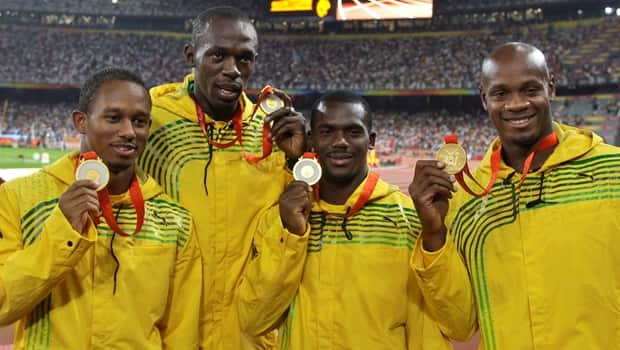
Usain Bolt loses 2008 Olympic relay gold after Nesta Carter's positive test

Usain Bolt has lost one of his nine Olympic gold medals in a doping case involving teammate Nesta Carter.
The IOC said Wednesday that Carter tested positive for methylhexaneamine, a banned stimulant, in re-analysis of samples from the 2008 Beijing Olympics.
Olympic rules state that the entire relay team can be disqualified and stripped of medals if one runner fails a doping test.
Carter and Bolt were teammates on the winning 4x100-metre team, which set a world record of 37.10 seconds. Carter ran the opening leg, and Bolt took the baton third in a team that also included Michael Frater and Asafa Powell.
"The Jamaican team is disqualified," the IOC said in a statement. "The corresponding medals, medallist pins and diplomas are withdrawn and shall be returned."
The relay title in Beijing completed the first of Bolt's gold medal sweeps in the 100, 200 and relay at three straight Olympics.

'This changes everything' 

The Canadian team of Pierre Browne, Anson Henry, Jared Connaughton, Hank Palmer — who finished sixth in the race — will now move into the top five.
"I hear I'm a fifth-place finisher now at the Olympics now," Henry, now a CBC Sports reporter, said on CBC News Network on Wednesday. "A couple of more positive [doping] tests and then I'll have a medal around my neck."
"But seriously, this changes everything", Henry continued. "[Carter] had a really good start in that race. We were right outside of Jamaica. He snuck up on Palmer really quickly. That changes [our] race. It changes our exchange. That changes my leg. Not to mention the rest of the teams."
According to Henry, the disqualification will cause a great deal of pain to the other sprinters. 
"Think about some of the things that are taken away from these [other] athletes," he said. "You see Richard Thompson with Trinidad and Tobago [crossing the finish line] in second place. Yeah, his team got a silver medal. But what better [way] than to cross the line [in first] for your country with your flag across your chest, arms raised, standing on the top of the podium? There were some other people that suffered because of this."
Media placeholder
CBC Sports' Anson Henry discusses downfall of Jamaican relay team6:15
Bolt set world record times for all three sprint titles at the Bird's Nest, establishing himself as the defining superstar of Olympic track.

Possible IAAF ban

Bolt and Carter will retain their gold medals from Jamaica's relay win at the 2012 London Olympics — in a record time of 36.84 seconds that stands today. Bolt ran the final leg on that team. He took the baton from Yohan Blake, who served a ban in 2009 for ingesting the same substance as Carter.
Carter and Bolt also helped lower their relay world record between the Olympic titles, taking gold at the 2011 world championships in Daegu, South Korea, in 37.04.
The 31-year-old Carter has teamed with Bolt on three straight world championship relay-winning teams, from 2011 through 2015. He also took an individual bronze in the 100 in 2013 in Moscow, behind Bolt and Justin Gatlin of the United States.
Carter, who did not compete at the Rio de Janeiro Olympics, faces a ban from the IAAF.
Trinidad and Tobago is in line to get the gold medal from 2008, Japan could be upgraded to silver, and fourth-place finisher Brazil could get the bronze medal.
Carter testified by video conference to an IOC disciplinary hearing held in Lausanne on Oct. 17.
The IOC's ruling states that Carter noted he was taking supplements in 2008 "advised in this respect by his coach, Mr. Stephen Francis."
"The athlete explained that he had given several samples for doping controls whilst he was taking Cell Tech and Nitro Tech before the 2008 Olympic Games and he had never tested positive for a prohibited substance," the detailed verdict stated.
"He therefore did not believe that these supplements could contain prohibited substances. He did not understand how methylhexaneamine could have been found in 2016."
Though methylhexaneamine was not specifically named on the 2008 list of prohibited substances, it "fell within the scope of the general prohibition of stimulants having a similar chemical structure or similar biological effect as the listed stimulants," the judging panel of three IOC members wrote.

Separate ruling 

The panel doubted if the supplements identified had caused the positive test given that Carter "used such supplements regularly and that this did not lead to other problems."
The runner cast doubt on his own ability to avoid doping rule violations. In a written statement to the IOC, "[Carter] asserted that he did not remember having received any formal anti-doping training in his career."
Carter can appeal the sanction to the Court of Arbitration for Sport. However, the IOC panel already anticipated one challenge in its written verdict.
"The Court of Arbitration for Sport ["CAS"] has confirmed that the presence or use of substances falling within the scope of generic definitions of the prohibited list, can be used as a basis of establishing anti-doping rules violations," the verdict said.
In a separate ruling Wednesday, another former Olympic champion was stripped of two silver medals from the Beijing Games.
The IOC said Russian athlete Tatiana Lebedeva tested positive for the anabolic steroid turinabol in re-tests, and would be disqualified from her runner-up placings in the long jump and triple jump.
Lebedeva won long jump gold at the 2004 Athens Olympics and also previously won Olympic silver and bronze in triple jump.

Saturday, January 21, 2017

LG G6 will have Google Assistant built-in, rumor says

Samsung's Galaxy S8 has long been rumored to feature a revamped virtual assistant called Bixby, and LG's G6 can't afford not to play the AI game. A new rumor out of both companies' home country of South Korea now claims that LG has done something that's pretty surprising in the Android world.
Instead of building its own sub-par virtual assistant, LG has apparently turned to Google for help. As such, the G6 will come with the Google Assistant built-in. Previously, the Google Assistant was exclusive to Google's own Pixel and Pixel XL smartphones (at least in the form that's integrated into the Android system, since it also lives in the Allo chat app and the Google Home device).
The Google Assistant is also an integral part of the upcoming Android Wear 2.0 release, which will be running on the LG Watch Sport and Watch Style, the first wearables to have the new OS version on board. These were co-developed with Google in a program not dissimilar to what the Nexus line used to be for smartphones. The two smartwatches will be unveiled on February 9, it's been rumored.
The LG G6 will be made official on February 26 at MWC in Barcelona. It's reportedly going to become available in early March, beating the Galaxy S8 to the market by about a month.

Monday, December 12, 2016

Oil rallies as OPEC, rivals reach first output deal since 2001

Oil rose Monday to an 18-month high after OPEC and some of its rivals reached their first deal since 2001 to jointly reduce output to try to tackle global oversupply.
On Saturday, producers from outside the Organization of the Petroleum Exporting Countries, led by Russia, agreed to reduce output by 558,000 bpd, short of the target of 600,000 bpd but still the largest contribution by non-OPEC ever.
That followed the Nov. 30 deal by OPEC to cut output by 1.2 million bpd for six months from Jan. 1, with top exporter Saudi Arabia cutting around 486,000 bpd to curb the supply glut that has dogged markets for two years.
Brent crude futures were up $1.33, or 2.5 percent, at $55.66 per barrel, having hit a session peak of $57.89, the highest since July 2015.
U.S. crude futures settled up $1.33, or 2.6 percent, at $52.83 a barrel. They earlier touched $54.51, also a high going back to July 2015.
"Right now the market is kind of feeding on itself," said Gene McGillian, manager of market research at Tradition Energy in Stamford, Connecticut.
"The market could push another $1 to $2 up to $55, and Brent could go to about $60, but at that point there are some concerns that are going to start to cap the rally."
For the deal to be effective, all parties must stick to their word. Higher prices also raise the chances of other producers boosting output, particularly U.S. shale operators, where rig counts have grown steadily in recent months. U.S. production remains about one million bpd below its peak of 9.6 million reached in 2015, according to U.S. Energy Department data.
PVM Oil Associates strategist David Hufton noted that "as things stand today, no cuts have been made and production is in fact still rising." He said it was difficult to "justify the front-end price surge other than that is where the liquidity is and where speculative players, moving in herds, always prefer to place their bets."

Friday, October 14, 2016

North Dakota Oil Production Hits two years low

Rail shipments of petroleum from Midwestern oil fields to East Coast refineries have plummeted as North Dakota’s oil production has fallen to a two-year low.
Production dropped below 1 million barrels per day for the first time in more than two years, officials said Thursday — yet another reminder that the drilling boom is over in the country's No. 2 oil state due to the slump in world oil prices.
The state produced an average of 981,039 barrels of oil daily in August, down from 1.029 million in July, the state Department of Mineral Resources said. Oil production numbers typically lag at least two months.
Those numbers are reflected in the crude shipment data collected by the U.S. Energy Information Administration, which show rail shipments from the Midwestern region were down 49 percent from the previous year in July.
Shipments from the Midwest to the East Coast — which represent more than half of the region’s production and move over rail lines crossing Minnesota and Wisconsin — were down by similar numbers.
The 5.4 million barrels that traveled to East Coast refineries in July was even 15 percent lower than in July 2013 when production was on the rise. That works out to fewer than three trains per day, about half the number that railroads reported to state officials in 2014.
East Coast shipments peaked in November 2014 at 13.8 million barrels, according to the EIA.

Tuesday, October 11, 2016

UBER confident that British Columbia will allow ride sharing in the Province

A senior adviser to Uber says he’s confident the B.C. government will allow the ride-sharing service to operate in the province – which is why the company hasn’t pushed its way in, as it has done in other jurisdictions.
Uber has launched in cities across Canada, often against the wishes of local governments, but has yet to enter British Columbia on a large scale.
Instead, despite briefly operating a limousine service in Vancouver in 2012, the company has heeded warnings to stay away as the province examines possible regulations.
“We’re confident that there will be a solution here in partnership with the government that embraces ride sharing – we remain committed to that,” said David Plouffe, a former campaign manager and special adviser to U.S. President Barack Obama who is now chief policy adviser at Uber.
“Our preference is that the government comes up with a solution that embraces ride sharing, and we’re confident that they will. This isn’t a problem for governments to solve. It’s an opportunity to be seized.”
But he said “the clock is ticking” on the issue given that about 200,000 British Columbians have downloaded the Uber app, signifying interest in the service.
Mr. Plouffe is to meet Wednesday with Premier Christy Clark, her office said, but he declined comment on what he would say to the Premier.
He said he was hoping for some policy decisions from the government before the Christmas holidays.
But TransLink Minister Peter Fassbender, who has a key role in the government’s review of ride sharing in advance of any possible legislation, appeared to rule that out Tuesday.
At best, he said, the government might disclose a position on ride sharing by the end of the year after consultation with stakeholders.
“It will be in a form and with sufficient clarity that everyone will know what potential changes could be made,” Mr. Fassbender said.
“It will be clear where government intends to go.”
Uber has been pressuring the province to act, issuing an open letter calling for government action, holding information sessions for prospective drivers and inviting potential customers to sign petitions and voice their support on social media.
Mr. Fassbender said the government won’t be rushed by the company’s campaign.
“They are very aggressive and very committed,” he said.
“They have done a lot of things, run a lot of ads, tried every tool they could to try and force us to move faster than we were prepared to move. We resisted that pressure.”
The government issued a report last month summing up consultations with stakeholders.
Mr. Fassbender said the intent is to honour the existing taxi industry, level the playing field between that industry and ride-sharing companies and protect the public interest.
Mr. Plouffe rejected the suggestion that Uber is overly zealous.
“I don’t think we’re pushy here. Whether it’s Toronto, Ottawa, Edmonton or almost all of India, South America, people are enjoying ride sharing now. I think the urgency is there,” he said.
“This debate has largely been settled in most parts of the world, including most parts of Canada.”
He said Vancouver is the largest city on the continent without ride sharing.
He declined to say exactly how Uber would move into B.C. if given a green light, saying he did not want to give away business secrets.
However, he said it was clear where the demand is – both as a transit option and as a source of income for drivers.
“The outlying cities and towns are really an important part of the discussion because those folks have fewer transportation options to come into the city of Vancouver.”

After Hurricane Matthew, Floodwaters Rise To Record Levels In North Carolina

When Hurricane Matthew lost strength and headed out to sea over the weekend, the storm took its high winds and driving rains with it.
But it left behind water — from the record rains that fell during its trip up the southeastern U.S. coast. And particularly in North Carolina, the long-gone storm has continued to threaten lives as floodwaters rise, sometimes to record levels, flowing over the banks of rivers and threatening dams.
More than half of those deaths occurred in North Carolina, where rescue operations are still underway.The hurricane killed hundreds of people in Haiti and elsewhere in the Caribbean, and more than two-dozen people in the U.S. have died as a result of the storm, The Associated Press reports.
Early forecasts had predicted that Hurricane Matthew would turn out to sea before causing much damage in North Carolina. But the storm stayed along the U.S. coast for longer than expected, making landfall in South Carolina and bringing torrential rains to both the Carolinas.
A "serious inland flooding event" began immediately, according to the National Hurricane Center, and the consequences are still unfolding as the rainwater flows downriver.
On Monday, volunteers, U.S. marshals and water-rescue crews used helicopters, boats and massive trucks to save people stranded in Lumberton, N.C., after the Lumber River burst its banks, the AP says.
Sean Rayford/Getty Images
"The rescue teams were expected to be back at work across eastern North Carolina on Tuesday as the deluge rolled downstream toward the Atlantic Ocean," the wire service writes. "At least three rivers were forecast to reach record levels, some not cresting until Friday."
On Monday night, President Obama signed a disaster declaration to make federal funds available to help North Carolina cope with the flooding, the AP says.
Jay Price of member station WUNC got a close look at the floods in Lumberton on Monday. He told NPR that he has seen places where the floodwaters were topping the roofs of cars. "You're dealing with just massive amounts of water," he said.
"The weather's great — picture perfect, in fact," he said. "It's kind of startling."In what he called an "ironic juxtaposition," the sun came out and it was bright and clear in the storm-stricken towns.
The crisis is far from over. In some cases, the floodwaters aren't expected to crest until Friday.
"Nobody quite knows how bad it's going to be in some of these communities, but they know it's going to be at or close to record levels," Price says.
A building is inundated with floodwaters in Lumberton on Monday. Record floodwaters were rising in some areas of North Carolina.
Sean Rayford/Getty Images
He notes that Matthew brought "huge amounts" of rain, topping 15 inches in some areas. And that rain fell on already saturated ground.
"The water just has nowhere to go," he said. "When I drove in, I was for miles and miles nowhere near any river.
Meanwhile, hundreds of thousands of customers across the South still didn't have electricity. The lights went out for millions of people and businesses after Matthew arrived on the coast. In some cases, it will take weeks to get the power back on, utilities say."It's just rising everywhere," Price said.

Friday, October 24, 2014

Real Madrid Vs. Barcelona

All eyes will be on Luis Suarez on Saturday as the striker makes his Barcelona debut at Real Madrid.
El Clasico between Barca and Real Madrid has always been the biggest event on the Primera Division calendar but Suarez's return from his four-month ban for biting Giorgio Chiellini at last summer's World Cup adds extra spice to an already highly-anticipated encounter.
Luis Enrique now has a decision to make as to whether he starts his marquee signing on the bench or goes with a three-pronged attack with Suarez, Neymar and Lionel Messi.
But the Barca coach has confirmed that Suarez will feature.
"Today I cannot play this game but you will have assurance he will play minutes," he told Spanish media at his pre-match press conference. "How many? I do not know."It's an important occasion for him and he will have minutes."
The head coach is highly unlikely to split the Argentinian and the Brazilian, who have scored 13 goals between them in the last five games and opposite number Carlo Ancelotti is refusing to get distracted by Suarez's potential debut.
When asked by Spanish radio station Cadena SER if he had a particular plan for facing the former Liverpool man, Ancelotti simply replied: "No, I do not know who will play on Saturday."
While Suarez is in line to play his first El Clasico, Barca midfielder Andres Iniesta is a veteran of such affairs and will make his 30th appearance in the fixture at the Bernabeu.
The Spain international will be the man expected to supply the service to his three prolific team-mates and he admits the entire squad is excited about Suarez's availability.
"He's happy to be available and the rest of us are happy about it too," he told a press conference. "We hope he performs as well as he has always done."
Away from the Luis Suarez show, Messi is on the brink of making Primera Division history as he sits just one goal behind Telmo Zarra's record of 251.
The Bernabeu would be the perfect place for the 27-year-old to break the record and Iniesta would be delighted to see him do it, if only because a Messi brace would mean things were going well in the game.
"I just want to see him get past the record, that'd be a good sign for us and mean we are in with a chance of winning," he said.
Barca currently sit at the top of the table, four points clear of Real who are third, and Iniesta is not losing focus on the task at hand amid all the hype surrounding the occasion.
"We will be going there with the intention of winning," he said. "It'd be a big mistake to think that we've got a four-point lead and even if we lose we'll still be top.
"We're just thinking about playing well, winning and stretching our lead in the table, which would be important, but not decisive at this stage of the season."
Luis Enrique has Sergio Busquests back in full training but he has not yet been given the all-clear by the medical staff to play.
James Rodriguez is set to play in his first El Clasico after starring against Liverpool in midweek and he has hailed the spirit in the camp ahead of the crunch clash.
"It will be a tough and complicated match," he told www.realmadrid.com.
"I want to approach it calmly, responsibly and also really be up for it, in order to help the team get the win.
"I'm in good form as is the whole squad. We have a strong group of players and are united, mentally speaking."
Rodriguez is set to keep his place with Isco being the man likely to drop out, with the potential return of Gareth Bale after Ancelotti admitted: "When well, Bale plays."
Ancelotti also revealed that Pepe is a doubt with a knock, but Sergio Ramos is in line to return, while Dani Carvajal could also take the place of Alvaro Arbeloa.
Cristiano Ronaldo, who has 13 career goals against Barcelona, will be looking to continue his run of having scored in every league game this season with 15 goals in seven games.

By AOL.

Thursday, September 18, 2014

The Scotland Independence Vote

With more than 50% of the votes taken in from the Scotland referendum in seems that the Scottish will support the "Yes," campaign. This will continue the British rule that has been going on for more than tree centuries.

Wednesday, September 17, 2014

New Apple devices include default kill switch

WASHINGTON - New Apple Inc phones include a theft deterrent system that enables users to lock their devices and wipe them clean of data if stolen, a victory for regulators who have long pushed the telecommunications industry to do more to stem theft.
The tool, known as a kill switch, will be standard on Apple's new iPhone 6 and iPhone 6 Plus devices and can be installed on previous models of iPhones starting Wednesday, according to an announcement from the office of New York Attorney General Eric Schneiderman.
Schneiderman has long fought alongside New York District Attorney George Gascón to convince device manufacturers to include the kill switch as a default setting on their devices.
"This is a game changer,” said Gascón. "This is a major development that will change behavior on the street and eventually turn around this violent epidemic."
The announcement marks the first time a kill switch is present as a default option on the iPhone.
In April, Apple was among 10 device makers to sign a voluntary agreement to make the feature available on new smartphones.
In 2012, 1.6 million Americans were victimized for their smartphones, according to Schneiderman's office.

Tuesday, September 16, 2014

Facebook Wants To Know If I Trust It

Last week, my email address and a very old email password appeared on a list of about five million compromised accounts that was leaked onto a Russian Bitcoin forum. I hadn't used that password in ages, and thought I was safe. As it turns outs, I was wrong.
My least-often used, but largest social media account, Facebook, still used this password. Some delightful resident of Indonesia decided to log into my account with it, but luckily, the security guards over at Facebook stopped the attempt and asked me to reset my password right away, via email. They also pressured me into activating two-step verification, which I am a big fan of, but had not turned on as I log into my Facebook account so infrequently.
I felt pretty good about Facebook. For a couple days at least.
Today, I decided to log back in and torture myself with some engagement photos or cat videos, and Facebook asked me if I'd like to take a survey. I love surveys so I took Facebook up on their offer:
Well, you did protect me from being hacked by a rogue Indonesian, so, sure, I am satisfied.
We don't know one another that well, Facebook. We had a thing back in high school and we were really close during prom, but we haven't talked much since then. I don't know you like that anymore; perhaps I never did.
I decided to dig a little deeper, so as not to dismiss a potentially caring and deep relationship with Facebook so quickly. I looked into which words Twitter thinks I use most often versus the words Facebook thinks I use most often.Clearly, I share the stories I write for The Wire across both platforms (link, written, interviews), but there's also a big difference in the kind of stories I share on Twitter (dolphin, sea, putin, kiev) and Facebook (death, police, interviews, ferguson.) Twitter is reserved for more light-hearted stories that I want to discuss with random Internet folk, whereas Facebook is for more serious matters that I prefer to discuss with friends. Facebook is also a bit outdated — I have written about Kiev more recently than about police officers or Ferguson.   Next, I looked at the ads I get on both networks. Facebook is trying to sell me shoes, phone cases ,and dresses. I don't actively post about any of those, but they are all generic to what my demographic is: 21-29, female, in a metropolitan city. I do like all of those things, but I am not compelled to click on any of their ads. Twitter, on the other hand, has me a little more figured out. A quick scroll down my timeline shows ads for a financial portfolio building firm I was researching for a story and Fanta, which I happen to love. It also makes sense, as I often tweet about my affection for Diet Coke.   With this method, I determined that Facebook, you certainly care about the ad dollars I can produce for you, and you care a lot about figuring out who I am, but you don't really know me . You care about the version of my profile that is most profitable. 
My first reaction is to click "Neither agree nor disagree." Sure, Facebook makes me feel creeped on and weird, but it hasn't actively violated my trust. It hasn't actively or consistently done anything to show it was trustworthy, either, besides this one time it protected my account from a hacker. Oh, right. That's why I got this survey at all. Because of that one hack that made me feel pretty okay about Facebook and want to start using it again. Facebook is skewing their own results with the timing of this survey. Of course their users are more likely to feel trusting of them right after the company protected them from a hack.
I decided to reach out to Facebook to learn a bit more about this strange timing and exactly what their plans were with my results. Would they show up in an investor report, used to prove to a board far more important than little old me that their mega company was very, very trustworthy? Would they become public? Well, I learned... absolutely nothing. I have no idea where that data is doing, or who inside (or outside) Facebook would be using it.
Notably, there is also no back button or the ability to change your answers:
So once you have said (well, multiple choice selected) your piece, Facebook wouldn't like to hear an updated opinion or second thought.
When the Washington Post's Brian Fung took a similar survey last year, Facebook told him, "We are constantly working to improve our service and getting regular feedback from the people who use it is an invaluable part of the process."
"Improve our service" could certainly mean "use this information in an internal investor report," meant to soothe those most invested in the company about their ability to be trustworthy. Perhaps when the public is allowed to see what they have to say about Facebook, then I would trust Facebook.
My Facebook account is now secure from whoever was in Indonesia and whoever else was scanning that list of five million hacked accounts, sure. I thank you for that Facebook, but I don't really think my account is secure from the prying eyes of your ad sales department.

Sunday, June 29, 2014

You May Have Been A Lab Rat In A Huge Facebook Experiment

A newly published paper reveals that scientists at Facebook conducted a massive psychological experiment on hundreds of thousands of users by tweaking their feeds and measuring how they felt afterward. In other words, Facebook decided to try to manipulate some people's emotional states -- for science. The research involved Facebook's News Feed -- the stream of status updates, photos and news articles that appears when you first fire up the site. For a week in January 2012, a group of researchers, variously affiliated with Facebook, Cornell University and the University of California, San Francisco, altered the algorithm that determines what shows up in News Feed for 689,003 people. One group was shown fewer posts containing words thought to evoke positive emotions, such as "love," "nice" and "sweet," while another group was shown fewer posts with negative words, like "hurt," "ugly" and "nasty." The findings were published this week in the Proceedings of the National Academy of Sciences, a scientific journal.
The researchers were studying a phenomenon called "emotional contagion," a fancy psychological term for something you've almost certainly experienced: If you spend more time with a happy-go-lucky friend, you end up being more of a ray of sunshine yourself. (Same goes for sadness: Hang with a Debbie Downer, and you likewise become a vector for gloom.) Researchers have found that emotions can be contagious during face-to-face interactions, when a friend's laugh or smile might lift your spirits. But what happens online? Facebook was trying to figure that out. It turns out that, yes, the Internet is just like real life in this way. People who were shown fewer positive words on Facebook tended to turn around and write posts of their own that contained fewer positive words (and more negative words). And people who were shown fewer negative words tended, in turn, to write posts with fewer negative words and more positive words.  Hypothesis: proven!  In the PNAS article, lead researcher Adam Kramer and his team note that "the effect sizes from the manipulations are small." And in a statement to The Huffington Post, Facebook offered justification for doing the research. "This research was conducted for a single week in 2012 and none of the data used was associated with a specific person's Facebook account," a company spokesperson told The Huffington Post. "We do research to improve our services and to make the content people see on Facebook as relevant and engaging as possible. A big part of this is understanding how people respond to different types of content, whether it's positive or negative in tone, news from friends, or information from pages they follow. We carefully consider what research we do and have a strong internal review process." Facebook employs a group of data scientists to study user activity and publish their findings, often pegged to events like Valentine's Day and national elections. But until now, the research has mostly fallen into the category of "observational studies" -- that is, research that involves someone poring over existing data and trying to draw conclusions from it.  The News Feed manipulation, though, is a different beast. It's an experiment, in which scientists create the data by tweaking one variable to see if it affects another. That's what's disconcerting: The "things" being manipulated in this case are people on Facebook -- i.e., basically everyone with an Internet connection. If you don't remember agreeing to being a Facebook guinea pig, well, you must not have read all of the site's mind-bogglingly complex terms of service when you set up your account. Within those TOS is language specifying that Facebook members consent to having information about them used for “internal operations, including troubleshooting, data analysis, testing, research and service improvement.” Even though this research was not illegal, Susan Fiske, the Princeton University psychology professor who edited the study for PNAS, was queasy about it. Fiske told The Atlantic: I was concerned until I queried the authors and they said their local institutional review board had approved it -- and apparently on the grounds that Facebook apparently manipulates people's News Feeds all the time. 

Neymar doubtful for Brazil's World Cup quarter-final

When Brazil takes on Colombia in the quarter-finals at the FIFA World Cup, the home team may be without star striker Neymar.
Brazil's leading goal scorer is suffering from a thigh injury. His leg is swollen and coach Luis Felipe Scolari is preparing for the reality that Neymar won't be fit in time for Friday's match.
Neymar suffered the injury early in Brazil's match against Chile. Although he played the full match and scored the deciding penalty, Neymar was hobbled for good portions.
Neymar is tied for second in World Cup scoring with four goals.

Saturday, June 28, 2014

FIFA World Cup: Brazil 1, Chile 1 (3-2 pen)

The hosts are through to the quarter-finals, but it was far from convincing.
Brazil barely survived a difficult Round of 16 matchup with Chile on Saturday, winning 3-2 in a penalty shootout after the match ended 1-1 to advance to the quarter-final.
Neymar scored the winning goal in the shootout, and Júlio César made two stops for Brazil.
Though they’re through, the Brazilians still look problematic all over the pitch. They seemed to run out of ideas in attack after Chile’s Alexis Sánchez evened the match in the 32nd minute, cancelling out a David Luiz header in the 18th. And the defence looked very shaky yet again, which doesn’t bode well ahead of a matchup with either Uruguay or Colombia.
Normal time ended with the score at 1-1.
Mauricio Pinilla nearly won it for Chile a minute away from the shootout, ringing a shot off the bar as Brazil keeper César could only watch and hope.

Uruguay furious with FIFA for banning star striker Suarez over World Cup biting incident

MONTEVIDEO, Uruguay - Soccer-crazy Uruguayans raged Thursday at FIFA's decision to kick their star player out of the World Cup for his third biting incident, fearing it could deal a death blow to their bid to win the sport's greatest tournament.
Uruguay's soccer federation said it planned to appeal the ban, which prohibits striker Luis Suarez from all soccer activities for four months. The ban also covers Uruguay's next nine international games, which rules him out of next year's Copa America. It will likely carry over to qualifying matches for the 2018 World Cup.
Uruguayans of all stripes were nearly unanimous in their support of Suarez, calling the punishment excessive for what they felt was an act of immaturity.
"It feels like Uruguay has been thrown out of the World Cup," Uruguayan soccer federation president Wilmar Valdez said in Rio.
Diego Suarez, the striker's youngest brother who is also a soccer player, called the sanction an "unbelievable" decision that has saddened him.
Juan Jose Monzillo, a fruit and vegetable vendor in Uruguay's capital of Montevideo, saw conspiracy behind the decision by soccer's governing body.
"They clearly wanted to kick Suarez out of the World Cup. Uruguay is a small country that eliminated two big nations like Italy and England and it doesn't benefit FIFA to let Uruguay continue playing," said Monzillo, 48, who listened to the news about Suarez on headphones as he tended his stand.
A crowd of fans, including President Jose Mujica at one point, gathered at Montevideo's international airport Thursday night expecting Suarez to fly home. But the Uruguayan Football Federation later announced that Suarez was still in Brazil, adding that he thanked the fans but giving no explanation for why he had not left for home.
Suarez bit the shoulder of Italy defender Giorgio Chiellini during Uruguay's 1-0 win in the group stage on Tuesday, but escaped unpunished in the game itself as the referee did not see the incident.
"Such behaviour cannot be tolerated on any football pitch and in particular not at a FIFA World Cup, when the eyes of millions of people are on the stars on the field," Claudio Sulser, chairman of the FIFA disciplinary committee, said in a statement.
But Uruguayans did not buy the explanation.
"The immorality and hypocrisy of FIFA has no limits. Neither does Chiellini's inclination for being a tattle-tale and a fink!" Luis Puig, a lawmaker for Uruguay's ruling Broad Front coalition said on his Twitter account.
Suarez also got support from former Argentine star Diego Maradona, who argued that the World Cup has seen worse foul play than the bite and those incidents have gone unpunished. "This is football, this is incidental contact," he said on Venezuela's Telesur network.
"They have no common sense or a fan's sensibility," said Maradona, who at the end of the broadcast pulled on a white T-shirt with the message: "Luisito, we are with you."
This is the third time Suarez has been banned for biting an opponent, following similar incidents with Ajax in the Dutch league and Liverpool. He was given a 10-match ban by the Premier League for biting Chelsea defender Branislav Ivanovic in April 2013.
Besides the biting incidents, Suarez has been vilified for racially abusing an opposing player and for a handball on the goal-line during an earlier World Cup quarterfinal. He also has been accused of having a penchant for diving.
But Suarez also stuns fans with moments of brilliance on the field, leaving some to compare him to the likes of Cristiano Ronaldo and Lionel Messi. The Uruguayan striker for Liverpool was last season's player of the year in England's Premier League.
Valdez, the head of Uruguay's soccer federation, said that it was Suarez who was targeted for aggression by the Italians.
"When he falls, several substitutes insult him on the ground and some members of Italy's staff even came off the bench to try to hit him," Valdez said, suggesting FIFA should investigate Italy.
Any appeal by Uruguay must first go to the FIFA appeal committee, said FIFA spokeswoman Delia Fischer. If rejected, Suarez and Uruguay could take the case to the Court of Arbitration for Sport in Lausanne, Switzerland.
"We should withdraw from the World Cup, because what they have done is so lamentable. But at least we can go forward with dignity," said former soccer player Robert Lima, who won several Uruguayan championship with the club Penarol.

Friday, June 27, 2014

One hundred years ago, Europe began its slow sleepwalk towards war

On the last Sunday of June in 1914, a 19-year-old student fired two pistol shots that killed the Austrian Archduke Franz Ferdinand and his wife, Sophie. The echoes of those shots have never really died away.
The heir to the throne of the Austro-Hungarian empire was visiting the then-obscure Bosnian city of Sarajevo when he encountered a group of would-be assassins, including Gavrilo Princip.
One threw a bomb, which failed to injure the archduke. But a wrong turn by his driver put Franz Ferdinand right in front of Princip. The young man fired, fatally wounded the archduke and his wife and precipitated a cataclysm.
The assassins were linked to a secret society in Serbia, which was then a country in its own right. Those ties would lead to disaster.
The archduke was little mourned even in Vienna, but his June 28 death was the catalyst that started the First World War, which has been called the greatest catastrophe of the 20th century.
That war still reverberates. The bitter fighting in the Balkans in the 1990s and the tensions and bloodshed of the Middle East are rooted in the aftermath of the war.
1914 was a time of reverence for institutions and authorities. Governments and churches were seen as mainstays of order and social stability. Aristocracies were taken for granted in most countries; due respect was paid.
Patriotism was seen as a virtue. Nationalism was a given.
Internationally, politics and power were dominated by the so-called Great Powers; Britain, Germany, Austro-Hungary, Russia, France and sometimes Italy. The United States, just beginning to flex its industrial and economic muscle, was not a member of the club. Most of Africa and much of Asia consisted of colonies owned by one or another of the European heavyweights. Canada, Australia and New Zealand were self-governing colonies, but colonies all the same.
The economies and finances of the big powers were closely intertwined. Their relations with each other could be touchy, but Europe had not seen a major conflict since the end of the Napoleonic Wars a century earlier. There had been a clash between France and Germany in 1870, which cost France two of its western provinces, but that was seen as an exception in a generally peaceful era.
But there were tensions and strains beneath the surface. France, leery of a more populous and economically strong Germany, fretted about a repeat of 1870 and allied with Russia as insurance.
Berlin, seeing the Franco-Russian pact, saw itself caught between foes east and west. Germany's only ally, Austro-Hungary, was a fragile, even ramshackle assembly of often-antagonistic minorities.
Vienna worried that neighbouring Serbia might promote revolution within the Austrian empire.
Russia, which lost a war to Japan in 1906, was concerned that its status as a great power might wane as it struggled to rebuild its army and modernize its industries. Even Britain, secure behind its powerful navy, had its traditional worry about one nation dominating Europe, especially the North Sea and Channel coasts.
The problem with all these individual concerns was that in 1914, the world was faced with, in Winston Churchill's words, "the sum of their fears."
In his book "The World Crisis," Churchill wrote of the last days of peace:
"There was a strange temper in the air. Unsatisfied by material prosperity the nations turned restlessly towards strife internal or external. National passions, unduly exalted in the decline of religion, burned beneath the surface of nearly every land with fierce if shrouded fires. Almost one might think the world wished to suffer."
For a couple of weeks after the assassinations, things seemed quiet.
But the smoldering crisis began to blaze late in July. Vienna saw the killing as an excuse to squelch Serbia once and for all and bring its own minority Slavs under tighter rein. The Austrians took the precaution of asking Berlin to back them up in the event Russia tried to step in on the Serbian side. Germany agreed — the so-called blank cheque seen by many historians as a major step towards all-out war.
On July 23, Vienna sent an ultimatum to Serbia which was couched in terms no sovereign country could accept. The Serbs suggested arbitration as a way to resolve dispute, but also begin to mobilize troops.
In those days, mobilization was seen as the last step before war. It meant calling up the reserves to bring units to their wartime manning levels and moving troops to assembly areas along the borders.
In response to the ultimatum, Serbia proposed arbitration, but began to mobilize. Austria-Hungary followed suit two days later.
From today, there's a horrible inevitability about 1914. One historian writes of Europe sleepwalking towards war. Yet each major power had its interests and fears and was dealing with them and what they saw as external threats. They all thought they could win something from a brief, but hard-fought war. Few expected the protracted cataclysm that lay ahead.
On July 26, Britain proposed a political conference to resolve the Austria-Serbia dispute. Germany refused to take part. Two days later, Austria-Hungary declared war on Serbia.
The next day, Britain called for international mediation. Russia urged German restraint, but began partial mobilization itself. Germany began to mobilize.
On July 30, Austrian artillery bombarded Belgrade, the Serbian capital. The next day, Russia began full mobilization. On Aug. 1, Germany declared war on Russia and France began mobilizing.
While Germany had enemies on both flanks, it also had a plan: hold off the slow-moving Russians in the east while launching an all-out attack in the west to crush France.
The German plan included a strong right wing that would swing across behind Paris and pin the French armies against the frontier. But there was not enough room to deploy the million-man right without spilling into Belgium.
That posed a problem because Britain, like Germany, was a guarantor of Belgian neutrality. Berlin, however, didn't think Britain would go to war over the treaty, which a German diplomat dismissed as "a scrap of paper."
On Aug. 3, Germany declared war on France, and invaded Belgium.
In London, the cabinet was faced with a terrible decision. Going to war to help France or Serbia was a tough sell politically. But doing so to defend neutral Belgium and Britain's word of honour was a different matter.
The foreign secretary, Sir Edward Grey, has a poignant passage in his memoirs about the hours before war came. He recalled a friend paying a call on the evening of Aug. 3.
"It was getting dusk, and the lamps were being lit in the space below on which we were looking," Grey wrote.
"My friend recalls that I remarked on this with the words: 'The lamps are going out all over Europe. We shall not see them lit again in our life-time.'"
The following evening, a British ultimatum to Germany expired without a reply and Britain — along with Canada and the rest of the empire — went to war.
The next four years would see millions of deaths, including nearly 60,000 Canadians.