Showing posts with label rescue. Show all posts

Wednesday, January 25, 2017

Google offers a glimpse into its fight against fake news

In the waning months of 2016, two of the world's biggest tech companies decided they would do their part to curb the spread of hoaxes and misinformation on their platforms — by this point, widely referred to under the umbrella of "fake news."
Facebook and Google announced they would explicitly ban fake news publishers from using their advertising networks to make money, while Facebook later announced additional efforts to flag and fact-check suspicious news stories in users' feeds.
How successful have these efforts been? Neither company will say much — but Google, at least, has offered a glimpse.
In a report released today, Google says that its advertising team reviewed 550 sites it suspected of serving misleading content from November to December last year.
Of those 550 sites, Google took action against 340 of them for violating its advertising policies.
"When we say 'take action' that basically means, this is a site that historically was working with Google and our Adsense products to show ads, and now we're no longer allowing our ad systems to support that content," said Scott Spencer, Google's director of product management for sustainable ads in an interview.
Nearly 200 publishers — that is, the site operators themselves — were also removed from Google's AdSense network permanently, the company said.
Not all of the offenders were caught violating the company's new policy specifically addressing misrepresentation; some may have run afoul of other existing policies.
In total, Google says, it took down 1.7 billion ads in violation of its policies in 2016.

Questions remain

No additional information is contained within the report — an annual review of bad advertising practices that Google dealt with last year.
In both an interview and a followup email, Google declined to name any of the publishers that had violated its policies or been permanently removed from its network. Nor could Google say how much money it had withheld from publishers of fake news, or how much money some of its highest-grossing offenders made. 
Some fake news site operators have boasted of making thousands of dollars a month in revenue from advertising displayed on their sites.
"There's no way to know. We take action against sites when they're identified and they violate our policies," Spencer said. "It's not like I can really extrapolate the number."The sites reviewed by Google also represent a very brief snapshot in time — the aftermath of the U.S. presidential election — and Spencer was unable to say how previous months in the year might have compared.

A bigger issue

Companies such as Google are only part of the picture. 
That, however, is easier said than done. Often, advertisers don't know all of the sites on which their ads run — making it difficult to weed out sites designed to serve misinformation. And even if they are able to maintain a partial list of offending sites, "there's no blacklist that's going to be able to keep up with fake news," Bidel said, when publishers can quickly create new sites.
Until advertisers have more insight into where their ads run, Bidel said, it's left to advertising platforms such as Google and Facebook to weed out offending sites.
In an email, Facebook declined to answer specific questions on its efforts — specifically, how many fake news publishers it has suspended or taken action against, the names of publishers or the amount of revenue Facebook has withheld from publishers of fake news.
Instead, the company provided a statement, attributed to an unnamed spokesperson: "It is still early days, but we're looking forward to learning and continuing to roll this out more broadly soon" — "this" referring to its previously announced tools and efforts to address fake news.
"I always say the bad guys with algorithms are going to be one step ahead of the good guys with algorithms," Bidel said. "I don't know that you're ever going to be able to eradicate this form of fraud, or any other form of fraud. But it can be brought to some acceptable level — and that level needs to be determined by the industry."

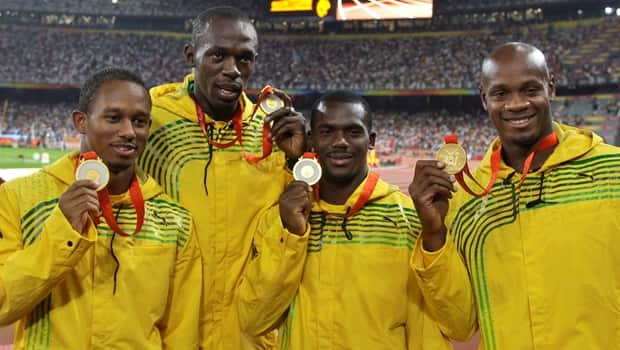
Usain Bolt loses 2008 Olympic relay gold after Nesta Carter's positive test

Usain Bolt has lost one of his nine Olympic gold medals in a doping case involving teammate Nesta Carter.
The IOC said Wednesday that Carter tested positive for methylhexaneamine, a banned stimulant, in re-analysis of samples from the 2008 Beijing Olympics.
Olympic rules state that the entire relay team can be disqualified and stripped of medals if one runner fails a doping test.
Carter and Bolt were teammates on the winning 4x100-metre team, which set a world record of 37.10 seconds. Carter ran the opening leg, and Bolt took the baton third in a team that also included Michael Frater and Asafa Powell.
"The Jamaican team is disqualified," the IOC said in a statement. "The corresponding medals, medallist pins and diplomas are withdrawn and shall be returned."
The relay title in Beijing completed the first of Bolt's gold medal sweeps in the 100, 200 and relay at three straight Olympics.

'This changes everything' 

The Canadian team of Pierre Browne, Anson Henry, Jared Connaughton, Hank Palmer — who finished sixth in the race — will now move into the top five.
"I hear I'm a fifth-place finisher now at the Olympics now," Henry, now a CBC Sports reporter, said on CBC News Network on Wednesday. "A couple of more positive [doping] tests and then I'll have a medal around my neck."
"But seriously, this changes everything", Henry continued. "[Carter] had a really good start in that race. We were right outside of Jamaica. He snuck up on Palmer really quickly. That changes [our] race. It changes our exchange. That changes my leg. Not to mention the rest of the teams."
According to Henry, the disqualification will cause a great deal of pain to the other sprinters. 
"Think about some of the things that are taken away from these [other] athletes," he said. "You see Richard Thompson with Trinidad and Tobago [crossing the finish line] in second place. Yeah, his team got a silver medal. But what better [way] than to cross the line [in first] for your country with your flag across your chest, arms raised, standing on the top of the podium? There were some other people that suffered because of this."
Media placeholder
CBC Sports' Anson Henry discusses downfall of Jamaican relay team6:15
Bolt set world record times for all three sprint titles at the Bird's Nest, establishing himself as the defining superstar of Olympic track.

Possible IAAF ban

Bolt and Carter will retain their gold medals from Jamaica's relay win at the 2012 London Olympics — in a record time of 36.84 seconds that stands today. Bolt ran the final leg on that team. He took the baton from Yohan Blake, who served a ban in 2009 for ingesting the same substance as Carter.
Carter and Bolt also helped lower their relay world record between the Olympic titles, taking gold at the 2011 world championships in Daegu, South Korea, in 37.04.
The 31-year-old Carter has teamed with Bolt on three straight world championship relay-winning teams, from 2011 through 2015. He also took an individual bronze in the 100 in 2013 in Moscow, behind Bolt and Justin Gatlin of the United States.
Carter, who did not compete at the Rio de Janeiro Olympics, faces a ban from the IAAF.
Trinidad and Tobago is in line to get the gold medal from 2008, Japan could be upgraded to silver, and fourth-place finisher Brazil could get the bronze medal.
Carter testified by video conference to an IOC disciplinary hearing held in Lausanne on Oct. 17.
The IOC's ruling states that Carter noted he was taking supplements in 2008 "advised in this respect by his coach, Mr. Stephen Francis."
"The athlete explained that he had given several samples for doping controls whilst he was taking Cell Tech and Nitro Tech before the 2008 Olympic Games and he had never tested positive for a prohibited substance," the detailed verdict stated.
"He therefore did not believe that these supplements could contain prohibited substances. He did not understand how methylhexaneamine could have been found in 2016."
Though methylhexaneamine was not specifically named on the 2008 list of prohibited substances, it "fell within the scope of the general prohibition of stimulants having a similar chemical structure or similar biological effect as the listed stimulants," the judging panel of three IOC members wrote.

Separate ruling 

The panel doubted if the supplements identified had caused the positive test given that Carter "used such supplements regularly and that this did not lead to other problems."
The runner cast doubt on his own ability to avoid doping rule violations. In a written statement to the IOC, "[Carter] asserted that he did not remember having received any formal anti-doping training in his career."
Carter can appeal the sanction to the Court of Arbitration for Sport. However, the IOC panel already anticipated one challenge in its written verdict.
"The Court of Arbitration for Sport ["CAS"] has confirmed that the presence or use of substances falling within the scope of generic definitions of the prohibited list, can be used as a basis of establishing anti-doping rules violations," the verdict said.
In a separate ruling Wednesday, another former Olympic champion was stripped of two silver medals from the Beijing Games.
The IOC said Russian athlete Tatiana Lebedeva tested positive for the anabolic steroid turinabol in re-tests, and would be disqualified from her runner-up placings in the long jump and triple jump.
Lebedeva won long jump gold at the 2004 Athens Olympics and also previously won Olympic silver and bronze in triple jump.

Sunday, January 22, 2017

Most Facebook hacks are done by friends, finds UBC survey

Want to keep your privacy protected? Keep your eyes on your friends.
A study conducted by Wali Ahmed Usmani, a master’s student at University of British Columbia found that those who you trust the most are the most likely to hack their way into your Facebook account.
The study, which was conducted between from February and March of 2016, looked to find out how common attacks on privacy are, who is most likely to be victimized, who is most likely to attack, why these attacks happen, what the damage is, and how one could possibly protect themselves.
1,308 adult Facebook users, 59% male and 41% female from the United States filled out surveys that included questions asking if they had someone use a device of theirs to access their own Facebook account without their permission, and if they had ever used someone else’s device to access that person’s Facebook account without permission.
“It’s clearly a widespread practice. Facebook private messages, pictures or videos are easy targets when the account owner is already logged on and has left their computer or mobile open for viewing,” said Usmani to ubc.ca.
The survey found that 24% of the group had accessed someone’s personal Facebook account without that person’s permission, and 21% had their Facebook’s violated. Reasons for the insider attacks ranged from practical jokes to invading privacy and reading a person’s messages, or in some circumstances malicious attacks on peoples’ friends using that person’s identity, or even deleting everything off their accounts. A lot of those who told their stores reported a lasting feeling of mistrust, ruined relationships, and embarrassment.
“A sizable fraction of Facebook users seem to have been involved in instances of social insider attacks. The high prevalence of attacks demonstrates a need for effective mechanisms to detect and report these attacks to account owners,” reads the report.
There are multiple ways to protect yourself from outside attacks, such as adding an authenticator, changing passwords often, and ensuring you don’t tell anyone your information. But the inside attacks are a much different animal, the only sure defense is to log out of your Facebook after every use on your devices.
Others made sure to make sure their devices were locked after use and making sure no one know the passwords for their devices.
But having to re-enter my Facebook password every time I wanted to simply scroll through my news feed for a bit (which I do very often throughout the day) or just send a few quick messages would get very tiresome. Researchers involved with the study suggested a passive log that would show how long was spent browsing personal messages and other related information. This would help to discourage people with the possibility of getting caught.
“Jealous snoops generally plan their action and focus on personal messages, accessing the account for 15 minutes or longer and the consequences are significant: in many cases, snooping effectively ended the relationship.” said computer science professor Ivan Beschastnikh, who was a co-author of the report.

Saturday, December 31, 2016

Twitter hoax reports Queen Elizabeth died

Many people would argue that 2016 has been the year of celebrity deaths. Others might say it was the year of “fake news.” A story from Britain this week showed it could perhaps be both.
Late Thursday, a Twitter account with the handle @BBCNewsUKI sent out a message claiming Buckingham Palace had announced the death of Queen Elizabeth II, the reigning monarch of the United Kingdom. “Circumstances are unknown,” the tweet read. “More details to follow.”
The news had an air of believability: Elizabeth is 90 years old and has been in poor health recently. This year, for the first time in three decades, she failed to attend a Christmas Day church service near her country home in Norfolk after suffering what was described as a “heavy cold.” The queen has not appeared in public since she fell ill.
Additionally, if the queen were to pass away, it is the BBC that would make the announcement. In fact, Britain’s public service broadcaster is known to hold regular rehearsals in case a member of the royal family dies unexpectedly.
The tweet, of course, was not real. @BBCNewsUKI followed up its tweet with the rather less-BBC-like message, “Love a Tuesday off if the queens dead, announce it before it’s too late.” The account was a fairly obvious fake, and it was soon suspended by Twitter.
But rumors that the queen was dead still sparked a frenzy online, with users rushing to add condolences and others attempting to verify the news.
A number of Twitter users began tweeting that there had been a “media blackout” in an attempt to hide news of the queen’s death from the public. By Friday, it was one of the top trending topics on Twitter - though many of the tweets appeared to be mocking the idea. One curious user even jogged down to Buckingham Palace to look for signs of activity. “Silly twitter,” he concluded.
The incident appeared to confirm that rehearsals for the death of a British monarch, long murmured about by BBC journalists, really exist.
If a “Category 1” royal — a list which would include the queen and her husband, the Duke of Edinburgh, Prince Charles and Prince William — were to die, the BBC has to quickly pull together a remarkably complicated but somber event. Normal broadcasting would be interrupted for an official announcement — probably a statement from Buckingham Palace itself — and the national anthem.
It is also expected that all comedy on the BBC network would be canceled until the after the funeral is held, as it was after the death of King George VI in 1952.

Tuesday, September 16, 2014

Obama: Ebola crisis 'spiraling out of control'

President Barack Obama issued a global call to action to fight West Africa's Ebola epidemic on Tuesday, warning the deadly outbreak was unprecedented and "spiraling out of control," threatening hundreds of thousands of people.
Speaking as he unveiled a major new US initiative which will see 3,000 US military personnel deployed to West Africa to combat the growing health crisis, Obama said the outbreak was spreading "exponentially."
"Here's the hard truth. In West Africa, Ebola is now an epidemic of the likes that we have not seen before," Obama said.
"It's spiraling out of control. It is getting worse. It's spreading faster and exponentially. Today, thousands of people in West Africa are infected. That number could rapidly grow to tens of thousands.
"And if the outbreak is not stopped now, we could be looking at hundreds of thousands of people infected with profound political and economic and security implications for all of us."
As well as the military deployment, the US will also set up a command and control center in the capital of Liberia, the hardest-hit country, build new treatment centers and train health workers.
The Ebola epidemic has killed more than 2,400 people in Guinea, Liberia, Nigeria and Sierra Leone this year.
The virus can fell its victims within days, causing severe fever and muscle pain, weakness, vomiting and diarrhea -- in some cases shutting down organs and causing unstoppable bleeding.
The United Nations Security Council is poised to adopt a resolution on Thursday exhorting countries to provide more field hospitals and urgent aid to the crisis-stricken region.
Likely passage of the resolution marks only the third time that the Security Council will vote on a public health crisis after resolutions on AIDS in 2000 and 2011.
The United Nations said nearly one billion dollars would be needed to beat back the worst-ever outbreak of the disease, which is on track to infect 20,000 people by the end of the year.
The world body has set a goal of stopping the spread of Ebola within six to nine months but aid agencies are complaining that help has been too slow.
Ban is planning a "high-level event" on the sidelines of the UN General Assembly next week to draw attention to the crisis.
The capacity of Guinea, Sierra Leone and Liberia to provide even the most basic necessities is "on the brink of collapse," she warned.
The United Nations said the response to the crisis would require $987.8 million (763 million euros), with about half needed for Liberia.
The World Bank meanwhile approved a $105 million grant, part of a $200 million pledge made in early August aimed at helping people cope with the economic impact of the crisis and strengthening public health systems.
"The world needs to do much, much more to respond to the Ebola crisis in these three countries," World Bank President Jim Yong Kim said in a statement.
The UN said if the international community and affected countries respond swiftly and energetically, transmission should begin to slow by the end of the year and halt by mid-2015.
China will send a 59-person mobile laboratory team from its Centre for Disease Control to Sierra Leone, including epidemiologists, clinicians and nurses -- bringing the number of Chinese medics in the country to 174, the WHO said.
The EU, Britain, France and Cuba have also pledged to send medical teams and other aid to the region.
Noting that the known Ebola toll "represents only a fraction of the real number," she stressed that "the ground response remains totally and lethally inadequate."
"The window of opportunity to contain this outbreak is closing," she warned.

Thursday, May 29, 2014

Harper government rejects offer to save $500M on new icebreaker

Public Works Minister Diane Finley has firmly rejected an offer by Quebec's Davie shipyard to save the government half a billion dollars on a new icebreaker.
Finley told reporters Thursday that "it's very hard to believe" that Davie could actually build the icebreaker for the budget originally set six years ago.
"I don't see how any reasonable person could suddenly believe they can do the same job for half the price," she said.
The new icebreaker — dubbed the Diefenbaker — was originally priced in 2008 at $720 million. However, since construction has been delayed for at least 10 years, that figure's been drastically revised to $1.3 billion.
Although no construction contract has been signed yet, the work has been assigned to the Seaspan shipyard in North Vancouver. However, Seaspan requires a $200-million upgrade before it can handle the job, and has also been assigned two new supply ships for the navy.
Since the work on the Diefenbaker won't even begin until those two ships are finished, it's not likely to enter service for a decade at least.
Finley was responding to an offer Davie made six months ago, but made public only this week, to start work on the icebreaker immediately, for delivery in two years. Davie is Canada's largest shipyard and requires no upgrade to do the work, according to Alex Vicefield, the CEO of Davie's parent company.
Vicefield told CBC News Thursday that his offer is both firm and realistic.
"We'll guarantee the costs. We're not asking for a cost-plus arrangement. We can guarantee the price," said Vicefield.
He added that the reason the government's budget for the job has soared to over a billion dollars is that costs in the shipbuilding industry commonly rise between five per cent and 10 per cent a year.
"Each year you wait to build the ship, the more expensive it gets."
Finley, however, insists that Davie lost out in the original bidding for the job and that its offer comes too late.
"Davie did not qualify. That procurement is done. It's over. And there's absolutely no reason to believe that those numbers would be credible. We already have a contract in place and we're going to move ahead with that."
When a reporter noted that there is, in fact, no construction contract with Seaspan, the minister added, "Well, we don't have a contract, but we have made an award under that procurement based on the credibility, the viability, the reliability of the companies at the time."
"They had a chance to compete. At the time, they weren't successful."
When the government made that decision in 2011, however, the Davie shipyard was in bankruptcy. Today, Vicefield says that's history, because Davie is now part of a competitive international shipping conglomerate.
"We're a competitive international shipbuilder today," he said.
"We're building these ships today. We're building similar vessels. What we would do here is, we would add this vessel[(the Canadian icebreaker] into our existing schedule, which maybe helps us to reduce some of the costs as well, compared to other shipyards where you really have to build the shipyard to build the ship. We have it going today."
The Davie yard recently finished a 130-metre offshore construction vessel for a Norwegian customer. Named the Cecon Pride, it was delivered on time for $200 million. The yard is now building two similar ships.

Saturday, May 17, 2014

NY Attorney General Calls for Ban of Soaps Containing Microbeads

New York Attorney General Eric T. Schneiderman has called for a state-wide ban of soaps containing microbeads, citing recent studies that show how harmful the tiny cosmetic abrasives can be to the environment.
The office of Attorney General Eric T. Schneiderman released a new report detailing the damages that microbeads - tiny plastic beads that are used as cleansing abrasives in cosmetic products - cause to New York waterways.
According to the report, which was prepared by the Attorney General's Environmental Protection Bureau (EPB), "nineteen tons of microbeads are washed down the drain each year and many end up in New York's waters, where they remain for decades, acting as sponges for toxic chemical pollutants."
The tiny "toxic sponges" can then be eaten by fish and wildlife, spreading toxin contamination throughout entire food chains and threatening the New York ecosystem, the authors of the report write.
Alongside this release, nine additional officials and political figures joined Schneiderman to support the passing of the Attorney General's Microbead-Free Waters Act, which was first proposed earlier this year. This bill would make New York State the first in the nation to ban the sale of any-and-all products containing microbeads.
"New York has always been at the forefront of national progress when it comes to addressing the issue of plastic pollution," Schneiderman said in a prepared statement. "By passing the Microbead-Free Waters Act, we will show that New York remains a leader in protecting the health of our families and our environment."
The bill was unanimously passed by the Assembly on May 5 and is currently being considered in the Senate.
However, research has shown that microbeads are not just a New York problem. Similar battles are being fought in other parts of the United States and Europe as well. "Beat the Microbead" is an international campaign dedicated to eliminating the use of the plastic abrasives in cosmetics. According to the organization - which is supported by the United Nation Environmental Programme - approximately 11 percent of all environmental problems caused by marine debris can be directly linked to microbeads. Eliminating this threat could take a significant chunk out of the water pollution problem that some experts call "the plastic soup."
Encouragingly, at least 21 companies around the world have already expressed a commitment to "phasing out" microbeads in their products. Other companies have not acknowledged the threat of these beads, but none have taken pains to deny the claims of environmental experts, according to the EPB report.

Sunday, April 6, 2014

Tetris anniversary marked with game on skyscraper

Hundreds of Tetris fans had a little fun Saturday with a big version of the classic video game.
The Philadelphia skyscraper-sized version created a spectacle against the night sky that organizers hoped inspired onlookers and players to think about the possibilities of technology.
The 29-story Cira Centre, which has hundreds of LED lights embedded in its glass facade, normally displays colorful geometric patterns at night. On Saturday, images of supersized shapes "fell" on two sides of the mirrored tower as competitors used joysticks to manoeuvr them into place.
It wasn't the first time Tetris has been played on a building. But the 100,000-square-foot "screen" — which includes the north and south faces of the structure — could be a record.
City resident Sam Robinson, 30, said he signed up on a whim for the lottery to play because he figured "it would be cool to play the world's largest game of Tetris."
"It has been probably 15 years since I played Tetris last on a Game Boy, and it's much different playing on the side of building that's a half-mile away," he said. "Everything's happening so quick."
The spectacle kicked off a citywide series of events called Philly Tech Week. It also celebrated the upcoming 30th anniversary of Tetris, a game revered as the epitome of elegance and simplicity, said Frank Lee, an associate professor of digital media at Drexel University.
Lee, a game designer who oversaw creation of the giant display, said putting it on an office building was like making a huge virtual campfire.
"This project began as a personal love letter to the games that I loved when I was a child - Pong last year, Tetris this year. But it ended up as a way of uniting the city of Philadelphia," Lee told the crowd.
Lee already holds the Guinness World Record for the world's largest architectural video game display for playing Pong on one side of the Cira Centre last year. Pong, the granddaddy of all video games, is an electronic version of paddleball developed by Atari in 1972.
Tetris, created by Russian computer programmer Alexey Pajitnov in 1984, challenges players to rotate and arrange falling shapes into complete rows.
It became a global phenomenon in the late 1980s after game designer Henk Rogers, who had seen Tetris at a trade show in Las Vegas, acquired the rights and struck a deal to put it on Nintendo's original Game Boy.
Rogers, who was among the players on Saturday in Philadelphia, said he can't believe the longevity of Tetris, which decades later continues to mesmerize players on more than 30 platforms.
"If a game lasts a year, that's amazing," said Rogers, now managing director of The Tetris Co. "They usually go out of style very quickly."
Rogers said several new Tetris products and initiatives are planned for release around its June 6 anniversary. He declined to discuss details.

Navy rescues family with sick baby from disabled sailboat hundreds of miles off Mexican coast

SAN DIEGO - U.S. sailors rescued a family with an ill 1-year-old baby from a disabled sailboat hundreds of miles off the Mexican coast and were headed Sunday to San Diego to get the girl medical treatment.
The girl, along with her parents and 3-year-old sister, were helped onto an inflatable raft and then taken aboard the USS Vandegrift at 8 a.m. Sunday. The baby girl was in stable condition and was heading to San Diego for medical treatment, the Coast Guard said in a news release.
Charlotte and Eric Kaufman were two weeks into their trip to sail the world when their daughter, Lyra, developed a fever and a rash covering most of her body and wasn't responding to medications. Then, their 36-foot sailboat lost steering and communication abilities about 900 miles off Mexico. They sent a satellite call for help to the U.S. Coast Guard on Thursday.
A California Air National Guard crew parachuted into the water and reached the boat Thursday night. The crew stabilized the girl and stayed by her side until the ship arrived.
The California Air National Guard dispatched four rescuers, who parachuted into the water and reached the disabled vessel. The team was able to stabilize the girl and pointed the sailboat, which does not have steering or communication abilities, toward Mexico, the 129th Rescue Wing said in a statement.
The rescuers stayed aboard the Rebel Heart to keep watch on the ill child until daylight when sailors helped them board the Navy frigate.
Before the family left, Lyra had salmonella poisoning, but doctors cleared her to travel after she was healthy again, said Charlotte Kaufman's sister, Sariah Kay English.
English initially was in daily email contact with the family but realized something was wrong when the communication stopped several days ago.
English said she was told the vessel took on water every time the motor was turned on. It's now slowly moving using only the sails.
When her sister first mentioned plans to sail with two young children, English recalled, "I thought it was nuts."
But English said the couple was always careful. Eric Kaufman is a Coast Guard-licensed captain who introduced sailing to Charlotte Kaufman during one of their early dates.
"They were not going into this blind. I knew they were doing this wisely," English said.
English said the couple made a network of friends who travelled around the globe with children and always stocked the sailboat with more food than they need.
"They were very overcautious. They're not new at sailing," English said. Unfortunately, "sickness sometimes happens."

Thursday, April 3, 2014

MH370 'black box' ship due in search zone

Australian navy vessel Ocean Shield, which is fitted with a US-supplied "black box" detector, was Friday expected in the area being scoured for wreckage of Flight MH370 as 14 planes continued the arduous search.
Nearly a month after the Malaysia Airlines jet carrying 239 people vanished authorities still have no idea how or why it crashed and warn that unless the black box is found, the mystery may never be solved.
But finding the flight data recorder using the towed pinger locator on Ocean Shield appears increasingly remote with officials warning that without a confirmed crash site, hopes of recovering the device are slim in the vast and unpredictable southern Indian Ocean.
Time is also ticking with the battery-powered signal from the black box expected to expire within days. Ocean Shield left Perth on Monday evening for the three-day voyage to the search zone.
The British navy's hydrographic ship HMS Echo is already in the area and spent Thursday scouring for sonic transmissions from the flight data recorder.
"One alert was experienced but discounted," the Perth-based Joint Agency Coordination Centre (JACC) said.
"False alerts may be experienced from biological sources such as whales or interference from shipping noise."
Weeks of looking for wreckage of the plane that veered off course en route from Kuala Lumpur to Beijing on March 8 have proved fruitless despite eight nations now involved in the increasingly desperate hunt for clues.
They drew another blank on Thursday with 10 military planes, four civil jets and nine ships due to resume the search on Friday, zig zagging across a huge area of about 217,000 square kilometres, 1,700 kilometres northwest of Perth.
"The weather forecast for today's search is fair, with visibility approximately 10 kilometres and a cloud base between 1,000 and 2,000 feet," JACC said.
If floating MH370 debris is eventually found, authorities plan to analyse recent weather patterns and ocean currents to determine where the plane went down.
Malaysia believes the flight was deliberately diverted by someone on board and that satellite data indicates it crashed in the Indian Ocean.
Malaysia's disjointed response to the crisis has been widely criticised, particularly by distraught relatives of the 153 Chinese people on the plane, and Australia has assumed increasing responsibility in the quest to find answers to one of aviation's greatest mysteries.
Prime Minister Tony Abbott on Thursday said there were no current plans to scale back the search but cautioned that a reassessment would have to be made eventually.
On a tour of the Perth military base being used as the staging post for the search effort on Thursday, Malaysian Prime Minister Najib Razak vowed "we will not rest" until the fate of flight was known.
"We want to find answers. We want to provide comfort to the families and we will not rest until answers are indeed found," he said, while admitting it was a "gargantuan task".

Friday, March 28, 2014

11 objects spotted in search for MH370

Chinese and Australian ships are enroute to the new search area off the coast of Perth to track down debris thought to be part of the missing Malaysia Airlines plane.
A Royal New Zealand Air Force Orion spotted 11 white rectangular objects in the Indian Ocean.
The cluster of objects is sitting just below the surface about 1600 kilometres west of Perth, New Zealand Air Vice-Marshal Kevin Short told media.
"It's hard to identify because all you're seeing is this one-metre rectangular piece of material."
The 11 objects were within five metres of each other and there were objects up to a couple of hundred miles away as well, he said.
"There seems to be patches of these objects and that's not unexpected, looking at how long the aircraft's been missing.
"If they're from that aircraft it's not unusual to have them separated by hundreds of miles."
The plane carrying 239 people, including six Australians and two New Zealanders, disappeared on March 8.
The objects had been marked with a sonar buoy and four ships would be in the area to retrieve them, Air Vice-Marshal Short said.
The objects would be photographed, with the images sent to investigators, then transported to Perth for further investigation, he said.
The search area was shifted 1000 kilometres north-east after international air crash investigators had their ”most credible lead” yet.
The new area was calculated after analysis of radar data indicated the aircraft was travelling faster than previously thought, meaning it would have used its fuel more quickly and travelled less distance.
At 319,000 square kilometres, the new search area revealed is massive, almost the same size as the Malaysian land mass and roughly 50 per cent larger than Victoria.
Five aircraft also spotted coloured objects in the new search area.
Photographs of the objects were taken and were to be assessed, while a Chinese ship in the new search area was directed towards the debris.
Australian Maritime Safety Authority emergency response manager John Young said all search planes and ships had been moved to the new zone.
"We have moved on from those search areas to the newest credible lead."
Any wreckage found would be handed over to Malaysian authorities.
The findings came with a warning from Malaysia Airlines of the effect that speculation about the flight's fate could have on the families.
"Whilst we understand that there will inevitably be speculation during this period, we do ask people to bear in mind the effect this has on the families of all those on board," the airline's group chief executive Ahmad Jauhari Yahya said.
"Their anguish and distress increases with each passing day, with each fresh rumour, and with each false or misleading report."
Mr Yahya said preparations were underway for family members of passengers and crew to be taken to Perth, should physical wreckage be found.

Police officer shot at Brampton courthouse

A police officer has been wounded after a shooter opened fire in the Brampton courthouse.
The shooter has also been shot, the Star has confirmed.
Peel EMS confirmed they are transferring one patient to hospital from the courthouse.
Two lawyers say they have been locked down inside the sprawling, multi-floor courthouse.
It’s not clear where the shooting took place inside the courthouse.
Lawyer Corey Nishio told the Star Friday morning he was locked in a courtroom on the second floor of the courthouse.
He said he didn’t hear any shots fired, but said people in his courtroom are hearing that three or four shots were fired near the entrance of the courthouse and that the victim may have been an officer who was handling security.
Criminal defence lawyer Will Jaksa told the Star via Twitter while on lockdown that people in the hallways on the second floor of the courthouse were “scrambling” into rooms on that floor. He was locked down in courtroom 202

“Cops bravely went running towards the gunshots,” Jaksa wrote.
Court staff were being updated by administration and the latest unconfirmed update was that “someone came into the building shooting . . . An officer was taken away by ambulance,” he said.
Peel police were not immediately available to confirm this information.
The Star’s Kenyon Wallace and Rachel Mendleson are inside the courthouse and are also on lockdown. They saw a police officer in uniform taken to an ambulance out the front entrance.
One witness told the Star she saw a man lying on the ground in a pool of blood.
A police tactical team is on scene, along with more than a dozen police cruisers that have blocked and three ambulances.

Wednesday, March 26, 2014

Is This Weird Little Blob The Future Of Bottled Water?

We get it. Our love of drinking water from disposable plastic bottles is a problem, enough of a problem that San Francisco actually wants to ban them . But then what will we drink water out of? Ooho, a biodegradable membrane made of brown algae, is an interesting idea.
Touted by some as an "edible water bottle," Ooho is actually more of a blob. The three London-based design students who developed the technology wanted to make something cheap, sustainable, and durable, so they improved upon a decades-old culinary technique called "spherification." Made popular by the molecular gastronomy nuts at El Bulli, spherification is exactly what it sounds like. Put simply, you turn liquid into spheres held together with a gelatinous membrane.
Ooho is actually not one but two membranes, for durability's sake. The double layer also makes it possible to sandwich a label in between the membranes, though Ooho's not quite ready for the supermarket. The real fun, of course, is trying to drink from Ooho. Since the container is edible, you could just pop the whole thing in your mouth like a bon-bon, but that doesn't seem particularly sanitary. Instead, you can just poke a hole in the membrane with your teeth and suck the water out. Based on Fast Company's test, however, you'll probably end up getting water everywhere.
All things considered, Ooha is a pretty cool, though slightly absurd invention. Will it save the world from living under a mountain of plastic Dasani bottles? Probably not. Does it signal the beginning of a new way to think about food packing? Absolutely.
And Ooha's not the only one onto this edible packaging idea, either. In the next month or so, Wikipearl will make its debut on the shelves of Whole Foods around Boston. The design of these little balls was inspired by biological cells and they are actually supposed to be eaten like bon bons. For now, however, it's safe to say that products like Ooho and Wikipearl are a novelty. An intriguing novelty! But a novelty nonetheless.

Monday, January 27, 2014

Captian 'Refused Chance' to Return to Sinking Concordia

An official coordinating the rescue from Italy's stricken cruise ship told a court Monday that the captain, accused of abandoning ship, refused twice to be taken back on board after making it safely to dry land.
Captain Francesco Schettino, who is on trial for multiple manslaughter, insists that he slipped off the Costa Concordia as it rolled over after hitting rocks off the island of Giglio, and fell onto a lifeboat which carried him ashore.
In a widely-quoted phone call a coast guard official is heard upbraiding Schettino and ordering him to "get back on board, for fuck's sake" -- an order the former captain refused point blank to follow.
"When I got to the rock where Schettino was, I told him I would take him back to Giglio port so he could get on a dinghy and be taken back to the Concordia, and get back on board if need be," Carlo Galli, the head of the traffic police coordinating the rescue, told the court.
Thirty-two people were killed in the nighttime disaster, which happened when passengers were sitting down to dinner.
Some drowned after throwing themselves into the icy sea, others were trapped in the lifts as the huge liner sank.
Helicopters desperately ferrying survivors to safety flew over Schettino as he sat huddled on an outcrop near the shore, Galli said.
"He told me he had to stay, to supervise his ship. When I repeated the invitation to take him back, another officer from the ship said it was a good idea to try and get back on board. Schettino said no again," he said.
Captain 'was dry' after leaving ship
Schettino has claimed he begged the lifeboat he found himself on to turn around and take him back to the ship, but his request was refused.
He has also said the ship's owner Costa Crociere, Europe's biggest cruise operator, told him by telephone not to return to the stricken liner.
"Schettino was dry, unlike the rest of the passengers with him. He asked to use my mobile phone, but I needed it to coordinate the rescue. We took the passengers to shore, he remained behind with one or two other officials," Galli said.
The Concordia hit rocks off the island of Giglio on the night of January 14, 2012, with 4,229 people from 70 countries on board.
Schettino has admitted to performing a risky "salute" manoeuvre near Giglio island and is accused of delaying the evacuation process after the impact.
The court heard from Andrea Bongiovanni, an official who says he tried to persuade Schettino to sound the alarm long before he eventually gave the order to do so.
"The ship's safety manager and I loudly insisted, along with the second in command Roberto Blosio, that the general alarm should be sounded. But captain Schettino gestured that we should wait, he didn't give the order," he said.
"We only managed to later," and once the extent of the damage to the ship became clear, "the captain looked me in the eyes and said: 'My career is over'," he added.
The trial, which began in July last year, is expected to last for months as hundreds of witnesses testify.

RCMP Drone Patrols P.E.I. Skies

RCMP have a new drone patrolling the skies of P.E.I. to get aerial perspectives on crashes and perhaps help with search and rescues.
The miniature helicopter caries a camera and operates by remote control. The unmanned aerial vehicle, as it's officially known, was custom-built for $18,000 for Saskatchewan RCMP. They gave it to Island police for free.
“The helicopter is carrying a Canon stock camera, like you'd buy at Future Shop or Staples. It's plugged into a live, encrypted, down link," RCMP spokesman Greg McCormick explained.
"It's a multi-rotor helicopter. There are six blades. It's made of carbon fibre.”
It fits in the back of a police cruiser and can be deployed in minutes. RCMP have just one regular helicopter to serve all of Atlantic Canada, so mini-copters could assist by taking aerial photos of highway accidents for crash analysts.
It may also help find missing people, RCMP said.
15-minute battery life
Sgt. Andrew Blackadar tested out the craft this week. "Actually it's a bit of fun. It's like a remote-controlled car, but a bit more sophisticated and it takes two of us to operate it," he said.
McCormick said it wouldn’t work for covert surveillance. “We don't use it for covert work. As you can tell, it's quite loud. It would certainly be a giveaway to its purpose,” he said as the drone buzzed overhead.
Its rechargeable battery only lasts for 15 minutes and it struggles in high winds.

Sunday, January 26, 2014

Genetic Clue to How Limbs Evolved

Fish have the genetic machinery necessary to make fingers, but it is not switched on, a study suggests.
The research in Plos Biology journal sheds light on how fish evolved into the earliest land animals millions of years ago.
For fish to make the transition to land, an existing DNA architecture had to be "hijacked" in order to make digits, the researchers said.
In order to do this, they took genes from fish and inserted them into mice.
It was already known that the genes for limbs are found in fish but how they evolved to form digits remained unclear.
To unravel the genetics, the authors used the zebrafish as a model. But other scientists said that zebrafish were not a useful species for studying limb evolution.
Lead author Joost Woltering from the University of Geneva, Switzerland, said that he was interested in the "longstanding evolutionary question - how did limbs actually develop out of ancestral fish fins?"
In order to answer this, Dr Woltering and his colleagues looked at the genetics of fin and limb developments in zebra fish and mice.
He was particularly interested in the division of the hand and arm (or digits), which does not exist in fish fins and "is considered one of the major morphological innovations during the fin-to-limb transition".

'Architect' genes

Tetrapods, the first four-legged creatures to walk the Earth, evolved from water to land over 380 million years ago in an era known as the Devonian period, often referred to as "the age of fish".
Fish and land animals both have clusters of genes called HoxA and HoxD and both are known to be essential in fin and limb development.
These Hox genes are sometimes referred to as "architect genes" as they are involved in making many of the physical structures animals possess.
However, when these Hox genes from fish were placed into mouse embryos, the genes that result in the arm were switched on but not the genes responsible for the hand or the digits.
This suggests that the genetic information needed to make tetrapod limbs was already present in fish before the tetrapods evolved.
"During embryogenesis it is key that developmental genes are switched on at exactly the right time and right place to ensure the development of a complete, coherent good functioning adult organism," Dr Woltering told BBC News.

Modernised genes

"The most surprising result is we found [DNA in fish] which is almost identical to the higher order DNA structure that we found in the mouse."
Another important conclusion of the study is that fish fins are not equivalent to the tetrapod hand and digits. Instead, the evolution of digits in land animals involved the repurposing of existing genetic infrastructure.
One of the co-authors of the study, Prof Denis Duboule, also from the University of Geneva, said: "Altogether, this suggests that our digits evolved during the fin-to-limb transition by modernisation of an already existing regulatory mechanism."
Other researchers in the field say that the study contains some flaws.
Jennifer Clack, from the Cambridge University Museum of Zoology, who was not involved with the study, said using the zebrafish as a model for the experiments was a bad choice.
"We know that this animal, and by inference its relatives... lack some of the developmental stages that make digits in tetrapods," she explained.
Prof Clack added that other finned fish such as Polydon [paddlefish] "do have that mechanism, operating in a similar way to that in tetrapods, to make a complex fin skeleton".
This suggests, she said, that the zebrafish at some point lost the ability to make digits.
This view was echoed by Per Ahlberg from the University of Uppsala, Sweden. He said that the molecular analysis was of a very high quality but that the evolutionary conclusions were flawed.
"This entire inference is based on the assumption that the zebrafish fin skeleton is reasonably representative of the ancestral condition for tetrapods, and it just isn't," he explained.
"Essentially, modern-day sturgeon, gar and bowfin (living primitive ray-finned fishes) have fin skeletons that are reasonably close to the shared ancestral condition for mouse and zebrafish."

Police Identify Gunman in Maryland Mall Shooting, Motive Unclear

Police identified the gunman on Sunday in a deadly Maryland mall shooting as a 19-year-old from the nearby city of College Park, but had no word on his motive nor whether he had any ties to the two people he shot and killed in a skate shop.
The gunman, identified as Darion Marcus Aguilar, opened fire with a shotgun in the shop at the mall in Columbia, Maryland,about 20 miles west of Baltimore, on Saturday before apparently killing himself, police said.
Aguilar, who lived with his mother, arrived at the mall by taxi about an hour before the shooting began, Howard County Police Chief Bill McMahon told a Sunday morning news conference.
He used a 12-gauge shotgun, and fired six to eight shots, killing Brianna Benlolo, 21, also of College Park, and Tyler Johnson, 25, of Mount Airy, Maryland, police said.
Both were employees of Zumiez, a skate shop where the shooting took place. A third person was also injured.
Police arriving at the scene found Aguilar's body and his backpack filled with crude explosives, and were initially concerned he had booby-trapped himself, McMahon said.

Saturday, January 25, 2014

US Athletes Cautioned on Wearing Team Gear Outside Sochi Venues

The US Olympic Committee has advised athletes taking part in the upcoming Sochi Games to avoid wearing their uniforms or Team USA logos outside Olympic venues, the State Department said.
The warning, released Friday, came amid growing concerns in Washington over security at the Games and as Pentagon chief Chuck Hagel said the United States would work with Russian authorities on "appropriate arrangements" if an emergency required evacuating Americans from Sochi.
On advice from the State Department, the US Olympic Committee told athletes in a memo not to call attention to their nationality outside the Olympic village as a safety precaution, officials said.
"I think it is just common sense that perhaps if you are an American Olympic athlete, perhaps you don't want to advertise that so much, far outside of the venues," a senior administration official told reporters.
State Department spokeswoman Marie Harf said that "we are in very close contact with the US Olympic Committee on issues related to security."
But she added that Russia was not a unique case and that the US government often provides similar advice at "big international events."
The White House has signaled concern over Russia's security preparations for next month's Winter Games in the Black Sea resort of Sochi, with officials privately complaining about Moscow's reluctance to share intelligence on terror threats.
The United States has repeatedly offered to provide help to Russia to ensure security for the event, a question that came up in a telephone conversation between President Barack Obama and Russian President Vladimir Putin on Tuesday.
But Hagel, speaking at a news conference after talks with his French counterpart, said Russia had not taken up the US offer so far: "Right now, there has been no request from the Russian government."
The Pentagon has announced it is deploying two warships to the Black Sea as a "precaution" in case of a terror attack.
When asked if the US military had contingency plans in place to evacuate Americans in the event of a terror attack, Hagel said: "If we need to extract our citizens, we will have appropriate arrangements with the Russians to do this."
US officials later said that a potential evacuation might not require a role for the military as commercial planes might be used. And in any emergency, American authorities would need to work closely with the Russian government, officials said.
"First and foremost, Russia has the responsibility in responding to and coping with situations that might affect the safety, security and the presence of their guests," a senior administration official told reporters.
"All the American citizens there are their guests," said the official, who spoke on condition of anonymity. "The US government will work with the Russian government on the various options should they need to be implemented."
As with previous Olympics, Washington has set up an operations center in Sochi with various security experts and a clear "chain of command" that would apply in any contingency, officials said.
Signaling its concern, the State Department issued an updated travel alert for Russia, urging all Olympics-bound US citizens to "remain attentive regarding their personal security at all times."
"Large-scale public events such as the Olympics present an attractive target for terrorists, and the US government continues to monitor reported threats of potential terrorist attacks in Sochi or in Russia in general," it said.
Insurgents based in North Caucasus republics such as Dagestan who are seeking their own independent state have vowed to disrupt the Games in a bid to undercut Putin.
In a recent video threat posted on a prominent North Caucasus extremist website, two men sitting in front of a jihadist flag warn of planned attacks at the February 7-23 event.

Coca- Cola Laptop Theft could have Comprimised Info

A theft of company laptops could have compromised info for 74,000 people.
A spokeswoman for the company said the laptops were stolen by a former employee responsible for maintenance and disposal of equipment, the business daily reported. The company on December 10 learned that personal information was stored on the laptops after recovering them, the newspaper said.
Coca-Cola could not immediately be reached for comment outside regular U.S. business hours.
The world's largest soft drink company has alerted domestic and Canadian employees about the security breach through a memo, the Journal reported.
Personal details such as social security numbers, driver's license numbers and credit-card information may have been compromised, the Journal said.
The company, which has managed to recover the laptops, which were not encrypted, contacted law enforcement authorities, while saying it could not confirm whether the information has been misused, the newspaper reported.

Baltimore Mall Shooting at Skateboard Store

Police in Maryland say three people died Saturday in a shooting at a mall in suburban Baltimore, including the presumed gunman, and another five people were injured.
The shooting took place at the Mall in Columbia, a suburb of both Baltimore and Washington.
"The shooting took place above the food court in a store called Zumiez, it's a skateboard shop," said Howard County Police Chief Bill McMahon at a news conference early Saturday afternoon.
"He had a large amount of ammunition on and about him. We are approaching this with an abundance of caution," said McMahon. "The situation is still fluid, still evolving, still dynamic."
McMahon said no motive is known yet but revealed that one male and one female, both in their twenties and employees of the store, are dead as well as the gun man, whose identity is still unknown. It wasn't clear whether the shooting was random or if the shooter and victims knew each other.
The five other people injured included one person being treated for a gun shot wound and another four who were injured while trying to escape.
Authorities received a call to the police emergency dispatcher at around 11:15 a.m. local time from someone reporting that shots had been fired. Police responded to the scene and found three people dead, including one person who was found near a gun and ammunition.
The mall is now closed for the rest of the day as investigators piece together what happened.
Gunshots, people running
The mall, which is at the centre of the town, typically opens at 10 a.m. on Saturdays and it was not known how many shoppers or workers might have been present at the time of the shooting.
Witnesses described moments of panic as they heard a succession of gunshots and screaming as people ran for cover into nearby stores and hid behind locked doors.
Joan Harding of Elkridge, Maryland, was shopping with her husband, David, for a tiara for their granddaughter's 18th birthday. She said she heard something heavy falling, followed by gunshots and people running.
"My husband said, `Get down!' and the girl that worked in the store said, `Get in the back,' " Harding said. That is where they hid until police gave the all-clear..
People were directed out of the mall and into a parking lot, where some boarded a bus and others walked toward their cars. Some people were seen crying. McMahon said detectives were interviewing witnesses as they emerged from the mall to try to get a better picture of the events that had unfolded.
Laura McKinzles of Columbia works at a kiosk in the mall. She said she heard between eight and 10 gunshots, followed by people running and screaming. She ran into the backroom of a perfume store and locked the door.
Allison Cohen, who works at the apparel store "Lucky Brand Jeans," said she always felt safe at the mall.
"I truly never thought something like this would ever happen here. It's really, really shocking," Cohen said.